

Beyond the Strait of Hormuz
How War Is Redrawing Trade Routes—and Elevating Pakistan
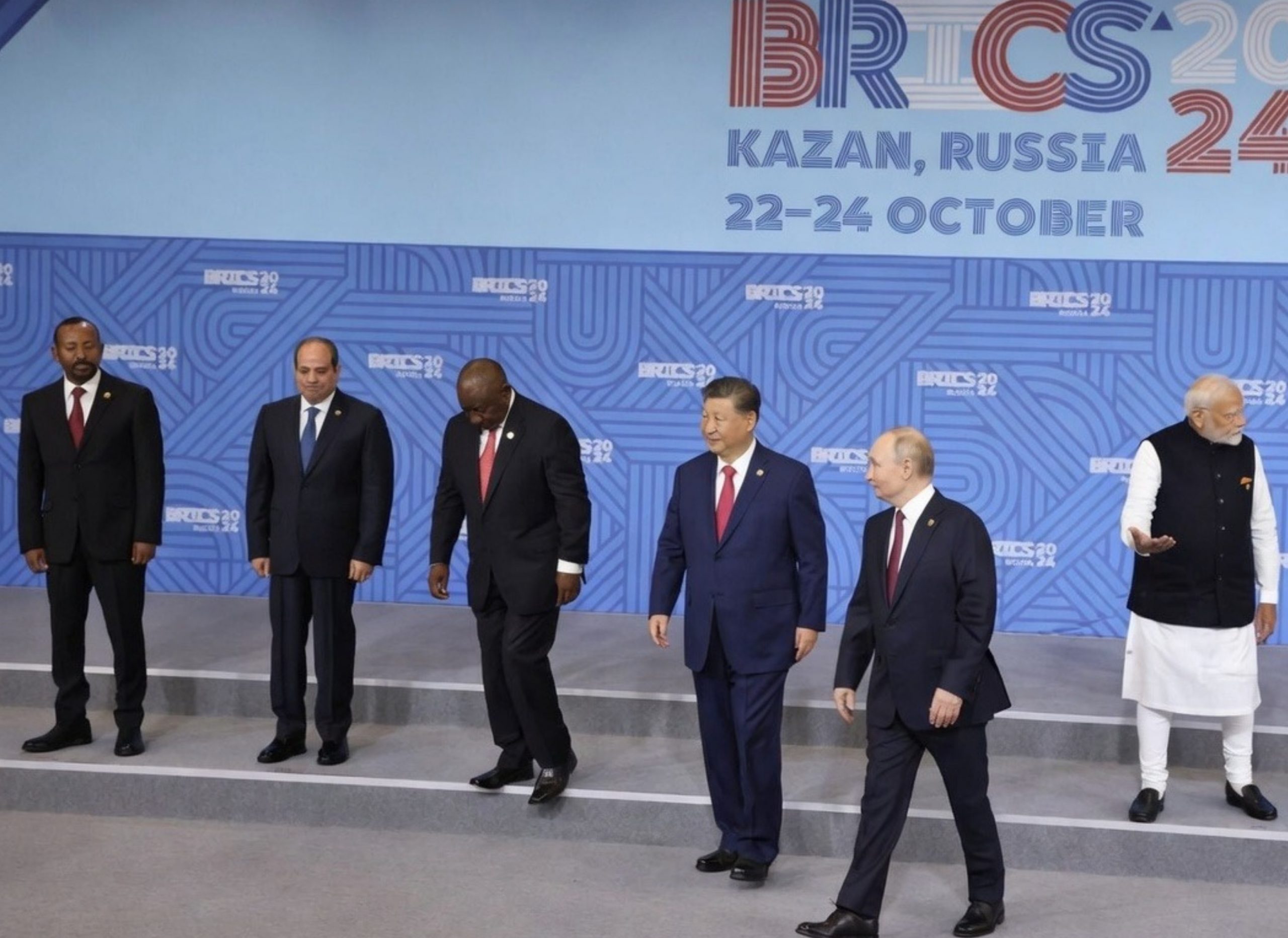
Ethiopian Prime Minister Abiy Ahmed, Egyptian President Abdel Fatath El-Sisi, South African President Cyril Ramaphosa, Chinese President Xi Jinping, Russian President Vladimir Putin, Indian President Narendra Modi and United Arab Emirates President Mohamed bin Zayed Al Nahyan pose for a group photo during the BRICS Leader's Summit, on October 23, 2024 in Kazan, Tatarstan Republic, Russia. Putin and representatives of 30 countries are gathering in Kazan for the 16th BRICS Summit today. (Photo by Contributor/Getty Images)
It has become commonplace to observe that the world is now multipolar. But what does that actually signify? The term “multipolar” is distinct from the term “bipolar” used to describe the Cold War era, during which the United States and the Soviet Union were the two predominant superpowers, as well as the term “unipolar” used to describe the first ten to twenty-five years (accounts vary) of the post-Cold War era, in which the U.S. was seen as the sole predominant superpower. The current multipolar era, by contrast, is one in which there are now more than two great powers. The exact number, though, is not clear, but the list of those regarded as global great powers usually includes America, China, Russia, India, and sometimes Europe as a possible one.
In addition, the current multipolar world is one in which numerous regional great powers are active in the areas they are located in and sometimes even farther afield. Among those regarded as regional great powers are Türkiye, Iran, Saudi Arabia, the United Arab Emirates, Israel, South Africa, Brazil, Mexico, and Indonesia. France, Britain, Germany, and Japan are all closely allied with the U.S., but are also viewed as regional great powers. Those reading this may believe that some of those I have mentioned do not belong on this list, while other countries I did not mention do. This only shows how inchoate the multipolar era currently is.
Beyond the observation that it contains several global and regional great powers, however, visions of the multipolar world appear to be based more on hopes or fears rather than reality. Some refer to a “multipolar world order,” which they see as being more “fair” than the previous Soviet-American bipolar order and especially the U.S.-dominated unipolar one. But if the U.S. did indeed pursue its own advantage rather than “fairness” during the bipolar and unipolar eras (those who hold this view often don’t describe the Soviet Union as being similar to the U.S. in this regard), the “rising” powers of the current multipolar era do not appear to be any different. They too appear to be pursuing their own advantage more than any vision of “fairness.” And the amount of conflict that has been occurring in the current multipolar era belies the notion that it has brought about order, much less a more just one.
Indeed, except for the bipolar Cold War era and the unipolar post-Cold War moment, international relations were usually characterized by a multipolar competition among great powers with one another regarding influence over other parts of the world. In fact, the current multipolar era seems to be similar to previous multipolar eras in world history in which several great powers of unequal capabilities vied with one another for influence or even control over less powerful countries. Far from the current multipolar era being unusual, then, it appears in retrospect that it was the bipolar Cold War and unipolar post-Cold War eras that were so.
is a professor emeritus at the George Mason University Schar School of Policy and Government, and a nonresident senior fellow at the Atlantic Council.
It has become commonplace to observe that the world is now multipolar. But what does that actually signify? The term “multipolar” is distinct from the term “bipolar” used to describe the Cold War era, during which the United States and the Soviet Union were the two predominant superpowers, as well as the term “unipolar” used to describe the first ten to twenty-five years (accounts vary) of the post-Cold War era, in which the U.S. was seen as the sole predominant superpower. The current multipolar era, by contrast, is one in which there are now more than two great powers. The exact number, though, is not clear, but the list of those regarded as global great powers usually includes America, China, Russia, India, and sometimes Europe as a possible one.
In addition, the current multipolar world is one in which numerous regional great powers are active in the areas they are located in and sometimes even farther afield. Among those regarded as regional great powers are Türkiye, Iran, Saudi Arabia, the United Arab Emirates, Israel, South Africa, Brazil, Mexico, and Indonesia. France, Britain, Germany, and Japan are all closely allied with the U.S., but are also viewed as regional great powers. Those reading this may believe that some of those I have mentioned do not belong on this list, while other countries I did not mention do. This only shows how inchoate the multipolar era currently is.
Beyond the observation that it contains several global and regional great powers, however, visions of the multipolar world appear to be based more on hopes or fears rather than reality. Some refer to a “multipolar world order,” which they see as being more “fair” than the previous Soviet-American bipolar order and especially the U.S.-dominated unipolar one. But if the U.S. did indeed pursue its own advantage rather than “fairness” during the bipolar and unipolar eras (those who hold this view often don’t describe the Soviet Union as being similar to the U.S. in this regard), the “rising” powers of the current multipolar era do not appear to be any different. They too appear to be pursuing their own advantage more than any vision of “fairness.” And the amount of conflict that has been occurring in the current multipolar era belies the notion that it has brought about order, much less a more just one.
Indeed, except for the bipolar Cold War era and the unipolar post-Cold War moment, international relations were usually characterized by a multipolar competition among great powers with one another regarding influence over other parts of the world. In fact, the current multipolar era seems to be similar to previous multipolar eras in world history in which several great powers of unequal capabilities vied with one another for influence or even control over less powerful countries. Far from the current multipolar era being unusual, then, it appears in retrospect that it was the bipolar Cold War and unipolar post-Cold War eras that were so.
is a professor emeritus at the George Mason University Schar School of Policy and Government, and a nonresident senior fellow at the Atlantic Council.
Further, many of the characteristics of the current multipolar era were present in the Cold War bipolar and post-Cold War unipolar ones as well. After the Sino-Soviet split that began in the late 1950s and escalated thereafter, the Cold War
was really a tripolar world. There were also several regional great powers back then that pursued their own ambitions—sometimes in a firm alliance with one of the two superpowers, but sometimes through switching alliances between them when it was found to be expedient. Some smaller countries allied with the United States because they feared the Soviet Union. But sometimes they allied with Washington less out of fear of Moscow and more out of fear of their immediate neighbors. The Soviet Union sometimes did support those neighbors or the internal opponents that U.S. allies feared, but sometimes governments claimed that Moscow was doing so in order to get American attention and support for causes Washington might not otherwise have backed.
Things got complicated when change of government occurred in what used to be known as the Third World, and the new regime moved from being aligned with Washington to being aligned with Moscow or vice versa. There were also some Third World governments that managed to cooperate with both the U.S. and the USSR at the same time. At the end of the Cold War, some of the regional conflicts that the U.S. and the USSR had been supporting opposing sides in did abate. Others, though, continued on for years or are even still ongoing. The bipolar Cold War was clearly not the main impetus for these conflicts, but local disputes instead.
Throughout the bipolar Cold War era, both superpowers often found it difficult to influence, much less control, the behavior of many of their own allies. This was even more true of the post-Cold War unipolar era. Despite the lack of competing global great powers for them to seek support from, there were many governments and other actors in small countries that regularly and routinely defied the U.S. This was most tellingly shown in Afghanistan and Iraq, where U.S.-led interventions overthrew sitting governments but were unable to defeat the forces of the overthrown regime and prevent it from returning to power in Afghanistan or to fully defeat opposition forces or prevent growing Iranian influence in Iraq. Further, the U.S. was unable to prevent the 2011 “Arab Spring” attempts at democratization from succumbing to authoritarian backlash or civil war.
While an image of the U.S. as the sole remaining superpower was broadcast both by those who supported and those who opposed this state of affairs, the truth in many instances was that, with Washington no longer seeing the need to thwart Soviet influence in various countries, the U.S. was simply less interested in them. Finally, whatever else the U.S. did during its “unipolar moment,” it certainly did not prevent the rise of rival great powers Russia and China—which only showed that the “moment” really was not unipolar at all in the sense of being controlled by just one great power.
What was frustrating for many smaller states during the unipolar era, though, was that the rivals of the U.S. were not willing or able to step in when the U.S. did not see supporting smaller states to be as high a priority as it did during the bipolar era, when smaller states could threaten that they would seek Soviet support if they could not get sufficient American backing. The current multipolar era, by contrast, allows smaller states greater possibilities of seeking various kinds of support from the U.S., China, Russia, and others still. This greater maneuverability for smaller powers is what characterizes the current multipolar era, and not the emergence of a “multipolar world order” establishing new and different norms or rules for the conduct of international relations, much less “fairness” in it.
Smaller states now have greater possibilities of seeking support from multiple powers.
Further, many of the characteristics of the current multipolar era were present in the Cold War bipolar and post-Cold War unipolar ones as well. After the Sino-Soviet split that began in the late 1950s and escalated thereafter, the Cold War was really a tripolar world. There were also several regional great powers back then that pursued their own ambitions—sometimes in a firm alliance with one of the two superpowers, but sometimes through switching alliances between them when it was found to be expedient. Some smaller countries allied with the United States because they feared the Soviet Union. But sometimes they allied with Washington less out of fear of Moscow and more out of fear of their immediate neighbors. The Soviet Union sometimes did support those neighbors or the internal opponents that U.S. allies feared, but sometimes governments claimed that Moscow was doing so in order to get American attention and support for causes Washington might not otherwise have backed.
Things got complicated when change of government occurred in what used to be known as the Third World, and the new regime moved from being aligned with Washington to being aligned with Moscow or vice versa. There were also some Third World governments that managed to cooperate with both the U.S. and the USSR at the same time. At the end of the Cold War, some of the regional conflicts that the U.S. and the USSR had been supporting opposing sides in did abate. Others, though, continued on for years or are even still ongoing. The bipolar Cold War was clearly not the main impetus for these conflicts, but local disputes instead.
Throughout the bipolar Cold War era, both superpowers often found it difficult to influence, much less control, the behavior of many of their own allies. This was even more true of the post-Cold War unipolar era. Despite the lack of competing global great powers for them to seek support from, there were many governments and other actors in small countries that regularly and routinely defied the U.S. This was most tellingly shown in Afghanistan and Iraq, where U.S.-led interventions overthrew sitting governments but were unable to defeat the forces of the overthrown regime and prevent it from returning to power in Afghanistan or to fully defeat opposition forces or prevent growing Iranian influence in Iraq. Further, the U.S. was unable to prevent the 2011 “Arab Spring” attempts at democratization from succumbing to authoritarian backlash or civil war.
While an image of the U.S. as the sole remaining superpower was broadcast both by those who supported and those who opposed this state of affairs, the truth in many instances was that, with Washington no longer seeing the need to thwart Soviet influence in various countries, the U.S. was simply less interested in them. Finally, whatever else the U.S. did during its “unipolar moment,” it certainly did not prevent the rise of rival great powers Russia and China—which only showed that the “moment” really was not unipolar at all in the sense of being controlled by just one great power.
What was frustrating for many smaller states during the unipolar era, though, was that the rivals of the U.S. were not willing or able to step in when the U.S. did not see supporting smaller states to be as high a priority as it did during the bipolar era, when smaller states could threaten that they would seek Soviet support if they could not get sufficient American backing. The current multipolar era, by contrast, allows smaller states greater possibilities of seeking various kinds of support from the U.S., China, Russia, and others still. This greater maneuverability for smaller powers is what characterizes the current multipolar era, and not the emergence of a “multipolar world order” establishing new and different norms or rules for the conduct of international relations, much less “fairness” in it.
Recommended
How War Is Redrawing Trade Routes—and Elevating Pakistan
How War Is Redrawing Trade Routes—and Elevating Pakistan
How a Peninsula Conflict Could Trigger a Multi-Theater Great Power Crisis
The Wilsonian Mission Never Ends
The Empire That Fights to Exist