

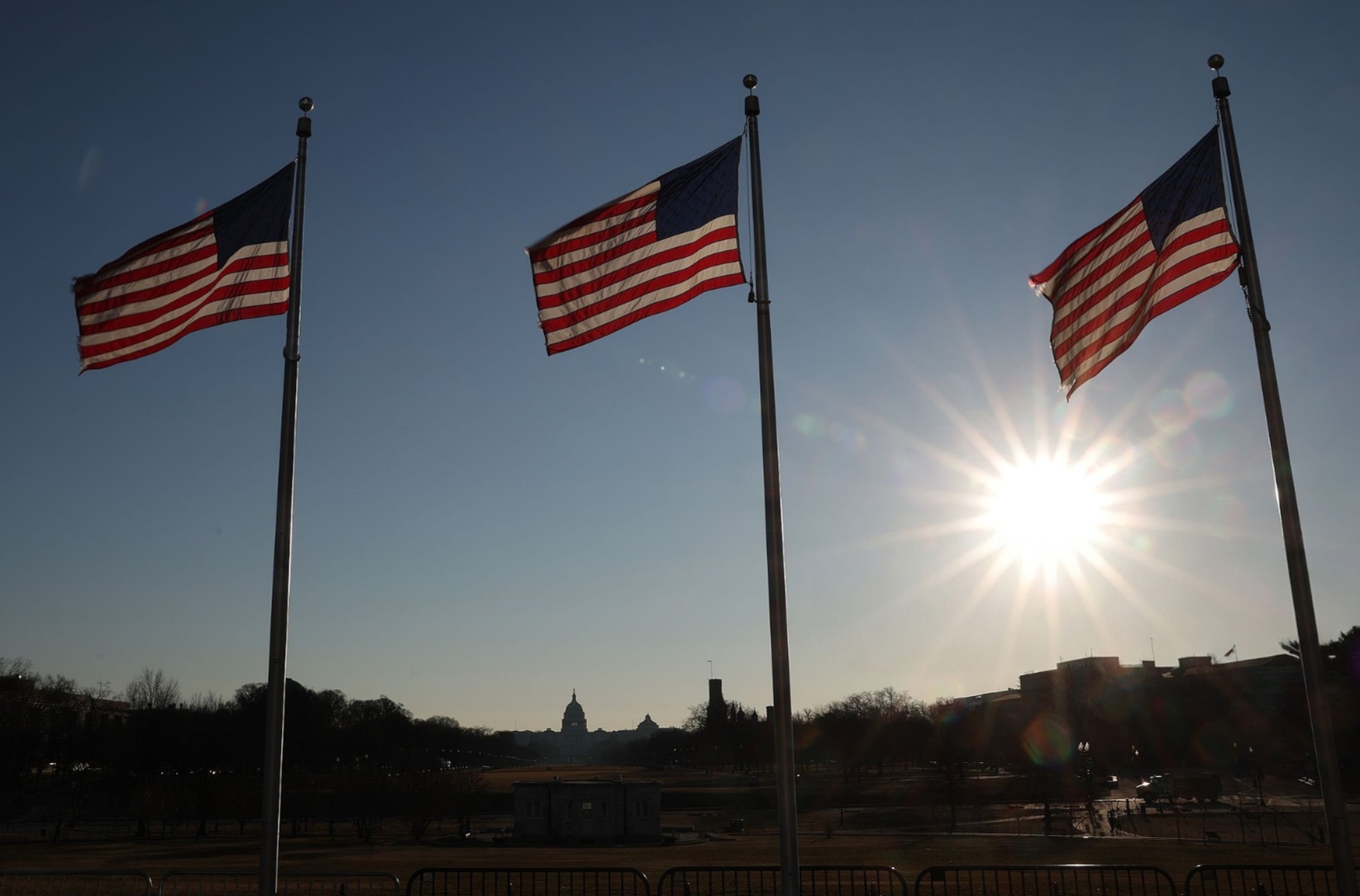
THE AMERICAN FLAG FLIES IN FRONT OF THE U.S. CAPITOL ON FEBRUARY 28, 2026 IN WASHINGTON, DC. U.S. PRESIDENT DONALD TRUMP ANNOUNCED THAT THE UNITED STATES AND ISRAEL HAD LAUNCHED AN ATTACK ON IRAN SATURDAY MORNING. (PHOTO BY WIN MCNAMEE/GETTY IMAGES)
The February 2026 decision to pursue kinetic operations in Iran while simultaneously leading postwar stabilization in Gaza is misaligned with the National Security Strategy and will likely overextend U.S. intelligence capacity and operations. These conflicting missions divide the military and the Intelligence Community’s (IC) resources and risk escalation that undermines the NSS goal of integrated deterrence and regional stability. By pursuing both missions concurrently, the U.S. increases the risk of failing to achieve its stated objectives in both—stability.
America’s Dual Burden
The United Nations estimates that it will cost around $70 billion to “reconstruct Gaza and make it safe” after two years of war. In the comprehensive peace plan, President Trump tasked the funding, governance, and oversight of Gaza postwar reconstruction to himself and the U.S. via his newly founded Board of Peace (BoP) organization. The plan states the BoP will “set the framework and handle the funding for the redevelopment of Gaza”, seemingly leaving the U.S. to foot the bill. As of March 2026, the U.S. has contributed $10 billion to the organization while 9 other states have contributed just $7 billion, leaving a considerable funding gap for the U.S. organization to fulfill.
In addition to funding responsibilities, the BoP also manages the International Stabilization Force (ISF), tasked with “long-term internal security” in the country. The force’s medium-term objective is to transfer security operations in Gaza from the IDF to the ISF, ultimately transitioning full responsibility to a Palestinian police force. Without a clear timeline for this final transition, the U.S. will oversee security operations in Gaza for the foreseeable future.
At the same time, military operations in Iran are ongoing with reports of the U.S. striking over 1,700 targets in the first days of the conflict. The U.S. is operating in concert with Israel, while other allies such as Gulf and European states are opting to forgo offensive actions. In just three days of kinetic action, the conflict is estimated to have cost the U.S. $5 billion in addition to six Americans’ lives lost. President Trump has estimated that the conflict may last around one month or longer, forcing the U.S. to endure its dual mission in the Middle East at least until then.
Contradicting the Strategy
Both the postwar reconstructor role in Gaza and military operations in Iran are antithetical to the 2025 NSS. The NSS asserts one of the main priorities for the U.S. is “burden shifting.” It emphasizes that U.S. allies must “assume primary responsibility for their regions.” President Trump’s decision to be the neutralizer of Iran and stabilizer of Gaza directly contradicts this strategy. By volunteering to manage postwar stabilization and pledging $3 billion more than wealthy actors in the region, the U.S. has assumed almost all this day-after burden for a region 6,000 miles away.
is a Master’s candidate in Security Policy Studies at the Elliott School of International Affairs, George Washington University, with a concentration in Conflict Resolution. Her research interests include foreign policy analysis, peacebuilding and stabilization, and Middle East and North Africa regional affairs.
The February 2026 decision to pursue kinetic operations in Iran while simultaneously leading postwar stabilization in Gaza is misaligned with the National Security Strategy and will likely overextend U.S. intelligence capacity and operations. These conflicting missions divide the military and the Intelligence Community’s (IC) resources and risk escalation that undermines the NSS goal of integrated deterrence and regional stability. By pursuing both missions concurrently, the U.S. increases the risk of failing to achieve its stated objectives in both—stability.
America’s Dual Burden
The United Nations estimates that it will cost around $70 billion to “reconstruct Gaza and make it safe” after two years of war. In the comprehensive peace plan, President Trump tasked the funding, governance, and oversight of Gaza postwar reconstruction to himself and the U.S. via his newly founded Board of Peace (BoP) organization. The plan states the BoP will “set the framework and handle the funding for the redevelopment of Gaza”, seemingly leaving the U.S. to foot the bill. As of March 2026, the U.S. has contributed $10 billion to the organization while 9 other states have contributed just $7 billion, leaving a considerable funding gap for the U.S. organization to fulfill.
In addition to funding responsibilities, the BoP also manages the International Stabilization Force (ISF), tasked with “long-term internal security” in the country. The force’s medium-term objective is to transfer security operations in Gaza from the IDF to the ISF, ultimately transitioning full responsibility to a Palestinian police force. Without a clear timeline for this final transition, the U.S. will oversee security operations in Gaza for the foreseeable future.
At the same time, military operations in Iran are ongoing with reports of the U.S. striking over 1,700 targets in the first days of the conflict. The U.S. is operating in concert with Israel, while other allies such as Gulf and European states are opting to forgo offensive actions. In just three days of kinetic action, the conflict is estimated to have cost the U.S. $5 billion in addition to six Americans’ lives lost. President Trump has estimated that the conflict may last around one month or longer, forcing the U.S. to endure its dual mission in the Middle East at least until then.
Contradicting the Strategy
Both the postwar reconstructor role in Gaza and military operations in Iran are antithetical to the 2025 NSS. The NSS asserts one of the main priorities for the U.S. is “burden shifting.” It emphasizes that U.S. allies must “assume primary responsibility for their regions.” President Trump’s decision to be the neutralizer of Iran and stabilizer of Gaza directly contradicts this strategy. By volunteering to manage postwar stabilization and pledging $3 billion more than wealthy actors in the region, the U.S. has assumed almost all this day-after burden for a region 6,000 miles away.
is a Master’s candidate in Security Policy Studies at the Elliott School of International Affairs, George Washington University, with a concentration in Conflict Resolution. Her research interests include foreign policy analysis, peacebuilding and stabilization, and Middle East and North Africa regional affairs.

The NSS also states that peace and diplomacy are necessary, even amongst nations of different values, to increase stability and end longstanding conflicts. Offensive strikes in Iran do not align with this strategy and instead risk the U.S. entering yet another nation-building war, which the NSS strongly condemns. So, although the NSS claims it will “applaud reform when and where it emerges organically, without trying to impose it from without,” the February 2026 strikes indicate a change in that strategy.
Ultimately, the NSS pledged to deprioritize the MENA region compared to recent administrations and instead emphasize the importance of protecting Gulf energy supplies, keeping the Strait of Hormuz open, and expanding the Abraham Accords. However, Iran’s retaliatory strikes, which shut down Gulf energy sites and closed the Strait of Hormuz, make it unlikely that states like Saudi Arabia will normalize relations with Israel, the initiator of the conflict. Ultimately, this military operation in the short term has pushed the U.S. farther, not closer, from all its stated goals in the region.
Intelligence Disconnect
Pursuing actions contradictory to the NSS, from which the National Intelligence Priorities Framework (NIPF) is partly derived, also makes it difficult for the IC to effectively gather and produce adequate intelligence. Although the NIPF is classified, the administration’s publicized emphasis on illegal immigration and drug trafficking throughout the Western Hemisphere suggests that most intelligence collection likely focuses on that issue. This is an early indicator that policy and intelligence may be disconnected, which can in turn hinder preparedness.
In 2017, the administration’s actions also strayed from the NSS as it asserted that defeating jihadist terrorism was essential alongside working with partners to prevent reemergence. However, through a series of social media posts, President Trump facilitated a speedy withdrawal of troops in Syria, surprising allies and advisers. Ultimately, this was not received well as the IC and military were unable to adequately prepare for this massive shift in policy. Today, the U.S. risks similar consequences, as continued retaliatory attacks against Gulf allies due to U.S. rash strikes in Iran, in addition to losing focus on stabilization, could cause devastating damage to the region for years to come. Ultimately, mixed strategic signals confuse coalition partners and complicate intelligence prioritization.
The NSS also states that peace and diplomacy are necessary, even amongst nations of different values, to increase stability and end longstanding conflicts. Offensive strikes in Iran do not align with this strategy and instead risk the U.S. entering yet another nation-building war, which the NSS strongly condemns. So, although the NSS claims it will “applaud reform when and where it emerges organically, without trying to impose it from without,” the February 2026 strikes indicate a change in that strategy.
Ultimately, the NSS pledged to deprioritize the MENA region compared to recent administrations and instead emphasize the importance of protecting Gulf energy supplies, keeping the Strait of Hormuz open, and expanding the Abraham Accords. However, Iran’s retaliatory strikes, which shut down Gulf energy sites and closed the Strait of Hormuz, make it unlikely that states like Saudi Arabia will normalize relations with Israel, the initiator of the conflict. Ultimately, this military operation in the short term has pushed the U.S. farther, not closer, from all its stated goals in the region.
Intelligence Disconnect
Pursuing actions contradictory to the NSS, from which the National Intelligence Priorities Framework (NIPF) is partly derived, also makes it difficult for the IC to effectively gather and produce adequate intelligence. Although the NIPF is classified, the administration’s publicized emphasis on illegal immigration and drug trafficking throughout the Western Hemisphere suggests that most intelligence collection likely focuses on that issue. This is an early indicator that policy and intelligence may be disconnected, which can in turn hinder preparedness.
In 2017, the administration’s actions also strayed from the NSS as it asserted that defeating jihadist terrorism was essential alongside working with partners to prevent reemergence. However, through a series of social media posts, President Trump facilitated a speedy withdrawal of troops in Syria, surprising allies and advisers. Ultimately, this was not received well as the IC and military were unable to adequately prepare for this massive shift in policy. Today, the U.S. risks similar consequences, as continued retaliatory attacks against Gulf allies due to U.S. rash strikes in Iran, in addition to losing focus on stabilization, could cause devastating damage to the region for years to come. Ultimately, mixed strategic signals confuse coalition partners and complicate intelligence prioritization.
In addition to the risks of unpreparedness from the disconnect in actions and strategy, sustained dual operations can also overextend the IC and military. The IC is now tasked with near-continuous collection and analysis on two demanding priorities. Intelligence is essential for airstrikes to locate targets and perform strikes; in turn, this will most likely be where most of the IC manpower is diverted. Reports have already surfaced on the use of human intelligence and signal intelligence to target Iran’s leaders. At the same time, the IC is also essential to the BoP objective of securing Gaza and disarming Hamas. Both require continuous surveillance and cultivation of assets from which the IC will have a limited pool of experienced analysts to do so, as both conflicts are within the same region. This overlap risks gaps in surveillance, superficial analyses, and burnout as the operations continue. Running intensive campaigns in Iran and Gaza in parallel likely pushes the IC beyond sustainable analytic and collection capacity, creating systematic blind spots, slowing warning, and weakening the quality of strategic advice to policymakers.
Monitoring Everyone
Beyond strategic misalignment and overextension, the dual missions in Iran and Gaza also heighten escalation risks and complicate coalition management in ways that further burden the IC. As the U.S. conducts sustained strikes in Iran while overseeing stabilization in Gaza, it must simultaneously monitor and interpret signals from a wide array of actors, including Iran’s leadership, Hezbollah, Iraqi militias, and Gulf partners. Each actor’s threshold for escalation, red lines, and domestic political pressures are distinct, requiring tailored analysis and constant updating from officers and analysts. With overextension of the IC and the various actors present in both conflicts, indicators from any of these actors of escalation or de-escalation risk being overlooked.
Coalition dynamics also add pressure to the IC throughout both operations. While Israel is in concert with the U.S. on the offensive in both conflicts, Gulf and European allies are urging restraint. This divergence forces U.S. policymakers to balance reassuring allies, maintaining access to bases and airspace, and avoiding actions that could fracture existing coalitions. Therefore, in addition to intelligence collected on adversaries such as Iran and its proxies, the IC must also continue to monitor its allies to predict and manage alliance cohesion. Understanding when support from an ally may be withdrawn is just as important as locating a target in enemy territory. As the operations wage on and U.S. actions continue to diverge from the NSS commitment, allies may question Washington’s reliability and long-term intentions, further complicating the intelligence picture. Therefore, the IC will increasingly need to collect and analyze information to inform both kinetic and diplomatic actions.
Strategic Misalignment
As the gap between what the NSS prioritizes and how the U.S. decides to act widens, the more pressure the IC will be put under. Additionally, with both operations taking place in the same region, this limits the resources and manpower the IC can provide to inform decision making and mitigate escalation risks. Unless policymakers realign objectives with available resources, narrow the scope of concurrent missions, or genuinely shift burdens to regional partners, the U.S. risks the overextension of the IC, which creates gaps in protection for the U.S. and its citizens. In the worst case, these gaps could allow preventable crises or intelligence miscalculations that undermine the very regional stability and deterrence that the NSS claims to prioritize.
In addition to the risks of unpreparedness from the disconnect in actions and strategy, sustained dual operations can also overextend the IC and military. The IC is now tasked with near-continuous collection and analysis on two demanding priorities. Intelligence is essential for airstrikes to locate targets and perform strikes; in turn, this will most likely be where most of the IC manpower is diverted. Reports have already surfaced on the use of human intelligence and signal intelligence to target Iran’s leaders. At the same time, the IC is also essential to the BoP objective of securing Gaza and disarming Hamas. Both require continuous surveillance and cultivation of assets from which the IC will have a limited pool of experienced analysts to do so, as both conflicts are within the same region. This overlap risks gaps in surveillance, superficial analyses, and burnout as the operations continue. Running intensive campaigns in Iran and Gaza in parallel likely pushes the IC beyond sustainable analytic and collection capacity, creating systematic blind spots, slowing warning, and weakening the quality of strategic advice to policymakers.
Monitoring Everyone
Beyond strategic misalignment and overextension, the dual missions in Iran and Gaza also heighten escalation risks and complicate coalition management in ways that further burden the IC. As the U.S. conducts sustained strikes in Iran while overseeing stabilization in Gaza, it must simultaneously monitor and interpret signals from a wide array of actors, including Iran’s leadership, Hezbollah, Iraqi militias, and Gulf partners. Each actor’s threshold for escalation, red lines, and domestic political pressures are distinct, requiring tailored analysis and constant updating from officers and analysts. With overextension of the IC and the various actors present in both conflicts, indicators from any of these actors of escalation or de-escalation risk being overlooked.
Coalition dynamics also add pressure to the IC throughout both operations. While Israel is in concert with the U.S. on the offensive in both conflicts, Gulf and European allies are urging restraint. This divergence forces U.S. policymakers to balance reassuring allies, maintaining access to bases and airspace, and avoiding actions that could fracture existing coalitions. Therefore, in addition to intelligence collected on adversaries such as Iran and its proxies, the IC must also continue to monitor its allies to predict and manage alliance cohesion. Understanding when support from an ally may be withdrawn is just as important as locating a target in enemy territory. As the operations wage on and U.S. actions continue to diverge from the NSS commitment, allies may question Washington’s reliability and long-term intentions, further complicating the intelligence picture. Therefore, the IC will increasingly need to collect and analyze information to inform both kinetic and diplomatic actions.
Strategic Misalignment
As the gap between what the NSS prioritizes and how the U.S. decides to act widens, the more pressure the IC will be put under. Additionally, with both operations taking place in the same region, this limits the resources and manpower the IC can provide to inform decision making and mitigate escalation risks. Unless policymakers realign objectives with available resources, narrow the scope of concurrent missions, or genuinely shift burdens to regional partners, the U.S. risks the overextension of the IC, which creates gaps in protection for the U.S. and its citizens. In the worst case, these gaps could allow preventable crises or intelligence miscalculations that undermine the very regional stability and deterrence that the NSS claims to prioritize.
Recommended

Xi’s China Beneath the Surface

The Machinery of Wealth and Obedience
The Last Ayatollah

India’s Internal Challenges to Global Leadership

How One Man Became Russia