The Collapse of Modernization Theory in China
The Chinese Experience That Challenges the Universality of Liberalism
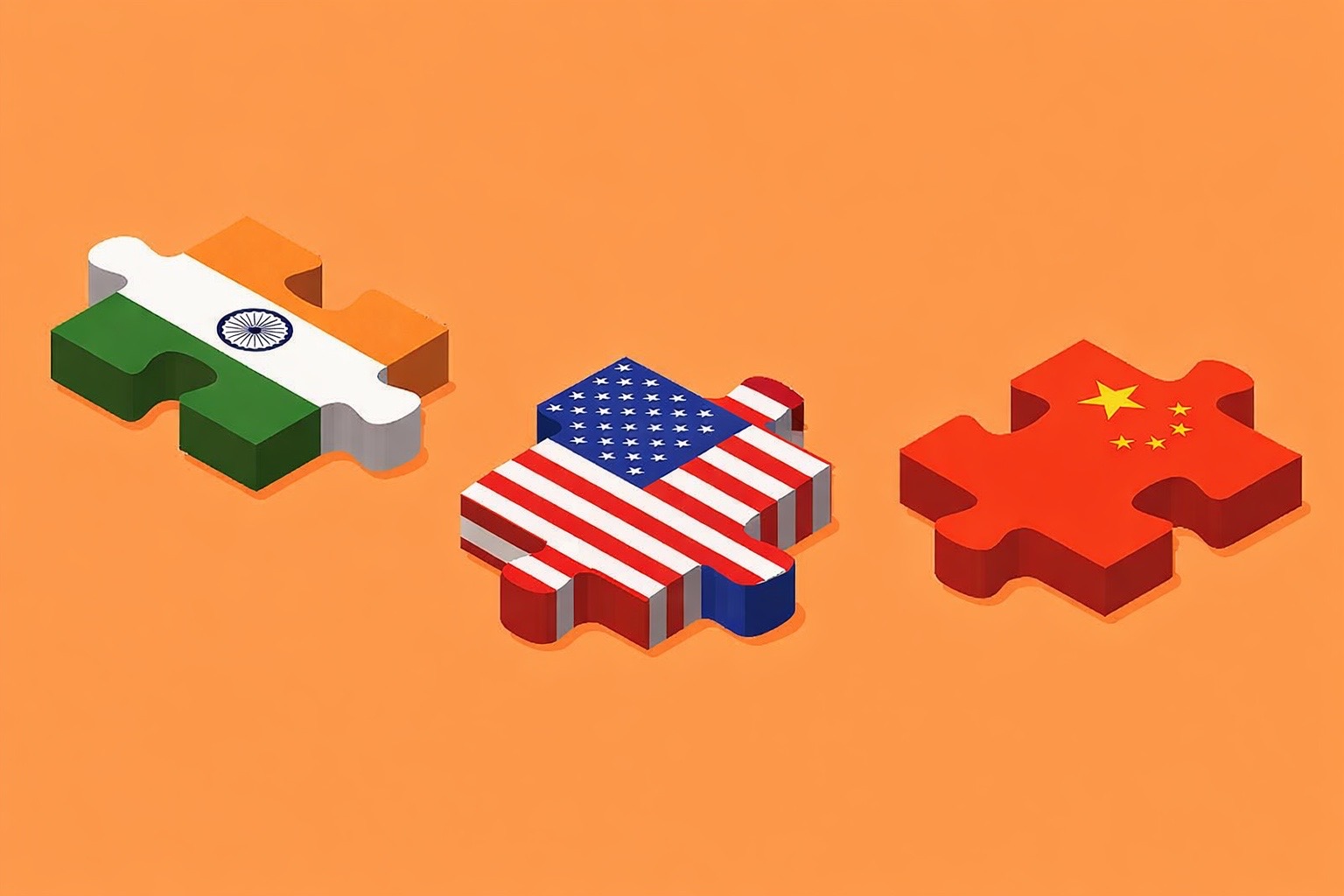
This illustration has been created by AI to use only in this article.
The geopolitics of the twenty-first century is changing fast enough to feel like experiencing Paul Kennedy’s “The Rise and Fall of the Great Powers” unfold in real time. The post-Cold War order, once framed as stable, liberal, and U.S.-led, is showing visible strain: norms are contested, institutions are stressed, and power is redistributing across regions and domains. The United States that anchored what many called the “unipolar moment” is increasingly absorbed by domestic polarization and strategic retrenchment, while China expands its economic, military, and diplomatic footprint. Meanwhile, Russia has revived expansionist instincts, and Europe is confronting the limits of its security assumptions.
India sits at the hinge of this transition: not an old power in restoration nor a status-quo superpower, but an aspiring one. It is demographically young, economically consequential, and strategically exposed. If a sharper U.S.–China rivalry hardens into a de facto bipolar structure, the pressure on middle and rising powers to “choose sides” will grow. Yet India has long treated autonomy not as rhetoric but as statecraft, first through non-alignment, later through issue-based partnerships designed to preserve room for maneuver. Unlike the Cold War era, however, India now operates with greater economic weight, deeper external partnerships, and higher ambitions, even as it confronts persistent domestic constraints and a volatile neighborhood.
In the contemporary scenario, India’s main goal is not to stay equally close to Washington and Beijing but to protect its freedom of action by building real national strength. In practice, that means partnering more closely on security when it serves India’s interests, staying economically engaged but carefully managing dependence, and widening its options through ties with other major and middle powers. The argument—and the hypothesis tested here—is that this strategy can work only if India keeps its links with both the United States and China strong enough to matter yet limited enough to avoid being pressured or strong-armed by either side. Ultimately, success will depend less on diplomatic messaging and more on whether India can quickly strengthen its domestic industrial base, technology ecosystem, and military capability while managing border tensions and stabilizing its immediate neighborhood.
Freedom of Action in a Multipolar World
India interprets the contemporary international order as moving toward multipolarity and, crucially, casts itself not merely as a participant but as a prospective pole within that system. This self-conception coexists with a clear-eyed assessment of relative constraints: compared to larger powers, the U.S. and China, India faces disadvantages in aggregate economic power, persistent security dependencies, and acute geographic vulnerabilities, especially along contested land borders and within a demanding regional environment. Yet these constraints have not diluted India’s long-standing preference for avoiding rigid bloc commitments. Instead, they have made the pursuit of autonomy more central to India’s strategic imagination.
In this context, India’s guiding doctrine is commonly described as strategic autonomy. Strategic autonomy refers to a state’s ability to make sovereign decisions in foreign policy and defense without being structurally constrained by external pressure or binding alliance obligations. It is not synonymous with isolationism or neutrality. Rather, it denotes flexibility and independence: the capacity to cooperate with multiple powers while retaining freedom of action and preserving bargaining leverage. For India, the concept carries deep historical resonance: colonial subjugation instilled an enduring determination that no external actor should “decide India’s place in the world.”
Strategic autonomy also represents continuity through adaptation. From Jawaharlal Nehru’s non-alignment during the Cold War to the current government’s emphasis on “multi-alignment,” successive Indian administrations have sought to preserve room for maneuver while responding to shifting distributions of power. Conceptually, it offers a middle path between rigid bloc politics and passive disengagement: a strategy aimed at reducing the risk of coercion by any single power or coalition by calibrating security partnerships, economic interdependence, and diplomatic positioning. Crucially, it also requires strengthening the domestic foundations of autonomy: economic resilience, technological and industrial capacity, and social cohesion, without which external flexibility becomes performative rather than durable.
At the same time, strategic autonomy differs from Cold War-era non-alignment in important ways. Non-alignment emerged in a bipolar system in which India was materially weaker and sought to avoid entrapment. Today, India’s larger economic scale, global partnerships, and great-power aspirations make autonomy less about abstention and more about selective alignment—the ability to cooperate or resist depending on issue area and national interest. In that sense, strategic autonomy is not simply a defensive posture; it is also a statement of status. It signals that India does not accept the category of a “mere middle power” but seeks to operate as a consequential actor capable of shaping outcomes and, at the margins, shifting the balance within an evolving global order.
Whether India can translate this ambition into a durable strategy will depend on the prudence, pragmatism, and patience of its policymakers. It is unrealistic to expect India to be fully aligned with both Washington and Beijing at once; the more plausible goal is to remain a pivotal actor that can work with each side without becoming dependent on either. The real test, therefore, lies in the bilateral relationships themselves—how India has managed its ties with the United States and China over time, what each side expects from India today, and where the points of convergence and friction are most likely to emerge.
is a young leader with the Pacific Forum and a graduate of the Master of Arts in Law and Diplomacy from the Fletcher School at Tufts University. His areas of interest include grand strategy, political economy, and transnationalism.
The geopolitics of the twenty-first century is changing fast enough to feel like experiencing Paul Kennedy’s “The Rise and Fall of the Great Powers” unfold in real time. The post-Cold War order, once framed as stable, liberal, and U.S.-led, is showing visible strain: norms are contested, institutions are stressed, and power is redistributing across regions and domains. The United States that anchored what many called the “unipolar moment” is increasingly absorbed by domestic polarization and strategic retrenchment, while China expands its economic, military, and diplomatic footprint. Meanwhile, Russia has revived expansionist instincts, and Europe is confronting the limits of its security assumptions.
India sits at the hinge of this transition: not an old power in restoration nor a status-quo superpower, but an aspiring one. It is demographically young, economically consequential, and strategically exposed. If a sharper U.S.–China rivalry hardens into a de facto bipolar structure, the pressure on middle and rising powers to “choose sides” will grow. Yet India has long treated autonomy not as rhetoric but as statecraft, first through non-alignment, later through issue-based partnerships designed to preserve room for maneuver. Unlike the Cold War era, however, India now operates with greater economic weight, deeper external partnerships, and higher ambitions, even as it confronts persistent domestic constraints and a volatile neighborhood.
In the contemporary scenario, India’s main goal is not to stay equally close to Washington and Beijing but to protect its freedom of action by building real national strength. In practice, that means partnering more closely on security when it serves India’s interests, staying economically engaged but carefully managing dependence, and widening its options through ties with other major and middle powers. The argument—and the hypothesis tested here—is that this strategy can work only if India keeps its links with both the United States and China strong enough to matter yet limited enough to avoid being pressured or strong-armed by either side. Ultimately, success will depend less on diplomatic messaging and more on whether India can quickly strengthen its domestic industrial base, technology ecosystem, and military capability while managing border tensions and stabilizing its immediate neighborhood.
Freedom of Action in a Multipolar World
India interprets the contemporary international order as moving toward multipolarity and, crucially, casts itself not merely as a participant but as a prospective pole within that system. This self-conception coexists with a clear-eyed assessment of relative constraints: compared to larger powers, the U.S. and China, India faces disadvantages in aggregate economic power, persistent security dependencies, and acute geographic vulnerabilities, especially along contested land borders and within a demanding regional environment. Yet these constraints have not diluted India’s long-standing preference for avoiding rigid bloc commitments. Instead, they have made the pursuit of autonomy more central to India’s strategic imagination.
In this context, India’s guiding doctrine is commonly described as strategic autonomy. Strategic autonomy refers to a state’s ability to make sovereign decisions in foreign policy and defense without being structurally constrained by external pressure or binding alliance obligations. It is not synonymous with isolationism or neutrality. Rather, it denotes flexibility and independence: the capacity to cooperate with multiple powers while retaining freedom of action and preserving bargaining leverage. For India, the concept carries deep historical resonance: colonial subjugation instilled an enduring determination that no external actor should “decide India’s place in the world.”
Strategic autonomy also represents continuity through adaptation. From Jawaharlal Nehru’s non-alignment during the Cold War to the current government’s emphasis on “multi-alignment,” successive Indian administrations have sought to preserve room for maneuver while responding to shifting distributions of power. Conceptually, it offers a middle path between rigid bloc politics and passive disengagement: a strategy aimed at reducing the risk of coercion by any single power or coalition by calibrating security partnerships, economic interdependence, and diplomatic positioning. Crucially, it also requires strengthening the domestic foundations of autonomy: economic resilience, technological and industrial capacity, and social cohesion, without which external flexibility becomes performative rather than durable.
At the same time, strategic autonomy differs from Cold War-era non-alignment in important ways. Non-alignment emerged in a bipolar system in which India was materially weaker and sought to avoid entrapment. Today, India’s larger economic scale, global partnerships, and great-power aspirations make autonomy less about abstention and more about selective alignment—the ability to cooperate or resist depending on issue area and national interest. In that sense, strategic autonomy is not simply a defensive posture; it is also a statement of status. It signals that India does not accept the category of a “mere middle power” but seeks to operate as a consequential actor capable of shaping outcomes and, at the margins, shifting the balance within an evolving global order.
Whether India can translate this ambition into a durable strategy will depend on the prudence, pragmatism, and patience of its policymakers. It is unrealistic to expect India to be fully aligned with both Washington and Beijing at once; the more plausible goal is to remain a pivotal actor that can work with each side without becoming dependent on either. The real test, therefore, lies in the bilateral relationships themselves—how India has managed its ties with the United States and China over time, what each side expects from India today, and where the points of convergence and friction are most likely to emerge.
is a young leader with the Pacific Forum and a graduate of the Master of Arts in Law and Diplomacy from the Fletcher School at Tufts University. His areas of interest include grand strategy, political economy, and transnationalism.
The Chinese Experience That Challenges the Universality of Liberalism

India’s relationships with the United States and China have moved through cycles of cooperation and tension. Unlike India’s long-standing ties with Russia, often described as an “all-weather” partnership, both Washington and Beijing have, at different points, clashed with New Delhi over core interests and policy choices. The result has been alternating phases of warmth and pressure, shaped less by sentiment and more by shifting strategic calculations.
Of the two, India–U.S. ties have generally been easier to expand because they lack the structural friction of a disputed land border and are increasingly supported by overlapping interests in the Indo-Pacific, technology, and defense cooperation. India–China relations, by contrast, are burdened by geography and history. Unresolved border disputes rooted in the legacies of the British Empire and compounded by decades of failed settlement continue to generate mistrust and crisis risk. The absence of a shared regional vision and the persistence of competing security goals in Asia have therefore made China not just a neighbor but a primary strategic challenger for India. Therefore, the interests, expectations, and constraints that shape each bilateral relationship are different and have evolved separately.
The Limits of Alignment
India’s relationship with the United States has never unfolded as a straightforward progression from distance to intimacy; rather, it has evolved through an ongoing and often delicate negotiation between India’s commitment to strategic autonomy and America’s preference for alliance-centered statecraft. Over time, this negotiation has been repeatedly shaped by recurring dynamics. At moments of regional security crises—particularly those involving Pakistan—the bilateral relationship has tended to recalibrate under pressure. At the same time, India’s pursuit of capital and advanced technology has created new avenues for cooperation, drawing the two countries closer in practical terms. Yet these convergences have consistently coexisted with a structural tension: while Washington often expects clearer political alignment, New Delhi continues to insist on preserving its independent decision-making. It is within this interplay of crisis, opportunity, and divergence that the true character of the U.S.–India relationship can be understood.
During the Cold War, the relationship ran on limited cooperation and recurring mistrust. Washington’s early tilt toward Pakistan—visible in its positions on Kashmir and debates at the United Nations Security Council—made New Delhi doubt U.S. reliability as a security partner. That tilt was rooted in Cold War logic: Pakistan was treated as a useful security ally against Soviet influence and as a channel into a broader Muslim world during a period shaped by the creation of Israel. Even so, the relationship was never fully frozen. Economic and development cooperation—especially food support through PL-480—kept an important baseline of engagement alive despite political estrangement.
Security cooperation spiked only when threat perceptions briefly aligned, most notably after the 1962 India–China war, but those moments rarely lasted. The sharpest Cold War low came in 1971: India signed a Treaty of Peace, Friendship, and Cooperation with the Soviet Union, and the United States deployed a naval task force into the Bay of Bengal during the Bangladesh crisis—reinforcing New Delhi’s belief that U.S. power could be used coercively in South Asia. In the 1980s, ties warmed cautiously as regional upheaval after the Soviet invasion of Afghanistan raised South Asia’s strategic importance and as India sought technology and capability inputs, but nuclear disagreements and U.S. assistance to Pakistan capped trust.
After 1991, the relationship shifted from ideological distance to pragmatic convergence—without erasing the autonomy tension. India’s economic reforms created far more room for trade, investment, and technology ties, but the early post–Cold War years still carried the non-proliferation shadow. The 1998 nuclear tests triggered U.S. sanctions under the Glenn Amendment, which many in India interpreted as punitive and unequal—an attempt to police India’s strategic choices rather than accommodate its security realities. Yet even this low point became part of the later reset: the Kargil conflict in 1999 signaled a meaningful U.S. recalibration, with Washington pressing Pakistan to withdraw and implicitly treating India’s position as the more stabilizing one.
The deeper transformation came when strategic logic and technology needs finally aligned. The 2008 civil nuclear breakthrough and the subsequent international enabling steps were widely seen as a watershed because they opened pathways for civil nuclear cooperation and symbolically treated India as an exceptional case outside the NPT framework. In the 2010s and 2020s, security cooperation became more operational: enabling agreements such as the Logistics Exchange Memorandum of Agreement (LEMOA), the Communications Compatibility and Security Agreement (COMCASA), and the Basic Exchange and Cooperation Agreement (BECA) institutionalized logistics cooperation, secure communications, and geospatial data-sharing—building habits of cooperation that look much closer to interoperability than earlier decades allowed.
This strategic convergence has also been reinforced by minilateral diplomacy in the Indo-Pacific. India’s participation in the consultations that revived the Quad framework in 2017 illustrates the pattern: India seeks coalition value and deterrence signaling but prefers flexible arrangements that stop short of alliance obligations. And in the 2020s, the relationship increasingly fused security with advanced technology, visible in initiatives like the Initiative on Critical and Emerging Technology (iCET), which explicitly aims to deepen cooperation across critical and emerging technologies as part of the broader strategic partnership.
India’s relationships with the United States and China have moved through cycles of cooperation and tension. Unlike India’s long-standing ties with Russia, often described as an “all-weather” partnership, both Washington and Beijing have, at different points, clashed with New Delhi over core interests and policy choices. The result has been alternating phases of warmth and pressure, shaped less by sentiment and more by shifting strategic calculations.
Of the two, India–U.S. ties have generally been easier to expand because they lack the structural friction of a disputed land border and are increasingly supported by overlapping interests in the Indo-Pacific, technology, and defense cooperation. India–China relations, by contrast, are burdened by geography and history. Unresolved border disputes rooted in the legacies of the British Empire and compounded by decades of failed settlement continue to generate mistrust and crisis risk. The absence of a shared regional vision and the persistence of competing security goals in Asia have therefore made China not just a neighbor but a primary strategic challenger for India. Therefore, the interests, expectations, and constraints that shape each bilateral relationship are different and have evolved separately.
The Limits of Alignment
India’s relationship with the United States has never unfolded as a straightforward progression from distance to intimacy; rather, it has evolved through an ongoing and often delicate negotiation between India’s commitment to strategic autonomy and America’s preference for alliance-centered statecraft. Over time, this negotiation has been repeatedly shaped by recurring dynamics. At moments of regional security crises—particularly those involving Pakistan—the bilateral relationship has tended to recalibrate under pressure. At the same time, India’s pursuit of capital and advanced technology has created new avenues for cooperation, drawing the two countries closer in practical terms. Yet these convergences have consistently coexisted with a structural tension: while Washington often expects clearer political alignment, New Delhi continues to insist on preserving its independent decision-making. It is within this interplay of crisis, opportunity, and divergence that the true character of the U.S.–India relationship can be understood.
During the Cold War, the relationship ran on limited cooperation and recurring mistrust. Washington’s early tilt toward Pakistan—visible in its positions on Kashmir and debates at the United Nations Security Council—made New Delhi doubt U.S. reliability as a security partner. That tilt was rooted in Cold War logic: Pakistan was treated as a useful security ally against Soviet influence and as a channel into a broader Muslim world during a period shaped by the creation of Israel. Even so, the relationship was never fully frozen. Economic and development cooperation—especially food support through PL-480—kept an important baseline of engagement alive despite political estrangement.
Security cooperation spiked only when threat perceptions briefly aligned, most notably after the 1962 India–China war, but those moments rarely lasted. The sharpest Cold War low came in 1971: India signed a Treaty of Peace, Friendship, and Cooperation with the Soviet Union, and the United States deployed a naval task force into the Bay of Bengal during the Bangladesh crisis—reinforcing New Delhi’s belief that U.S. power could be used coercively in South Asia. In the 1980s, ties warmed cautiously as regional upheaval after the Soviet invasion of Afghanistan raised South Asia’s strategic importance and as India sought technology and capability inputs, but nuclear disagreements and U.S. assistance to Pakistan capped trust.
After 1991, the relationship shifted from ideological distance to pragmatic convergence—without erasing the autonomy tension. India’s economic reforms created far more room for trade, investment, and technology ties, but the early post–Cold War years still carried the non-proliferation shadow. The 1998 nuclear tests triggered U.S. sanctions under the Glenn Amendment, which many in India interpreted as punitive and unequal—an attempt to police India’s strategic choices rather than accommodate its security realities. Yet even this low point became part of the later reset: the Kargil conflict in 1999 signaled a meaningful U.S. recalibration, with Washington pressing Pakistan to withdraw and implicitly treating India’s position as the more stabilizing one.
The deeper transformation came when strategic logic and technology needs finally aligned. The 2008 civil nuclear breakthrough and the subsequent international enabling steps were widely seen as a watershed because they opened pathways for civil nuclear cooperation and symbolically treated India as an exceptional case outside the NPT framework. In the 2010s and 2020s, security cooperation became more operational: enabling agreements such as the Logistics Exchange Memorandum of Agreement (LEMOA), the Communications Compatibility and Security Agreement (COMCASA), and the Basic Exchange and Cooperation Agreement (BECA) institutionalized logistics cooperation, secure communications, and geospatial data-sharing—building habits of cooperation that look much closer to interoperability than earlier decades allowed.
This strategic convergence has also been reinforced by minilateral diplomacy in the Indo-Pacific. India’s participation in the consultations that revived the Quad framework in 2017 illustrates the pattern: India seeks coalition value and deterrence signaling but prefers flexible arrangements that stop short of alliance obligations. And in the 2020s, the relationship increasingly fused security with advanced technology, visible in initiatives like the Initiative on Critical and Emerging Technology (iCET), which explicitly aims to deepen cooperation across critical and emerging technologies as part of the broader strategic partnership.
Still, the “autonomy test” never disappeared; it simply moved into new arenas. In security, it shows up when U.S. sanctions frameworks intersect with India’s legacy defense ties. In economics, it shows up more bluntly through leverage. The 2025 tariff escalation, explicitly linked in U.S. messaging to India’s Russian oil imports, demonstrated how quickly economic instruments can be used to push strategic behavior. The February 2026 interim framework that lowered tariffs to 18% and referenced India’s “intention” to scale up purchases illustrates both the resilience and the fragility of the partnership: it is important enough to rescue but also susceptible to sharp swings when U.S. policy turns unilateral.
Finally, people-to-people ties have become a quiet stabilizer in a way they were not during the Cold War. The Indian diaspora in the United States anchors dense networks in higher education, entrepreneurship, and technology, and remittances are one measurable indicator of this broader social and economic linkage. The World Bank lists India as the world’s largest recipient of remittances, including $125 billion in 2023. These ties do not eliminate strategic disagreements, but they make the relationship harder to fully reverse because cooperation is no longer only a government-to-government choice; it is embedded in society and markets.
Taken together, the long arc is clear: India–U.S. relations evolved from Cold War-era mistrust—managed through selective economic cooperation—into a post-1991 strategic partnership driven by shared interests in Asian stability and technology-driven power. Yet the partnership remains structurally “managed,” not unconditional: it deepens when it builds Indian capability, and it frays when U.S. leverage politics threatens to turn interdependence into constraint.
Partnership on India’s Terms
To understand where the India–U.S. partnership can deepen—and where it will repeatedly face friction—it is useful to be clear about what each side ultimately seeks from the other. From Washington’s perspective, India is valuable as a strategic counterweight in Asia and as a partner in shaping the Indo-Pacific balance. The United States benefits when India is sufficiently capable to complicate Chinese coercion, contribute to regional deterrence, and cooperate through flexible arrangements in the Indo-Pacific—without requiring a formal alliance. At the same time, U.S. policy often carries an implicit preference that India’s security dependence does not disappear entirely: access, interoperability, and defense-industrial cooperation become stronger levers when India continues to rely on U.S. and partner ecosystems for key capabilities. Alongside the strategic logic sits an economic one. The United States also wants India to function as a major economic partner and market, especially for energy, advanced technology, defense platforms, and agricultural goods—an expectation reinforced by Washington’s tendency to view global competition increasingly through a U.S.–China lens.
India’s objectives are related but not identical. India values the United States as a capability partner, a source of technology, investment, and security cooperation that can strengthen deterrence in the Indo-Pacific and offset the risks created by a more powerful China. Yet India’s larger goal is not alignment; it is leverage and flexibility. New Delhi does not want to become over-dependent on the United States for security, technology, or trade because dependence creates vulnerability, particularly when U.S. domestic politics or unilateral economic tools can rapidly reshape policy. Recent trade frictions have reinforced this lesson: reliability is not guaranteed, and India’s bargaining position improves only when it has alternatives and can credibly resist pressure. In practice, then, India seeks a partnership with Washington that enhances its capabilities while preserving room for independent choices, cooperating where interests converge but avoiding commitments that could turn partnership into constraint.
Seen this way, the India–U.S. relationship is best described as strategic convergence with negotiated autonomy: a partnership that grows when it strengthens India’s capacity and options and strains when either side tries to convert interdependence into discipline. This sets up the contrast with China: where India’s core challenge is not managing a partner’s expectations but managing a competitor’s proximity, coercive capacity, and unresolved border risks.
Geography as Destiny
India–China relations have traveled a long distance from the optimism of the early 1950s to the guarded, high-stakes relationship India manages today. If India–U.S. ties evolved from mistrust into a capability-oriented partnership, India–China ties evolved from fraternity into a form of managed rivalry, one that mixes deep economic interdependence with recurring security crises. For India’s broader strategy of strategic autonomy, China is the harder test because the relationship is shaped not only by interests but by geography: contested borders, proximity, and the ever-present risk that a political disagreement can become a military incident.
The relationship began with genuine postcolonial hope. India was among the first major non-communist countries to recognize the People’s Republic of China in December 1949, and the early years were defined by the language of Asian solidarity and peaceful coexistence. But the foundations were fragile. China’s consolidation of control over Tibet after 1950 transformed the strategic geography of the Himalayas and brought two large states into direct contact. India tried to preserve stable ties, relinquishing inherited colonial-era privileges in Tibet, but the central problem was never resolved: a boundary that neither side accepted as fully settled, inherited from the ambiguities of British imperial cartography and diplomacy. The dispute in the western sector around Aksai Chin and the contestation in the eastern sector associated with what India administers as Arunachal Pradesh were not simply technical disagreements over lines on a map. They reflected incompatible historical narratives and competing security imperatives along a difficult frontier.
The more plausible goal is to remain a pivotal actor that can work with each side without becoming dependent on either.
By the late 1950s, mistrust deepened. China’s tightening grip in Tibet and India’s decision to grant asylum to the Dalai Lama in 1959 hardened positions, and diplomatic efforts to bridge differences failed. The 1962 war ruptured the relationship and set the terms of rivalry for decades to come. After 1962, political engagement largely froze, and China’s growing strategic cooperation with Pakistan reinforced India’s sense that Beijing was willing to constrain India’s strategic space through regional partnerships. When normalization resumed in the late 1970s and 1980s, it did not remove the dispute; it reorganized the relationship around a practical compromise: the border would remain unresolved, but it would be managed so that limited cooperation could continue.
That logic shaped the post–Cold War phase. Through the 1990s and 2000s, India and China sought to maintain stability along the Line of Actual Control through confidence-building agreements and dialogue mechanisms. The aim was straightforward: keep the frontier calm enough to allow trade and diplomacy to expand. For a time, this produced a workable arrangement—an uneasy but functional coexistence in which political signaling and military restraint created space for economic engagement.
The problem was that this “management model” relied on the assumption that peace on the border could be preserved through understandings and restraint. In the 2010s, that assumption began to weaken. The Doklam standoff in 2017 signaled that crisis behavior had returned, and the Galwan clash in 2020 marked a more serious turning point. From India’s perspective, this was not simply another dispute; it was evidence that the border could be used as a tool of pressure. The response in New Delhi was a shift toward stronger deterrence—accelerated infrastructure at the frontier, changes in force posture, and a wider reassessment of China as India’s primary continental security challenge. This shift carries real costs. High-altitude preparedness demands sustained resources, and every additional rupee spent to harden the Himalayan frontier competes with naval modernization and maritime presence—capabilities India sees as essential for sustaining influence in the Indian Ocean.
Yet even amid rivalry, economic interdependence has continued. Trade between the two countries has expanded alongside strategic mistrust, creating a relationship that is neither simple hostility nor genuine partnership. For India, the key concern is not trade per se, but asymmetric dependence, especially in sectors that touch national security and industrial resilience. In recent years, India’s trade deficit with China has widened dramatically, reinforcing worries that economic ties can become a strategic vulnerability. India’s trade deficit with China hit a record level in 2024/25, alongside rising concerns about dumping and dependence. India’s post-2020 restrictions in the digital domain—along with broader de-risking measures—reflect an attempt to reduce exposure where dependence could translate into coercion, without pretending that full economic decoupling is feasible in the near term.
Diplomatically, India has kept channels open, even in periods of heightened tension. Both countries continue to share space in forums such as BRICS and the Shanghai Cooperation Organisation, and they periodically signal interest in stabilizing ties. A limited stabilization effort has been visible since late 2024, particularly through border management understandings and resumed dialogues; India’s Ministry of External Affairs has publicly indicated that disengagement understandings reached in October 2024 were holding in relevant areas. But this remains a tactical thaw rather than a strategic reset. The deeper drivers—border contestation, China–Pakistan coordination, and competition for influence across Asia and the Indian Ocean region—continue to shape India’s view of China as a strategic challenger, not simply a difficult neighbor.
The broader analytical point is that India–China relations now operate under a dual reality. Economically, the incentives to trade and remain connected are strong; strategically, the incentives to deter, hedge, and reduce vulnerability are stronger than at any point since the Cold War. This is why China is central to India’s contemporary balancing problem. With the United States, India’s challenge is to gain capabilities without being pulled into alliance discipline. With China, India’s challenge is more basic: to prevent proximity from becoming coercion and to manage rivalry without allowing each border crisis to foreclose diplomacy or derail India’s wider development agenda.
Leverage and Limits
To see why India–China ties remain both economically connected and strategically brittle, it is important to clarify what each side ultimately seeks—and what each fears—from the other. From Beijing’s perspective, China often speaks the language of multipolarity, but it is less clear that it welcomes India as a fully equal pole in Asia. At a minimum, China prefers an India that does not challenge Beijing’s claim to primacy in the regional order. Geography gives China enduring leverage: as India’s continental neighbor with a disputed border, proximity to India’s periphery, and deep partnerships in South Asia, Beijing can apply pressure through a mix of military signaling, diplomacy, and economic tools. A stronger, more autonomous India complicates China’s strategic bandwidth because it forces Beijing to allocate resources to the Himalayan frontier and the Indian Ocean at the very moment it seeks to concentrate capabilities for long-term competition with the United States in the Indo-Pacific.
At the same time, China has incentives to keep the relationship from collapsing into permanent confrontation. It benefits from trade with India, from access to a large market, and from presenting a Global South narrative in multilateral forums where both countries have influence. Beijing has also shown periodic willingness to compartmentalize disputes and cooperate on functional areas—such as clean energy, certain technology domains, and critical mineral supply chains—when that serves its broader geopolitical aim of reducing U.S. influence. Yet cooperation has clear limits: China often acts to slow or complicate India’s rise in areas that touch national power, particularly where India seeks to build independent manufacturing capacity and reduce strategic dependence.
India’s interests start from a different premise. New Delhi does not want a relationship defined only by hostility because the costs of continuous escalation on the border are high and because China remains a major economic actor in India’s supply chains. India has therefore repeatedly signaled willingness to engage diplomatically and cooperate in multilateral settings, even during periods of tension. But India’s core objective is to prevent China from becoming so dominant that India loses bargaining space. The unresolved boundary remains the structural constraint: it creates an environment in which trust is thin, crises recur, and military preparedness absorbs scarce resources.
For India, reducing vulnerability is therefore central. That means limiting dependence on China in sensitive sectors, especially critical minerals and high-end manufacturing inputs, by building domestic capacity and diversifying supply chains. It also means widening India’s external options: strengthening partnerships in both the Global North and the Global South and presenting India as a stable, reliable alternative for trade, investment, and technology cooperation. In practice, India treats China not only as a competitor but as a strategic rival whose actions can directly impede India’s larger ambitions. Managing this relationship, then, is less about achieving “normal” bilateral ties and more about sustaining a stable baseline—enough to avoid crisis and keep room for growth—while steadily building the leverage India needs to negotiate with China from a position of greater strength.
The Test of Strategic Autonomy
India’s strategic autonomy will be decided in the coming decade, not because India lacks ambition, but because the international environment is becoming less forgiving. As U.S.–China competition sharpens, the room for middle and rising powers to remain flexible shrinks, and pressure increasingly travels through trade, technology, finance, and security partnerships. For India, managing two dominant powers at once will therefore require more than careful diplomacy. Autonomy will depend on whether India can build the domestic and external foundations that make independent choice credible under stress.
The core theory is simple: India sustains autonomy when it has capability at home and options abroad. Even if India becomes the world’s third-largest economy in the near future, the absolute and per capita gaps with the United States and China will remain large. India’s strategic capital is not only size; it is momentum, the ability to sustain high growth and convert it into power-relevant capacity. That means building domestic strength in the sectors that determine leverage in a coercive era: advanced manufacturing, defense production, AI and digital infrastructure, semiconductor and electronics ecosystems, critical minerals and processing, and energy resilience. Autonomy also requires domestic stability. If growth is uneven and social fault lines widen, external actors gain opportunities to apply pressure indirectly. In other words, inclusive growth and social cohesion are not just development goals; they are strategic defenses.
Operationally, India’s toolkit has three parts. The first is capability-building: accelerating industrial upgrading, reducing single-point import dependence in critical sectors, and ensuring the military can deter and absorb pressure on land and at sea without consuming national resources indefinitely. The second is coalition diversification: widening India’s external options beyond Washington and Beijing through deeper economic and strategic partnerships with Europe, Japan, ASEAN, the Gulf, Australia, and key African partners. The objective is not symbolic “multi-alignment,” but practical insurance so no single relationship becomes a chokepoint. The third is geographic consolidation: sustaining influence in South Asia and the Indian Ocean, because India’s autonomy weakens if its neighborhood becomes permeable to external leverage or if it cannot protect the maritime corridors on which its economy depends.
Still, the “autonomy test” never disappeared; it simply moved into new arenas. In security, it shows up when U.S. sanctions frameworks intersect with India’s legacy defense ties. In economics, it shows up more bluntly through leverage. The 2025 tariff escalation, explicitly linked in U.S. messaging to India’s Russian oil imports, demonstrated how quickly economic instruments can be used to push strategic behavior. The February 2026 interim framework that lowered tariffs to 18% and referenced India’s “intention” to scale up purchases illustrates both the resilience and the fragility of the partnership: it is important enough to rescue but also susceptible to sharp swings when U.S. policy turns unilateral.
Finally, people-to-people ties have become a quiet stabilizer in a way they were not during the Cold War. The Indian diaspora in the United States anchors dense networks in higher education, entrepreneurship, and technology, and remittances are one measurable indicator of this broader social and economic linkage. The World Bank lists India as the world’s largest recipient of remittances, including $125 billion in 2023. These ties do not eliminate strategic disagreements, but they make the relationship harder to fully reverse because cooperation is no longer only a government-to-government choice; it is embedded in society and markets.
Taken together, the long arc is clear: India–U.S. relations evolved from Cold War-era mistrust—managed through selective economic cooperation—into a post-1991 strategic partnership driven by shared interests in Asian stability and technology-driven power. Yet the partnership remains structurally “managed,” not unconditional: it deepens when it builds Indian capability, and it frays when U.S. leverage politics threatens to turn interdependence into constraint.
Partnership on India’s Terms
To understand where the India–U.S. partnership can deepen—and where it will repeatedly face friction—it is useful to be clear about what each side ultimately seeks from the other. From Washington’s perspective, India is valuable as a strategic counterweight in Asia and as a partner in shaping the Indo-Pacific balance. The United States benefits when India is sufficiently capable to complicate Chinese coercion, contribute to regional deterrence, and cooperate through flexible arrangements in the Indo-Pacific—without requiring a formal alliance. At the same time, U.S. policy often carries an implicit preference that India’s security dependence does not disappear entirely: access, interoperability, and defense-industrial cooperation become stronger levers when India continues to rely on U.S. and partner ecosystems for key capabilities. Alongside the strategic logic sits an economic one. The United States also wants India to function as a major economic partner and market, especially for energy, advanced technology, defense platforms, and agricultural goods—an expectation reinforced by Washington’s tendency to view global competition increasingly through a U.S.–China lens.
India’s objectives are related but not identical. India values the United States as a capability partner, a source of technology, investment, and security cooperation that can strengthen deterrence in the Indo-Pacific and offset the risks created by a more powerful China. Yet India’s larger goal is not alignment; it is leverage and flexibility. New Delhi does not want to become over-dependent on the United States for security, technology, or trade because dependence creates vulnerability, particularly when U.S. domestic politics or unilateral economic tools can rapidly reshape policy. Recent trade frictions have reinforced this lesson: reliability is not guaranteed, and India’s bargaining position improves only when it has alternatives and can credibly resist pressure. In practice, then, India seeks a partnership with Washington that enhances its capabilities while preserving room for independent choices, cooperating where interests converge but avoiding commitments that could turn partnership into constraint.
Seen this way, the India–U.S. relationship is best described as strategic convergence with negotiated autonomy: a partnership that grows when it strengthens India’s capacity and options and strains when either side tries to convert interdependence into discipline. This sets up the contrast with China: where India’s core challenge is not managing a partner’s expectations but managing a competitor’s proximity, coercive capacity, and unresolved border risks.
Geography as Destiny
India–China relations have traveled a long distance from the optimism of the early 1950s to the guarded, high-stakes relationship India manages today. If India–U.S. ties evolved from mistrust into a capability-oriented partnership, India–China ties evolved from fraternity into a form of managed rivalry, one that mixes deep economic interdependence with recurring security crises. For India’s broader strategy of strategic autonomy, China is the harder test because the relationship is shaped not only by interests but by geography: contested borders, proximity, and the ever-present risk that a political disagreement can become a military incident.
The relationship began with genuine postcolonial hope. India was among the first major non-communist countries to recognize the People’s Republic of China in December 1949, and the early years were defined by the language of Asian solidarity and peaceful coexistence. But the foundations were fragile. China’s consolidation of control over Tibet after 1950 transformed the strategic geography of the Himalayas and brought two large states into direct contact. India tried to preserve stable ties, relinquishing inherited colonial-era privileges in Tibet, but the central problem was never resolved: a boundary that neither side accepted as fully settled, inherited from the ambiguities of British imperial cartography and diplomacy. The dispute in the western sector around Aksai Chin and the contestation in the eastern sector associated with what India administers as Arunachal Pradesh were not simply technical disagreements over lines on a map. They reflected incompatible historical narratives and competing security imperatives along a difficult frontier.
By the late 1950s, mistrust deepened. China’s tightening grip in Tibet and India’s decision to grant asylum to the Dalai Lama in 1959 hardened positions, and diplomatic efforts to bridge differences failed. The 1962 war ruptured the relationship and set the terms of rivalry for decades to
come. After 1962, political engagement largely froze, and China’s growing strategic cooperation with Pakistan reinforced India’s sense that Beijing was willing to constrain India’s strategic space through regional partnerships. When normalization resumed in the late 1970s and 1980s, it did not remove the dispute; it reorganized the relationship around a practical compromise: the border would remain unresolved, but it would be managed so that limited cooperation could continue.
That logic shaped the post–Cold War phase. Through the 1990s and 2000s, India and China sought to maintain stability along the Line of Actual Control through confidence-building agreements and dialogue mechanisms. The aim was straightforward: keep the frontier calm enough to allow trade and diplomacy to expand. For a time, this produced a workable arrangement—an uneasy but functional coexistence in which political signaling and military restraint created space for economic engagement.
The problem was that this “management model” relied on the assumption that peace on the border could be preserved through understandings and restraint. In the 2010s, that assumption began to weaken. The Doklam standoff in 2017 signaled that crisis behavior had returned, and the Galwan clash in 2020 marked a more serious turning point. From India’s perspective, this was not simply another dispute; it was evidence that the border could be used as a tool of pressure. The response in New Delhi was a shift toward stronger deterrence—accelerated infrastructure at the frontier, changes in force posture, and a wider reassessment of China as India’s primary continental security challenge. This shift carries real costs. High-altitude preparedness demands sustained resources, and every additional rupee spent to harden the Himalayan frontier competes with naval modernization and maritime presence—capabilities India sees as essential for sustaining influence in the Indian Ocean.
Yet even amid rivalry, economic interdependence has continued. Trade between the two countries has expanded alongside strategic mistrust, creating a relationship that is neither simple hostility nor genuine partnership. For India, the key concern is not trade per se, but asymmetric dependence, especially in sectors that touch national security and industrial resilience. In recent years, India’s trade deficit with China has widened dramatically, reinforcing worries that economic ties can become a strategic vulnerability. India’s trade deficit with China hit a record level in 2024/25, alongside rising concerns about dumping and dependence. India’s post-2020 restrictions in the digital domain—along with broader de-risking measures—reflect an attempt to reduce exposure where dependence could translate into coercion, without pretending that full economic decoupling is feasible in the near term.
Diplomatically, India has kept channels open, even in periods of heightened tension. Both countries continue to share space in forums such as BRICS and the Shanghai Cooperation Organisation, and they periodically signal interest in stabilizing ties. A limited stabilization effort has been visible since late 2024, particularly through border management understandings and resumed dialogues; India’s Ministry of External Affairs has publicly indicated that disengagement understandings reached in October 2024 were holding in relevant areas. But this remains a tactical thaw rather than a strategic reset. The deeper drivers—border contestation, China–Pakistan coordination, and competition for influence across Asia and the Indian Ocean region—continue to shape India’s view of China as a strategic challenger, not simply a difficult neighbor.
The broader analytical point is that India–China relations now operate under a dual reality. Economically, the incentives to trade and remain connected are strong; strategically, the incentives to deter, hedge, and reduce vulnerability are stronger than at any point since the Cold War. This is why China is central to India’s contemporary balancing problem. With the United States, India’s challenge is to gain capabilities without being pulled into alliance discipline. With China, India’s challenge is more basic: to prevent proximity from becoming coercion and to manage rivalry without allowing each border crisis to foreclose diplomacy or derail India’s wider development agenda.
Leverage and Limits
To see why India–China ties remain both economically connected and strategically brittle, it is important to clarify what each side ultimately seeks—and what each fears—from the other. From Beijing’s perspective, China often speaks the language of multipolarity, but it is less clear that it welcomes India as a fully equal pole in Asia. At a minimum, China prefers an India that does not challenge Beijing’s claim to primacy in the regional order. Geography gives China enduring leverage: as India’s continental neighbor with a disputed border, proximity to India’s periphery, and deep partnerships in South Asia, Beijing can apply pressure through a mix of military signaling, diplomacy, and economic tools. A stronger, more autonomous India complicates China’s strategic bandwidth because it forces Beijing to allocate resources to the Himalayan frontier and the Indian Ocean at the very moment it seeks to concentrate capabilities for long-term competition with the United States in the Indo-Pacific.
At the same time, China has incentives to keep the relationship from collapsing into permanent confrontation. It benefits from trade with India, from access to a large market, and from presenting a Global South narrative in multilateral forums where both countries have influence. Beijing has also shown periodic willingness to compartmentalize disputes and cooperate on functional areas—such as clean energy, certain technology domains, and critical mineral supply chains—when that serves its broader geopolitical aim of reducing U.S. influence. Yet cooperation has clear limits: China often acts to slow or complicate India’s rise in areas that touch national power, particularly where India seeks to build independent manufacturing capacity and reduce strategic dependence.
India’s interests start from a different premise. New Delhi does not want a relationship defined only by hostility because the costs of continuous escalation on the border are high and because China remains a major economic actor in India’s supply chains. India has therefore repeatedly signaled willingness to engage diplomatically and cooperate in multilateral settings, even during periods of tension. But India’s core objective is to prevent China from becoming so dominant that India loses bargaining space. The unresolved boundary remains the structural constraint: it creates an environment in which trust is thin, crises recur, and military preparedness absorbs scarce resources.
For India, reducing vulnerability is therefore central. That means limiting dependence on China in sensitive sectors, especially critical minerals and high-end manufacturing inputs, by building domestic capacity and diversifying supply chains. It also means widening India’s external options: strengthening partnerships in both the Global North and the Global South and presenting India as a stable, reliable alternative for trade, investment, and technology cooperation. In practice, India treats China not only as a competitor but as a strategic rival whose actions can directly impede India’s larger ambitions. Managing this relationship, then, is less about achieving “normal” bilateral ties and more about sustaining a stable baseline—enough to avoid crisis and keep room for growth—while steadily building the leverage India needs to negotiate with China from a position of greater strength.
The Test of Strategic Autonomy
India’s strategic autonomy will be decided in the coming decade, not because India lacks ambition, but because the international environment is becoming less forgiving. As U.S.–China competition sharpens, the room for middle and rising powers to remain flexible shrinks, and pressure increasingly travels through trade, technology, finance, and security partnerships. For India, managing two dominant powers at once will therefore require more than careful diplomacy. Autonomy will depend on whether India can build the domestic and external foundations that make independent choice credible under stress.
The core theory is simple: India sustains autonomy when it has capability at home and options abroad. Even if India becomes the world’s third-largest economy in the near future, the absolute and per capita gaps with the United States and China will remain large. India’s strategic capital is not only size; it is momentum, the ability to sustain high growth and convert it into power-relevant capacity. That means building domestic strength in the sectors that determine leverage in a coercive era: advanced manufacturing, defense production, AI and digital infrastructure, semiconductor and electronics ecosystems, critical minerals and processing, and energy resilience. Autonomy also requires domestic stability. If growth is uneven and social fault lines widen, external actors gain opportunities to apply pressure indirectly. In other words, inclusive growth and social cohesion are not just development goals; they are strategic defenses.
Operationally, India’s toolkit has three parts. The first is capability-building: accelerating industrial upgrading, reducing single-point import dependence in critical sectors, and ensuring the military can deter and absorb pressure on land and at sea without consuming national resources indefinitely. The second is coalition diversification: widening India’s external options beyond Washington and Beijing through deeper economic and strategic partnerships with Europe, Japan, ASEAN, the Gulf, Australia, and key African partners. The objective is not symbolic “multi-alignment,” but practical insurance so no single relationship becomes a chokepoint. The third is geographic consolidation: sustaining influence in South Asia and the Indian Ocean, because India’s autonomy weakens if its neighborhood becomes permeable to external leverage or if it cannot protect the maritime corridors on which its economy depends.
The stress tests will show whether this strategy is working. The first is a hardened U.S.–China binary: if rivalry tightens further, India will face rising demands to align. Success would look like India remaining a pivotal partner to both—cooperating with the United States on security and technology while keeping China relations stable
enough to avoid constant crisis—without accepting alliance-style discipline from either side. Failure would look like strategic enclosure: India formally independent but materially constrained by sanctions threats, tariff coercion, technology restrictions, or border pressure.
Second, and often overlooked, stress test is the opposite scenario: a partial U.S.–China détente or bargain in which Washington and Beijing become closer partners than either is with India, even if competition persists elsewhere. In such a setting, India risks being treated as a secondary variable—pressed to accommodate terms set by the two larger powers. That is precisely why India’s balancing logic also contains a structural imperative: India must stay close enough to both powers that its bilateral relationships remain more valuable on key issues than their relationship with each other, so it is not bypassed in moments of great-power bargaining. Failure to maintain workable ties with either side would then be doubly costly, shrinking India’s channels of influence and narrowing its room to hedge.
Third is the border itself. If escalatory incidents recur frequently, India may be forced into costly permanent mobilization, diverting resources from maritime modernization and economic upgradation—the very engines of long-term autonomy. Fourth is economic coercion and supply-chain shocks. India’s resilience will be measured by whether it can absorb pressures such as tariffs, export controls, and investment screening without making strategic concessions. Fifth is internal cohesion and implementation capacity: if growth slows, inequalities widen, or governance bottlenecks persist, India’s bargaining position erodes regardless of diplomatic skill.
In the best case, India sustains rapid growth, upgrades its technology and industrial base, strengthens deterrence, stabilizes its neighborhood, and builds a diversified partnership portfolio. That combination would allow it to keep workable relations with both the United States and China while steadily expanding its influence as a consequential power. In the worst case, India remains dependent in critical sectors, faces recurring border crises, and becomes vulnerable to external leverage, reducing strategic autonomy from an organizing doctrine to a rhetorical preference. The difference between these futures will be determined less by how India describes the world order and more by how quickly it can build capability, preserve cohesion, and keep crises from consuming the resources needed to rise.
Between Two Elephants
India’s foreign policy story in the twenty-first century is the story of a rising power trying to keep its hands on the steering wheel in a world that increasingly wants to grab it. The United States offers partnership and capability, yet occasionally reminds India that economic and political leverage can be applied quickly when interests diverge. China offers scale and proximity—yet the unresolved border and recurring coercion ensure that competition is never far from the surface. Between these two powers, India’s approach has become neither non-alignment in the old sense nor alliance in the new one, but a constant effort to widen options: cooperate where interests converge, hedge where dependence becomes risky, and build partnerships beyond the two giants to avoid being boxed in.
And because, as the saying goes, when two elephants fight, it is the grass that suffers, India’s task is to ensure it is never just grass. In the end, the endurance of this strategy will not be decided by declarations of autonomy but by the strength that sustains it. If India can keep growing, translate growth into technological and military capability, hold its society together, and stabilize its neighborhood and maritime space, it can remain a pivotal actor—close enough to both powers to matter, yet independent enough to choose. If it cannot, the pressure of a more coercive world will steadily narrow its room for maneuver until autonomy survives more as aspiration than as practice.
India’s approach has become neither non-alignment in the old sense nor alliance in the new one, but a constant effort to widen options.
The stress tests will show whether this strategy is working. The first is a hardened U.S.–China binary: if rivalry tightens further, India will face rising demands to align. Success would look like India remaining a pivotal partner to both—cooperating with the United States on security and technology while keeping China relations stable enough to avoid constant crisis—without accepting alliance-style discipline from either side. Failure would look like strategic enclosure: India formally independent but materially constrained by sanctions threats, tariff coercion, technology restrictions, or border pressure.
Second, and often overlooked, stress test is the opposite scenario: a partial U.S.–China détente or bargain in which Washington and Beijing become closer partners than either is with India, even if competition persists elsewhere. In such a setting, India risks being treated as a secondary variable—pressed to accommodate terms set by the two larger powers. That is precisely why India’s balancing logic also contains a structural imperative: India must stay close enough to both powers that its bilateral relationships remain more valuable on key issues than their relationship with each other, so it is not bypassed in moments of great-power bargaining. Failure to maintain workable ties with either side would then be doubly costly, shrinking India’s channels of influence and narrowing its room to hedge.
Third is the border itself. If escalatory incidents recur frequently, India may be forced into costly permanent mobilization, diverting resources from maritime modernization and economic upgradation—the very engines of long-term autonomy. Fourth is economic coercion and supply-chain shocks. India’s resilience will be measured by whether it can absorb pressures such as tariffs, export controls, and investment screening without making strategic concessions. Fifth is internal cohesion and implementation capacity: if growth slows, inequalities widen, or governance bottlenecks persist, India’s bargaining position erodes regardless of diplomatic skill.
In the best case, India sustains rapid growth, upgrades its technology and industrial base, strengthens deterrence, stabilizes its neighborhood, and builds a diversified partnership portfolio. That combination would allow it to keep workable relations with both the United States and China while steadily expanding its influence as a consequential power. In the worst case, India remains dependent in critical sectors, faces recurring border crises, and becomes vulnerable to external leverage, reducing strategic autonomy from an organizing doctrine to a rhetorical preference. The difference between these futures will be determined less by how India describes the world order and more by how quickly it can build capability, preserve cohesion, and keep crises from consuming the resources needed to rise.
Between Two Elephants
India’s foreign policy story in the twenty-first century is the story of a rising power trying to keep its hands on the steering wheel in a world that increasingly wants to grab it. The United States offers partnership and capability, yet occasionally reminds India that economic and political leverage can be applied quickly when interests diverge. China offers scale and proximity—yet the unresolved border and recurring coercion ensure that competition is never far from the surface. Between these two powers, India’s approach has become neither non-alignment in the old sense nor alliance in the new one, but a constant effort to widen options: cooperate where interests converge, hedge where dependence becomes risky, and build partnerships beyond the two giants to avoid being boxed in.
And because, as the saying goes, when two elephants fight, it is the grass that suffers, India’s task is to ensure it is never just grass. In the end, the endurance of this strategy will not be decided by declarations of autonomy but by the strength that sustains it. If India can keep growing, translate growth into technological and military capability, hold its society together, and stabilize its neighborhood and maritime space, it can remain a pivotal actor—close enough to both powers to matter, yet independent enough to choose. If it cannot, the pressure of a more coercive world will steadily narrow its room for maneuver until autonomy survives more as aspiration than as practice.
Recommended
How the Chinese Military Could Shape China’s Next Chapter
How America’s Liberal Order Lost Its Domestic Foundation

What Does a Strong Europe Mean for America?

A Hamiltonian Approach to Power and Foreign Policy

China’s Post-Ideological Strategy of Power