


More Than a Doctrine
U.S. Foreign Policy as a Debate Without End
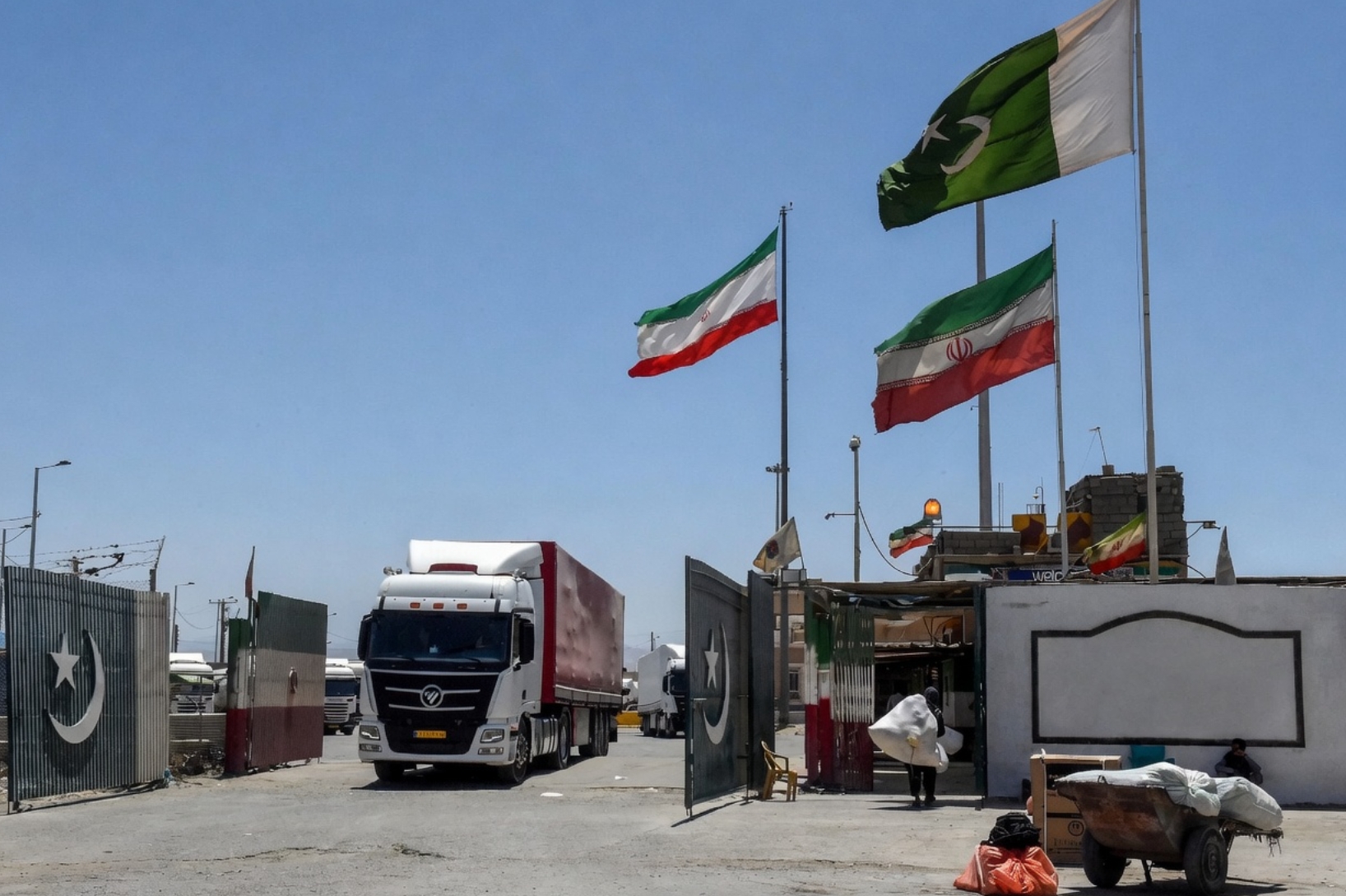
Iranian cargo trucks cross into the Pakistan-Iran border at Taftan, Balochistan province on June 18, 2025, amid the ongoing conflict between Israel and Iran. Pakistan has closed all its border crossings with neighbouring Iran for an indefinite period, provincial officials said on June 16, as Israel and Iran trade intense strikes and threaten further attacks. (Photo by Banaras KHAN / AFP) (Photo by BANARAS KHAN/AFP via Getty Images)
Pakistan is not merely reacting to the current phase of the 2026 Iran war; it is functioning as a system-adjusting intermediary within a rapidly reordering regional landscape. As established channels of diplomacy, trade, and financial coordination have fractured under wartime pressure, Islamabad has emerged as a critical node through which regional and extra-regional actors are progressively rerouting engagement, commerce, and influence.
The “Islamabad process,” the Iran-bound transit corridor, and the evolving Gulf financial realignment point to an emerging order that is less centralized, less maritime-dependent, and increasingly reliant on intermediary states capable of operating across competing alignments. Pakistan sits at the intersection of these shifts and, more decisively, helps structure them.
Pakistan’s Emergence as Lead Mediator
In the early weeks of the Iran war, few observers would have anticipated Pakistan’s emergence as a diplomatic bridge in the most consequential Middle Eastern crisis in a generation. Yet by early April, Islamabad had positioned itself as the principal conduit between Washington and Tehran. The ceasefire announcement of April 8, delivered by Prime Minister Shehbaz Sharif, and the subsequent hosting of direct U.S.–Iranian talks on Pakistani soil marked a significant departure from established diplomatic channels.
This outcome was not simply a function of Pakistani diplomatic agility, but of realignment within a system experiencing growing coordination breakdown. Pakistan’s suitability as an intermediary derives from a convergence of attributes that have become newly salient in contexts of high-intensity conflict, namely strategic ambiguity (its ability to maintain functional ties across rival alignments), cross-bloc embeddedness (its simultaneous connectivity to competing regional systems), and relative expendability (its limited centrality to any single strategic architecture).
Unlike European actors constrained by alliance commitments, or Gulf states divided by intra-regional rivalries and competing security partnerships, Pakistan is sufficiently connected to all relevant parties to maintain credibility, yet not so central to any single alignment that engagement through it imposes prohibitive strategic costs.
The decisive condition was the simultaneous erosion of alternative intermediaries. European states were constrained by transatlantic alignment pressures that limited diplomatic autonomy. Gulf actors were internally divided, with competing security calculations undermining collective brokerage capacity. Multilateral forums lacked both operational agility and trust among principal belligerents. The result was not the disappearance of diplomacy, but a narrowing of viable conduits capable of sustaining engagement.
Pakistan entered this space not as a neutral broker in the classical sense, but as a multi-access interlocutor embedded across competing strategic spheres. Its security relationship with the United States, longstanding defense ties with Saudi Arabia, and historically functional—if strained—channels with Iran allowed it to maintain simultaneous lines of communication where others could not. This positioning enabled Islamabad not merely to transmit messages, but to shape the architecture of engagement itself.
Crucially, Pakistan’s role extended beyond facilitation into procedural structuring. By influencing sequencing, framing, and tempo, it shaped the diplomatic environment in which negotiations occurred. The Islamabad Talks of April 11–12, though ultimately inconclusive, demonstrated that even amid kinetic escalation, controlled engagement could be sustained through an intermediary capable of absorbing reputational and political risk. Iran’s subsequent indication that it would engage “in Pakistan and nowhere else” underscored the consolidation of trust within a system otherwise marked by diplomatic dislocation.
As direct channels between primary adversaries became politically and operationally untenable, both sides have begun to rely on an intermediary capable of sustaining limited diplomatic continuity amid instability. Pakistan has emerged as a facilitating actor in this context, absorbing elements of crisis communication in the absence of direct engagement. Rather than reflecting a settled institutional role, this remains an early-stage and potentially contingent form of mediation shaped by immediate constraints in the conflict environment.
Regional interactions are increasingly mediated by states positioned at the intersection of rival systems rather than exclusively through hierarchical coordination or formal multilateral mechanisms. In this sense, Pakistan’s significance is defined less by material scale than by its positional capacity to stabilize interaction across otherwise fragmented political blocs.
The Trade Corridor
A parallel adaptation has unfolded in the economic domain, where the activation of six overland transit routes linking Pakistan’s ports to Iranian border crossings reflects far more than a logistical workaround to wartime disruption. It signals an incremental reconfiguration of regional trade geography under conditions of coercion and exposure. U.S. naval operations around Iranian ports announced April 13, alongside escalating insecurity in the Strait of Hormuz, have exposed the fragility of maritime centrality as an organizing principle of regional commerce. War-risk insurance premiums have surged and large numbers of vessels were left stranded across regional ports and anchorages. The immediate priority was continuity of trade flows.
What distinguishes this adjustment is a shift in how trade routes are evaluated. In stable conditions, maritime transport dominates on efficiency, scale, and reliability. In less stable environments, risk recalibrates that logic, placing greater weight on diversification and redundancy. The Iran-bound corridor reflects this shift, not as a substitute for maritime trade but as an expansion of viable routing options within regional logistics planning. The Gwadar–Gabd route, in particular, can in some cases shorten transit times while reducing exposure to maritime risk, reinforcing its utility as a supplementary pathway.
The economic rationale for Pakistan is equally compelling. With its Afghan border crossings (Torkham, Chaman) closed since the October 2025 hostilities, and its Indian border long sealed, Iran has become its only meaningful overland outlet. Islamabad’s objective is less to facilitate third-country flows than to regularize channels for its own exports, while opening a potential corridor toward otherwise inaccessible Central Asian markets. The result is a dual function, immediate trade relief coupled with a longer-term effort to position Pakistan as a regional logistics hub.
Within this evolving configuration, Pakistan’s territory is no longer simply a transit space for goods, but increasingly part of planning frameworks that weigh cost, risk, and reliability across multiple pathways. It functions less as a passive corridor than as an intermediary within supply-chain decision-making, where political and security considerations are integrated alongside commercial logic.
This adjustment is reinforced by the convergence of multiple external actors on Pakistan’s geography. Iran seeks overland access under conditions of maritime constraint, China advances a hedge against chokepoint exposure through Gwadar and CPEC, and third-country exporters respond to rising insurance costs and heightened risk across Gulf shipping lanes. The corridor thus operates less as a bilateral route than as a shared space of logistical adaptation shaped by overlapping constraints.
Within this configuration, Pakistan occupies a central but bounded role. Its territory links South Asia and West Asia and, to a more limited extent, Central Asia, while supporting additional routes that coexist with established maritime networks. The key dynamic is not substitution but redundancy, with multiple pathways emerging as safeguards against disruption.
More broadly, connectivity is no longer shaped solely by efficiency and cost, but also by reliability and exposure to political risk. Pakistan’s role therefore extends beyond facilitating transit to influencing the conditions under which alternative routes are activated. Regional connectivity is becoming more layered, with multiple pathways coexisting and being selectively utilized depending on prevailing constraints.
The Gulf Fracture and Financial Statecraft
Pakistan’s position in the Gulf financial space has become more deeply entangled with shifting patterns of regional alignment and financial statecraft. As direct channels between key external actors have become more constrained by geopolitical fragmentation, financial flows have acquired an indirect signaling function, with liquidity support, withdrawals, and rollover decisions more frequently interpreted through a strategic lens.
Emirati influence over Pakistan’s financial space was already established, but the abrupt withdrawal of liquidity support was widely read as a signal of political displeasure and a means of exerting pressure over Islamabad’s regional positioning. Saudi Arabia’s rapid response through fresh deposits and the extension of existing support was both stabilizing and likely aimed at consolidating influence amid shifting Gulf alignments. Rather than reflecting coordinated Gulf behavior, these moves underscore a more fragmented environment in which financial instruments are used to manage influence and shape perceptions under conditions of uncertainty.
As direct channels between primary actors became constrained, financial intermediaries and aligned states began absorbing limited coordination functions, sustaining continuity amid instability. Pakistan has emerged as a facilitating node in this process, managing financial stress and external expectations in the absence of direct engagement. This remains an early-stage and contingent development, driven more by liquidity pressures and geopolitical positioning than by any settled institutional role.
Financial interactions are increasingly routed through states positioned at the intersection of overlapping geopolitical and economic systems rather than through formal multilateral or hierarchical mechanisms. Pakistan’s significance lies less in material scale than in its capacity to absorb shocks, manage external expectations, and stabilize interaction across otherwise divided political blocs.
The China Dimension
China’s role in these developments is both understated and central. Through CPEC, Beijing has long envisioned Pakistan as a critical node in its broader connectivity strategy. The activation of the Iran-bound corridor provides that vision with its most concrete operational expression to date. In this sense, the corridor contributes to the gradual emergence of parallel economic infrastructures that operate with reduced exposure to U.S.-centered maritime and financial systems. While still partial and contingent, this reflects a broader trend in which major powers are progressively competing not only within a shared system but over the design of alternative systems themselves.
Infrastructure thus becomes geopolitical not only in placement but in systemic function: it determines which constraints — naval, financial, regulatory — are operative. The China–Pakistan corridor therefore functions as an experimental space for testing post-maritime connectivity under conditions of systemic stress. By linking Gwadar to Iranian markets, the corridor enhances the strategic utility of Chinese infrastructure while deepening Pakistan’s embedding within China’s regional architecture. The relationship is best understood as symbiotic, generating a connectivity framework that operates alongside, rather than in place of, existing systems.
A central question is whether Pakistan’s actions are primarily reactive or whether they constitute a form of agenda-setting. What begins as contingency gradually hardens into a durable pattern through repeated use and institutional reliance. Pakistan is therefore crossing the threshold from reactive adaptation to constrained agenda-setting. The Islamabad process, the transit corridor, and the evolving financial alignments are becoming embedded structures that other actors now factor into their own calculations. Reactive behavior absorbs shocks; agenda-shaping behavior reorganizes systems. Pakistan’s trajectory reflects movement along this continuum.
Risks, Constraints, and Structural Paradox
The durability of Pakistan’s position is far from assured. Security challenges in Balochistan threaten corridor viability. Diplomatic friction with Washington could intensify if the corridor is perceived as undermining U.S. pressure on Iran. Economic fragility, reflected in dependence on IMF support and external financing, limits strategic autonomy. These vulnerabilities highlight a central paradox, namely that intermediary power is inherently opportunity-dependent rather than capability-independent.
The same conditions that elevate intermediaries — systemic stress and uncertainty — also constrain their ability to consolidate gains. Influence expands rapidly under disruption but remains difficult to institutionalize into durable hierarchy. Moreover, these adaptations remain contingent on the trajectory of the Iran war. De-escalation could reduce demand for alternative corridors and mediation structures, while escalation could increase Pakistan’s exposure without guaranteeing proportional gains.
Taken together, Pakistan’s mediation efforts, trade corridor, and financial realignment illustrate how regional order is being reassembled under conditions of systemic stress. Traditional anchors — U.S. primacy, maritime centrality, and cohesive Gulf coordination — are weakening, giving rise to more decentralized systems defined by redundancy, flexibility, and cross-alignment connectivity.
Pakistan’s trajectory illustrates a broader shift in how power operates under conditions of systemic stress. Influence no longer derives solely from material capabilities or formal alliances, but from positional intermediation—the capacity to connect fragmented systems of diplomacy, logistics, and finance. Whether this represents a transient wartime configuration or the early formation of a more durable pluralized order remains uncertain. What is clear is that systemic stress is not simply weakening order. It is actively reshaping the mechanisms through which order is produced.
is an assistant professor in the School of Public Affairs at American University and non-resident senior fellow at the Middle East Institute.
Pakistan is not merely reacting to the current phase of the 2026 Iran war; it is functioning as a system-adjusting intermediary within a rapidly reordering regional landscape. As established channels of diplomacy, trade, and financial coordination have fractured under wartime pressure, Islamabad has emerged as a critical node through which regional and extra-regional actors are progressively rerouting engagement, commerce, and influence.
The “Islamabad process,” the Iran-bound transit corridor, and the evolving Gulf financial realignment point to an emerging order that is less centralized, less maritime-dependent, and increasingly reliant on intermediary states capable of operating across competing alignments. Pakistan sits at the intersection of these shifts and, more decisively, helps structure them.
Pakistan’s Emergence as Lead Mediator
In the early weeks of the Iran war, few observers would have anticipated Pakistan’s emergence as a diplomatic bridge in the most consequential Middle Eastern crisis in a generation. Yet by early April, Islamabad had positioned itself as the principal conduit between Washington and Tehran. The ceasefire announcement of April 8, delivered by Prime Minister Shehbaz Sharif, and the subsequent hosting of direct U.S.–Iranian talks on Pakistani soil marked a significant departure from established diplomatic channels.
This outcome was not simply a function of Pakistani diplomatic agility, but of realignment within a system experiencing growing coordination breakdown. Pakistan’s suitability as an intermediary derives from a convergence of attributes that have become newly salient in contexts of high-intensity conflict, namely strategic ambiguity (its ability to maintain functional ties across rival alignments), cross-bloc embeddedness (its simultaneous connectivity to competing regional systems), and relative expendability (its limited centrality to any single strategic architecture).
Unlike European actors constrained by alliance commitments, or Gulf states divided by intra-regional rivalries and competing security partnerships, Pakistan is sufficiently connected to all relevant parties to maintain credibility, yet not so central to any single alignment that engagement through it imposes prohibitive strategic costs.
The decisive condition was the simultaneous erosion of alternative intermediaries. European states were constrained by transatlantic alignment pressures that limited diplomatic autonomy. Gulf actors were internally divided, with competing security calculations undermining collective brokerage capacity. Multilateral forums lacked both operational agility and trust among principal belligerents. The result was not the disappearance of diplomacy, but a narrowing of viable conduits capable of sustaining engagement.
Pakistan entered this space not as a neutral broker in the classical sense, but as a multi-access interlocutor embedded across competing strategic spheres. Its security relationship with the United States, longstanding defense ties with Saudi Arabia, and historically functional—if strained—channels with Iran allowed it to maintain simultaneous lines of communication where others could not. This positioning enabled Islamabad not merely to transmit messages, but to shape the architecture of engagement itself.
Crucially, Pakistan’s role extended beyond facilitation into procedural structuring. By influencing sequencing, framing, and tempo, it shaped the diplomatic environment in which negotiations occurred. The Islamabad Talks of April 11–12, though ultimately inconclusive, demonstrated that even amid kinetic escalation, controlled engagement could be sustained through an intermediary capable of absorbing reputational and political risk. Iran’s subsequent indication that it would engage “in Pakistan and nowhere else” underscored the consolidation of trust within a system otherwise marked by diplomatic dislocation.
As direct channels between primary adversaries became politically and operationally untenable, both sides have begun to rely on an intermediary capable of sustaining limited diplomatic continuity amid instability. Pakistan has emerged as a facilitating actor in this context, absorbing elements of crisis communication in the absence of direct engagement. Rather than reflecting a settled institutional role, this remains an early-stage and potentially contingent form of mediation shaped by immediate constraints in the conflict environment.
Regional interactions are increasingly mediated by states positioned at the intersection of rival systems rather than exclusively through hierarchical coordination or formal multilateral mechanisms. In this sense, Pakistan’s significance is defined less by material scale than by its positional capacity to stabilize interaction across otherwise fragmented political blocs.
The Trade Corridor
A parallel adaptation has unfolded in the economic domain, where the activation of six overland transit routes linking Pakistan’s ports to Iranian border crossings reflects far more than a logistical workaround to wartime disruption. It signals an incremental reconfiguration of regional trade geography under conditions of coercion and exposure. U.S. naval operations around Iranian ports announced April 13, alongside escalating insecurity in the Strait of Hormuz, have exposed the fragility of maritime centrality as an organizing principle of regional commerce. War-risk insurance premiums have surged and large numbers of vessels were left stranded across regional ports and anchorages. The immediate priority was continuity of trade flows.
What distinguishes this adjustment is a shift in how trade routes are evaluated. In stable conditions, maritime transport dominates on efficiency, scale, and reliability. In less stable environments, risk recalibrates that logic, placing greater weight on diversification and redundancy. The Iran-bound corridor reflects this shift, not as a substitute for maritime trade but as an expansion of viable routing options within regional logistics planning. The Gwadar–Gabd route, in particular, can in some cases shorten transit times while reducing exposure to maritime risk, reinforcing its utility as a supplementary pathway.
The economic rationale for Pakistan is equally compelling. With its Afghan border crossings (Torkham, Chaman) closed since the October 2025 hostilities, and its Indian border long sealed, Iran has become its only meaningful overland outlet. Islamabad’s objective is less to facilitate third-country flows than to regularize channels for its own exports, while opening a potential corridor toward otherwise inaccessible Central Asian markets. The result is a dual function, immediate trade relief coupled with a longer-term effort to position Pakistan as a regional logistics hub.
Within this evolving configuration, Pakistan’s territory is no longer simply a transit space for goods, but increasingly part of planning frameworks that weigh cost, risk, and reliability across multiple pathways. It functions less as a passive corridor than as an intermediary within supply-chain decision-making, where political and security considerations are integrated alongside commercial logic.
This adjustment is reinforced by the convergence of multiple external actors on Pakistan’s geography. Iran seeks overland access under conditions of maritime constraint, China advances a hedge against chokepoint exposure through Gwadar and CPEC, and third-country exporters respond to rising insurance costs and heightened risk across Gulf shipping lanes. The corridor thus operates less as a bilateral route than as a shared space of logistical adaptation shaped by overlapping constraints.
Within this configuration, Pakistan occupies a central but bounded role. Its territory links South Asia and West Asia and, to a more limited extent, Central Asia, while supporting additional routes that coexist with established maritime networks. The key dynamic is not substitution but redundancy, with multiple pathways emerging as safeguards against disruption.
More broadly, connectivity is no longer shaped solely by efficiency and cost, but also by reliability and exposure to political risk. Pakistan’s role therefore extends beyond facilitating transit to influencing the conditions under which alternative routes are activated. Regional connectivity is becoming more layered, with multiple pathways coexisting and being selectively utilized depending on prevailing constraints.
The Gulf Fracture and Financial Statecraft
Pakistan’s position in the Gulf financial space has become more deeply entangled with shifting patterns of regional alignment and financial statecraft. As direct channels between key external actors have become more constrained by geopolitical fragmentation, financial flows have acquired an indirect signaling function, with liquidity support, withdrawals, and rollover decisions more frequently interpreted through a strategic lens.
Emirati influence over Pakistan’s financial space was already established, but the abrupt withdrawal of liquidity support was widely read as a signal of political displeasure and a means of exerting pressure over Islamabad’s regional positioning. Saudi Arabia’s rapid response through fresh deposits and the extension of existing support was both stabilizing and likely aimed at consolidating influence amid shifting Gulf alignments. Rather than reflecting coordinated Gulf behavior, these moves underscore a more fragmented environment in which financial instruments are used to manage influence and shape perceptions under conditions of uncertainty.
As direct channels between primary actors became constrained, financial intermediaries and aligned states began absorbing limited coordination functions, sustaining continuity amid instability. Pakistan has emerged as a facilitating node in this process, managing financial stress and external expectations in the absence of direct engagement. This remains an early-stage and contingent development, driven more by liquidity pressures and geopolitical positioning than by any settled institutional role.
Financial interactions are increasingly routed through states positioned at the intersection of overlapping geopolitical and economic systems rather than through formal multilateral or hierarchical mechanisms. Pakistan’s significance lies less in material scale than in its capacity to absorb shocks, manage external expectations, and stabilize interaction across otherwise divided political blocs.
The China Dimension
China’s role in these developments is both understated and central. Through CPEC, Beijing has long envisioned Pakistan as a critical node in its broader connectivity strategy. The activation of the Iran-bound corridor provides that vision with its most concrete operational expression to date. In this sense, the corridor contributes to the gradual emergence of parallel economic infrastructures that operate with reduced exposure to U.S.-centered maritime and financial systems. While still partial and contingent, this reflects a broader trend in which major powers are progressively competing not only within a shared system but over the design of alternative systems themselves.
Infrastructure thus becomes geopolitical not only in placement but in systemic function: it determines which constraints — naval, financial, regulatory — are operative. The China–Pakistan corridor therefore functions as an experimental space for testing post-maritime connectivity under conditions of systemic stress. By linking Gwadar to Iranian markets, the corridor enhances the strategic utility of Chinese infrastructure while deepening Pakistan’s embedding within China’s regional architecture. The relationship is best understood as symbiotic, generating a connectivity framework that operates alongside, rather than in place of, existing systems.
A central question is whether Pakistan’s actions are primarily reactive or whether they constitute a form of agenda-setting. What begins as contingency gradually hardens into a durable pattern through repeated use and institutional reliance. Pakistan is therefore crossing the threshold from reactive adaptation to constrained agenda-setting. The Islamabad process, the transit corridor, and the evolving financial alignments are becoming embedded structures that other actors now factor into their own calculations. Reactive behavior absorbs shocks; agenda-shaping behavior reorganizes systems. Pakistan’s trajectory reflects movement along this continuum.
Risks, Constraints, and Structural Paradox
The durability of Pakistan’s position is far from assured. Security challenges in Balochistan threaten corridor viability. Diplomatic friction with Washington could intensify if the corridor is perceived as undermining U.S. pressure on Iran. Economic fragility, reflected in dependence on IMF support and external financing, limits strategic autonomy. These vulnerabilities highlight a central paradox, namely that intermediary power is inherently opportunity-dependent rather than capability-independent.
The same conditions that elevate intermediaries — systemic stress and uncertainty — also constrain their ability to consolidate gains. Influence expands rapidly under disruption but remains difficult to institutionalize into durable hierarchy. Moreover, these adaptations remain contingent on the trajectory of the Iran war. De-escalation could reduce demand for alternative corridors and mediation structures, while escalation could increase Pakistan’s exposure without guaranteeing proportional gains.
Taken together, Pakistan’s mediation efforts, trade corridor, and financial realignment illustrate how regional order is being reassembled under conditions of systemic stress. Traditional anchors — U.S. primacy, maritime centrality, and cohesive Gulf coordination — are weakening, giving rise to more decentralized systems defined by redundancy, flexibility, and cross-alignment connectivity.
Pakistan’s trajectory illustrates a broader shift in how power operates under conditions of systemic stress. Influence no longer derives solely from material capabilities or formal alliances, but from positional intermediation—the capacity to connect fragmented systems of diplomacy, logistics, and finance. Whether this represents a transient wartime configuration or the early formation of a more durable pluralized order remains uncertain. What is clear is that systemic stress is not simply weakening order. It is actively reshaping the mechanisms through which order is produced.
is an assistant professor in the School of Public Affairs at American University and non-resident senior fellow at the Middle East Institute.
Recommended
U.S. Foreign Policy as a Debate Without End
Why Winning the Battle May Be Losing the War

The Empire That Fights to Exist
The Last Ayatollah

A Hamiltonian Approach to Power and Foreign Policy