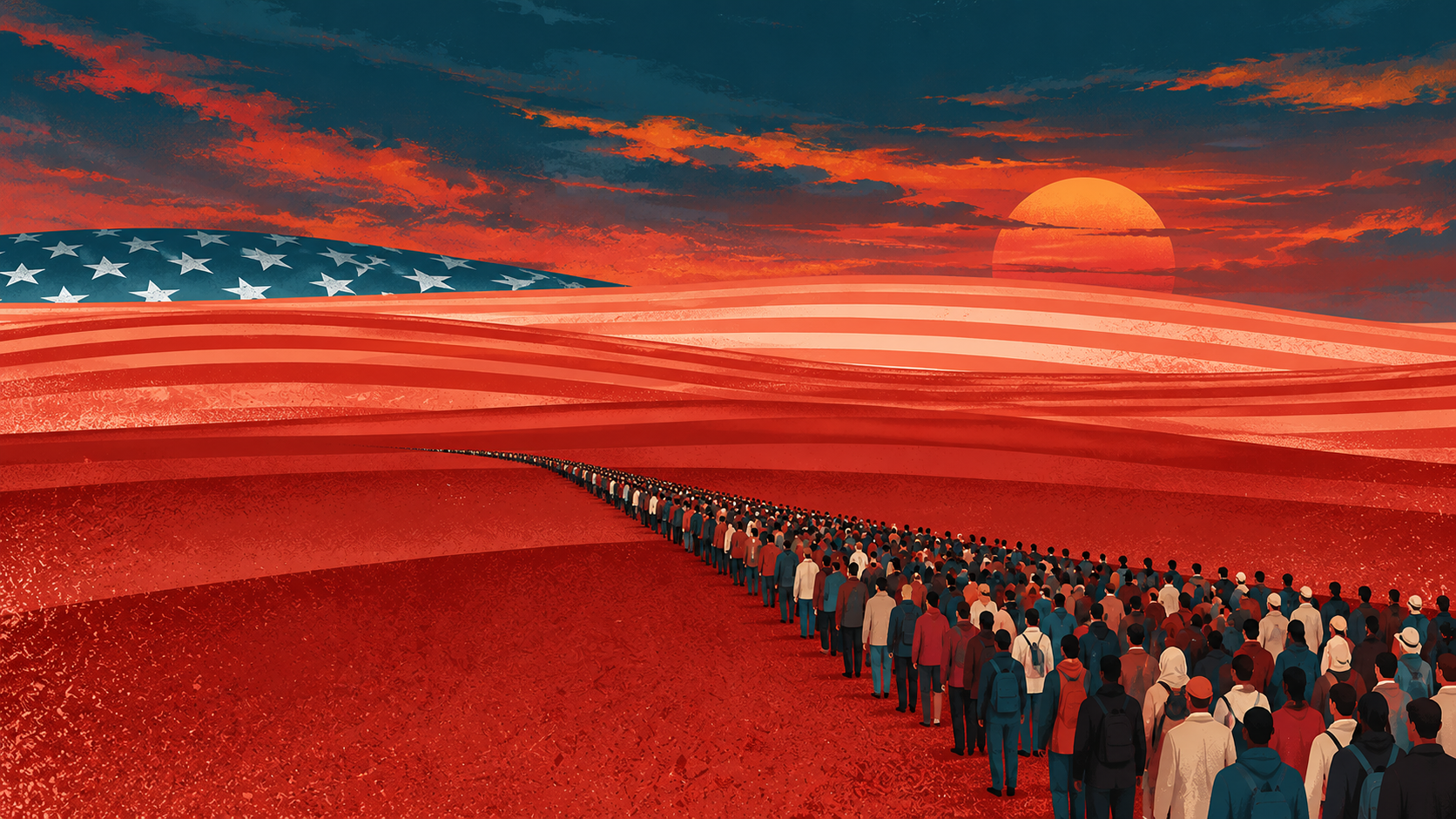


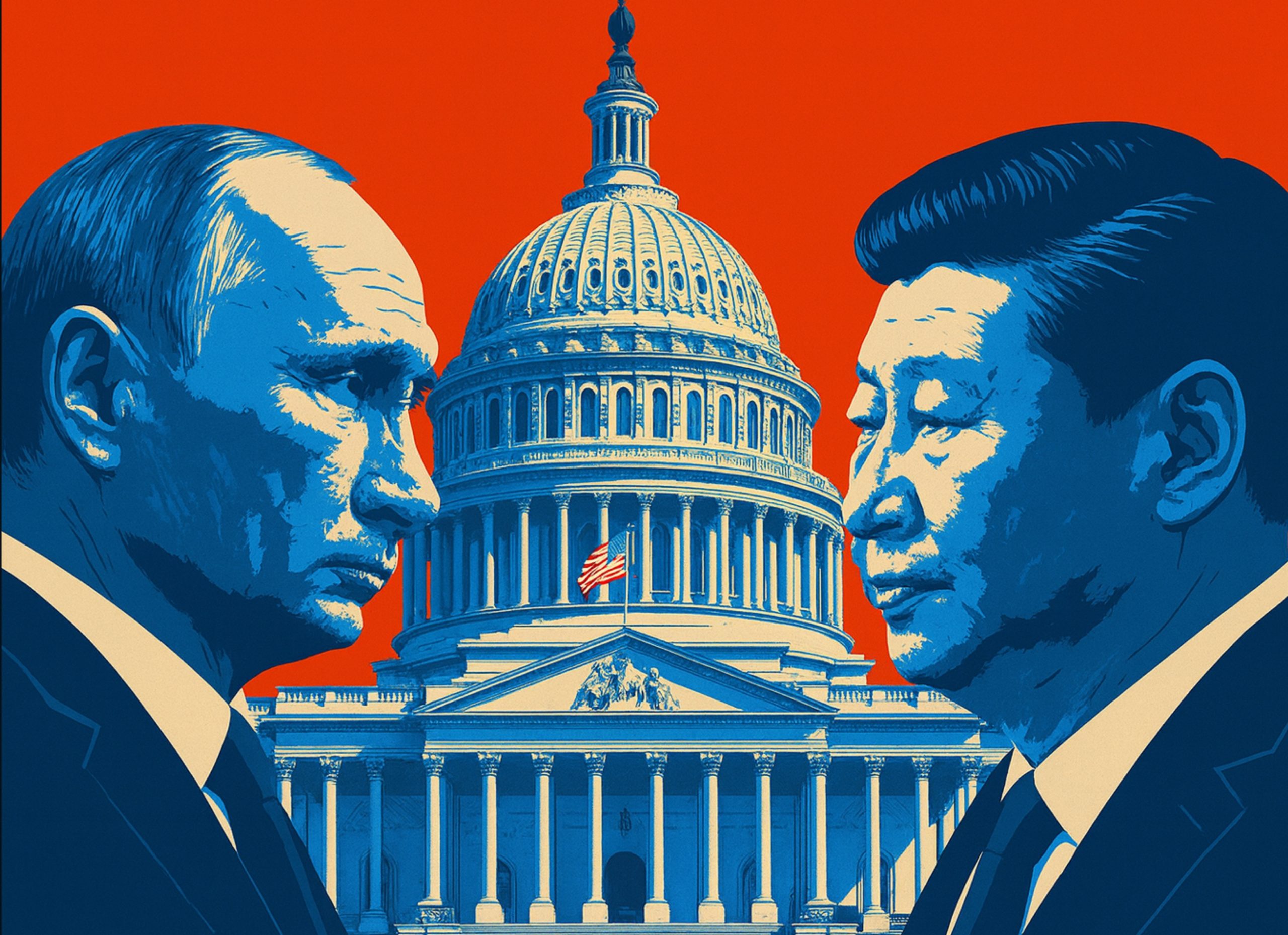
This illustration has been created by AI to useonly in this article.
No issue has defined the United States as a body politic like migration. From—and even before—its origins as a nation of immigrants, America has constantly asked itself who has the right to stake a claim to this country. At times, this questioning has taken the form of overtly racist laws and policies, while at others, it has been remarkably open to strangers. This article aims to shed light on some of the less well-known parts of this story: how controls on migration have altered and continue to alter the balances of power, both at home and abroad.
For as long as America has existed, it has been anxious about who could lay a claim to its land and rights. In a missive that is humorous in retrospect, Benjamin Franklin, one of the first and most prominent figures to encourage the people of the Thirteen Colonies to see themselves not only as British subjects or residents of their particular colony but as members of a greater American community, wrote despairingly of the number of German and Dutch immigrants coming to his province of Pennsylvania. As part of a larger book, he complained, “Why should Pennsylvania, founded by the English, become a colony of Aliens, who will shortly be so numerous as to Germanize us instead of our Anglifying them, and will never adopt our language or customs, any more than they can acquire our complexion?”
Indeed, he noted that the total proportion of white people in the world was quite small, emphasizing that “in Europe, the Spaniards, Italians, French, Russians and Swedes are generally of what we call a swarthy complexion; as are the Germans also, the Saxons only excepted, who with the English make the principal body of white people on the face of the earth.” That was 1755. The United States would not declare its independence for another 21 years, and already there were fears of America becoming demographically altered, becoming less white—with Germans, now universally considered white, to blame.
The question of migration played a key role in American nationhood. The Declaration of Independence, in its list of complaints against King George, charges that “He has endeavoured to prevent the population of these States; for that purpose obstructing the Laws for Naturalization of Foreigners; refusing to pass others to encourage their migrations hither,” suggesting that while the revolution was based in large part on the Crown’s and Parliament’s denial of the political rights of Englishmen, the architects of independence believed that it should be easier than it was to become an Englishman, at least in the eyes of the law.
And yet one of the first laws passed by the First Congress, the Naturalization Act of 1790, did not shy away from incorporating racial preferences. That law allowed any “free white person … of good character” to become a U.S. citizen after residing in the country for only two years, with minimal scrutiny; in fact, all they had to do was apply for naturalization in any court and take the requisite oath. This was, of course, a deliberate choice to exclude all who were not white from eligibility to naturalize, regardless of character. But early on, it became apparent that not even all white Europeans would be accepted into the fold, and that this often took overtly geopolitical forms. During what became known as the Quasi-War with France, the Adams administration developed a set of parallel fears: one of Americans becoming unfaithful to constitutional democracy (and to the Federalist Party), and the other of foreign, usually French, agitators spreading dangerous ideas under the guise of free speech. Hence the package of laws that became the Alien and Sedition Acts.
As most relevant here, the Alien Friends Act allowed the president to declare specific foreigners to be persona non grata in the United States and order their departure from the country, while the Alien Enemies Act allowed the government to collectively expel male citizens of foreign countries designated as hostile to the U.S., and the Naturalization Act of 1798 increased from 5 to 14 years the amount of time before which a foreigner could be naturalized as a U.S. citizen. Although the Alien Friends Act was not invoked against anyone before it expired according to its own terms, it did have the effect of coercing French ideologues to leave the country in anticipation of proceedings being brought against them. The Naturalization Act went further and tied American migration policy to national security and international relations.
is a recent graduate of the University of Chicago, where he received an MA in International Relations. His research interests focus on global commodity chains and migration, the two great cross-border issues.
No issue has defined the United States as a body politic like migration. From—and even before—its origins as a nation of immigrants, America has constantly asked itself who has the right to stake a claim to this country. At times, this questioning has taken the form of overtly racist laws and policies, while at others, it has been remarkably open to strangers. This article aims to shed light on some of the less well-known parts of this story: how controls on migration have altered and continue to alter the balances of power, both at home and abroad.
For as long as America has existed, it has been anxious about who could lay a claim to its land and rights. In a missive that is humorous in retrospect, Benjamin Franklin, one of the first and most prominent figures to encourage the people of the Thirteen Colonies to see themselves not only as British subjects or residents of their particular colony but as members of a greater American community, wrote despairingly of the number of German and Dutch immigrants coming to his province of Pennsylvania. As part of a larger book, he complained, “Why should Pennsylvania, founded by the English, become a colony of Aliens, who will shortly be so numerous as to Germanize us instead of our Anglifying them, and will never adopt our language or customs, any more than they can acquire our complexion?”
Indeed, he noted that the total proportion of white people in the world was quite small, emphasizing that “in Europe, the Spaniards, Italians, French, Russians and Swedes are generally of what we call a swarthy complexion; as are the Germans also, the Saxons only excepted, who with the English make the principal body of white people on the face of the earth.” That was 1755. The United States would not declare its independence for another 21 years, and already there were fears of America becoming demographically altered, becoming less white—with Germans, now universally considered white, to blame.
The question of migration played a key role in American nationhood. The Declaration of Independence, in its list of complaints against King George, charges that “He has endeavoured to prevent the population of these States; for that purpose obstructing the Laws for Naturalization of Foreigners; refusing to pass others to encourage their migrations hither,” suggesting that while the revolution was based in large part on the Crown’s and Parliament’s denial of the political rights of Englishmen, the architects of independence believed that it should be easier than it was to become an Englishman, at least in the eyes of the law.
And yet one of the first laws passed by the First Congress, the Naturalization Act of 1790, did not shy away from incorporating racial preferences. That law allowed any “free white person … of good character” to become a U.S. citizen after residing in the country for only two years, with minimal scrutiny; in fact, all they had to do was apply for naturalization in any court and take the requisite oath. This was, of course, a deliberate choice to exclude all who were not white from eligibility to naturalize, regardless of character. But early on, it became apparent that not even all white Europeans would be accepted into the fold, and that this often took overtly geopolitical forms. During what became known as the Quasi-War with France, the Adams administration developed a set of parallel fears: one of Americans becoming unfaithful to constitutional democracy (and to the Federalist Party), and the other of foreign, usually French, agitators spreading dangerous ideas under the guise of free speech. Hence the package of laws that became the Alien and Sedition Acts.
As most relevant here, the Alien Friends Act allowed the president to declare specific foreigners to be persona non grata in the United States and order their departure from the country, while the Alien Enemies Act allowed the government to collectively expel male citizens of foreign countries designated as hostile to the U.S., and the Naturalization Act of 1798 increased from 5 to 14 years the amount of time before which a foreigner could be naturalized as a U.S. citizen. Although the Alien Friends Act was not invoked against anyone before it expired according to its own terms, it did have the effect of coercing French ideologues to leave the country in anticipation of proceedings being brought against them. The Naturalization Act went further and tied American migration policy to national security and international relations.
is a recent graduate of the University of Chicago, where he received an MA in International Relations. His research interests focus on global commodity chains and migration, the two great cross-border issues.


Because the Adams administration was hostile to revolutionary France and the ideas with which it was associated, the Naturalization Act aimed to make it harder for a person holding those ideas to enter the American body politic and thereby change the makeup of the citizen body. This law represented an early migration restriction based on political ideology and allegiance, and its target was a white, European population. Future such restrictions tended to apply either to specific ideologies associated with Europeans (such as anarchism and socialism) or to racial categories targeted for exclusion at particular times.
After the Civil War, and with Reconstruction sadly in the rearview mirror for the foreseeable future, America faced a renewed pair of crises, one of labor and the other of demographics. The West Coast in particular saw an increase in Chinese migration. In part, this was due to the various crises in China itself, from civil war to drought to general poverty. It was also due to the promise that America offered to working men, from mining and panning for gold to building the railroads that rapidly tied the coasts together to toiling in the factories. At first, this did not seem like a crisis at all, but an opportunity; indeed, many historians note that initial Chinese migrants were well received, especially in areas that were already prospering economically.
But when booms turned to busts and prosperity became scarce, then the migrants who had once been seen as indispensable turned into rivals competing for a slice of a shrinking pie. Unsurprisingly, it was the West Coast that led the national opposition to Chinese immigration and to the integration of Chinese people who had already made the journey. In the years following the Gold Rush, California experimented with imposing occupational taxes on foreign miners, taxing them monthly for operating in the state regardless of their profits. Although the tax was quickly lowered from $20 to $3 per month and failed to scare Chinese immigrants out of California altogether, it did largely drive them out of the mining industry, meaning less competition for white miners, and into lower-profit jobs, especially in restaurants and laundries. This was a one-two punch, in that it both left Chinese immigrants generally poorer on account of their reduced earning potential and fed into propaganda efforts depicting them as an essentially undifferentiated mass good only for menial work. (And when Chinese residents did find success in these jobs, exemplified by the large number of Chinese restaurants and laundromats that opened in the San Francisco area, the state and city authorities came up with new ways to stunt this growth, such as forbidding laundromats from being built in wooden buildings, which the U.S. Supreme Court found to be pretextual and discriminatory.)
One of the leading anti-Chinese agitators, who found success at both the state and federal levels, was a businessman and labor organizer named Denis Kearney—himself an immigrant from Ireland. Kearney, who saw the arrival of more and more Chinese migrants as a threat to both the bargaining power of white laborers and the identity of America as a white nation, found success when an unexpected partner agreed with him—China itself. In the 1850s, the Chinese emperor supported restrictions on migration by Chinese subjects, fearing a loss of productive workers at a time when the country was in strife. Thus, while California continued to pass laws targeting the Chinese (including one which explicitly banned their entry, before that was ruled invalid by the state courts), this did not lead to tensions at the international level. But when the U.S. and China, in the Burlingame Treaty of 1868, agreed to allow Chinese subjects to come to the U.S. with virtually no restrictions, this represented a threat to the West Coast nativist movement’s hold on local politics. Here was Washington, situated politically as well as geographically on the East Coast, guaranteeing to allow Chinese subjects (in Article VI of the treaty) the same rights of travel and residence as were enjoyed by citizens of more favored European nations, something that would potentially override state discriminatory laws. In effect, this treaty, with respect to migration, represented a conscious attempt by the federal government to reassert control over the border and ensure that it was used in the national interest, as so judged, rather than the local interests of nativist factions.
But when the nativists took over at the federal level, the balance of power shifted. Essentially, following incidents of labor unrest in the early 1870s, public opinion shifted towards restricting Chinese migration, in effect transforming the West Coast from an outlier to the vanguard. In 1875, Congress passed the Page Act, which combined measures targeting immigrants by attribute (prohibiting individuals with criminal records in their own country from entering the U.S.) with measures specifically targeting Asians, especially women. Three years later, Congress moved to ban Chinese immigration altogether, failing only on account of the veto pen wielded by President Rutherford Hayes. Come 1882 and the winds had changed. Congress tried again, and this time succeeded in enacting the Chinese Exclusion Act, whose title left little to the imagination.
This law banned the entry of most Chinese laborers into the U.S. for a period of 10 years (later extended to 20, which had been the initial plan, and then made permanent) and excluded people of Chinese origin from becoming naturalized as U.S. citizens. When the Chinese Exclusion Act was made permanent in 1902, it also required all Chinese subjects residing in the U.S. to obtain a formal certificate of residence. For almost four decades, Chinese migrants were treated as a category separate from the others. It was not until 1940 that Congress enacted a general alien registration statute, which covered all noncitizens in the country. And the Chinese Exclusion Act itself remained on the books until 1943, at which point Congress allowed 105 Chinese immigrants to come to the United States every year, in addition to relaxing the ban on their naturalization as U.S. citizens. Further legislation in 1952 and 1965 would do away with national origin quotas altogether.
Because the Adams administration was hostile to revolutionary France and the ideas with which it was associated, the Naturalization Act aimed to make it harder for a person holding those ideas to enter the American body politic and thereby change the makeup of the citizen body. This law represented an early migration restriction based on political ideology and allegiance, and its target was a white, European population. Future such restrictions tended to apply either to specific ideologies associated with Europeans (such as anarchism and socialism) or to racial categories targeted for exclusion at particular times.
After the Civil War, and with Reconstruction sadly in the rearview mirror for the foreseeable future, America faced a renewed pair of crises, one of labor and the other of demographics. The West Coast in particular saw an increase in Chinese migration. In part, this was due to the various crises in China itself, from civil war to drought to general poverty. It was also due to the promise that America offered to working men, from mining and panning for gold to building the railroads that rapidly tied the coasts together to toiling in the factories. At first, this did not seem like a crisis at all, but an opportunity; indeed, many historians note that initial Chinese migrants were well received, especially in areas that were already prospering economically.
But when booms turned to busts and prosperity became scarce, then the migrants who had once been seen as indispensable turned into rivals competing for a slice of a shrinking pie. Unsurprisingly, it was the West Coast that led the national opposition to Chinese immigration and to the integration of Chinese people who had already made the journey. In the years following the Gold Rush, California experimented with imposing occupational taxes on foreign miners, taxing them monthly for operating in the state regardless of their profits. Although the tax was quickly lowered from $20 to $3 per month and failed to scare Chinese immigrants out of California altogether, it did largely drive them out of the mining industry, meaning less competition for white miners, and into lower-profit jobs, especially in restaurants and laundries. This was a one-two punch, in that it both left Chinese immigrants generally poorer on account of their reduced earning potential and fed into propaganda efforts depicting them as an essentially undifferentiated mass good only for menial work. (And when Chinese residents did find success in these jobs, exemplified by the large number of Chinese restaurants and laundromats that opened in the San Francisco area, the state and city authorities came up with new ways to stunt this growth, such as forbidding laundromats from being built in wooden buildings, which the U.S. Supreme Court found to be pretextual and discriminatory.)
One of the leading anti-Chinese agitators, who found success at both the state and federal levels, was a businessman and labor organizer named Denis Kearney—himself an immigrant from Ireland. Kearney, who saw the arrival of more and more Chinese migrants as a threat to both the bargaining power of white laborers and the identity of America as a white nation, found success when an unexpected partner agreed with him—China itself. In the 1850s, the Chinese emperor supported restrictions on migration by Chinese subjects, fearing a loss of productive workers at a time when the country was in strife. Thus, while California continued to pass laws targeting the Chinese (including one which explicitly banned their entry, before that was ruled invalid by the state courts), this did not lead to tensions at the international level. But when the U.S. and China, in the Burlingame Treaty of 1868, agreed to allow Chinese subjects to come to the U.S. with virtually no restrictions, this represented a threat to the West Coast nativist movement’s hold on local politics. Here was Washington, situated politically as well as geographically on the East Coast, guaranteeing to allow Chinese subjects (in Article VI of the treaty) the same rights of travel and residence as were enjoyed by citizens of more favored European nations, something that would potentially override state discriminatory laws. In effect, this treaty, with respect to migration, represented a conscious attempt by the federal government to reassert control over the border and ensure that it was used in the national interest, as so judged, rather than the local interests of nativist factions.
But when the nativists took over at the federal level, the balance of power shifted. Essentially, following incidents of labor unrest in the early 1870s, public opinion shifted towards restricting Chinese migration, in effect transforming the West Coast from an outlier to the vanguard. In 1875, Congress passed the Page Act, which combined measures targeting immigrants by attribute (prohibiting individuals with criminal records in their own country from entering the U.S.) with measures specifically targeting Asians, especially women. Three years later, Congress moved to ban Chinese immigration altogether, failing only on account of the veto pen wielded by President Rutherford Hayes. Come 1882 and the winds had changed. Congress tried again, and this time succeeded in enacting the Chinese Exclusion Act, whose title left little to the imagination.
This law banned the entry of most Chinese laborers into the U.S. for a period of 10 years (later extended to 20, which had been the initial plan, and then made permanent) and excluded people of Chinese origin from becoming naturalized as U.S. citizens. When the Chinese Exclusion Act was made permanent in 1902, it also required all Chinese subjects residing in the U.S. to obtain a formal certificate of residence. For almost four decades, Chinese migrants were treated as a category separate from the others. It was not until 1940 that Congress enacted a general alien registration statute, which covered all noncitizens in the country. And the Chinese Exclusion Act itself remained on the books until 1943, at which point Congress allowed 105 Chinese immigrants to come to the United States every year, in addition to relaxing the ban on their naturalization as U.S. citizens. Further legislation in 1952 and 1965 would do away with national origin quotas altogether.
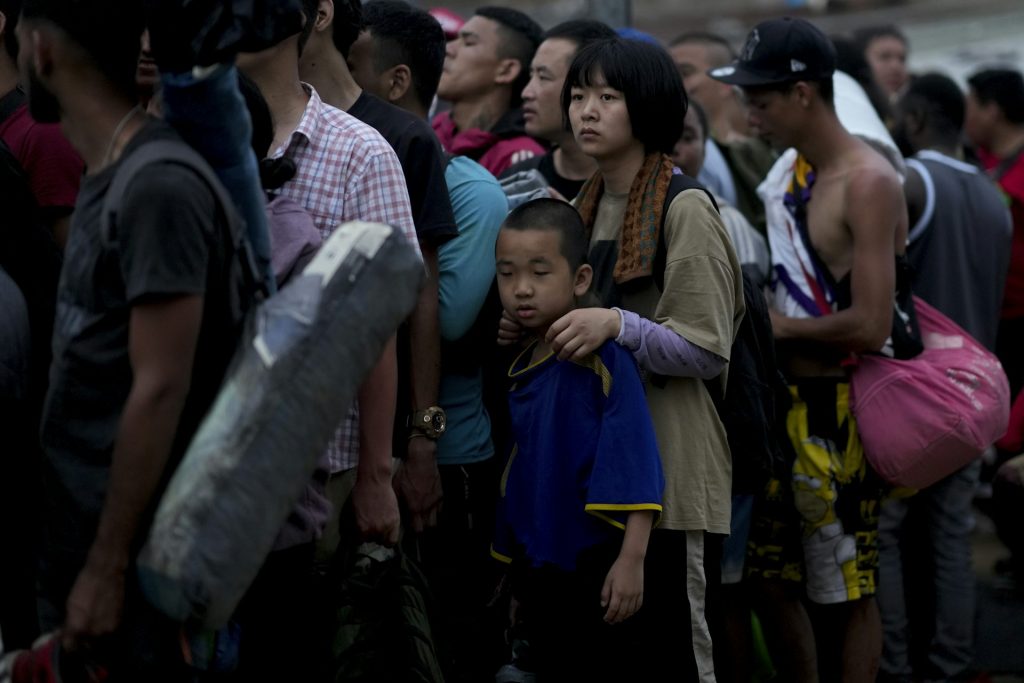
The Chinese exclusion frenzy produced caselaw that strengthened the hand of the executive branch, at the expense of both U.S. relations with foreign countries and the most basic rights of U.S. citizens. In Chae Chan Ping v. United States (1889), the Supreme Court affirmed the power of Congress to enact restrictive immigration laws that violated existing treaty obligations, treating border control as a fundamental attribute of sovereignty that could not be contracted away in any case. And in United States v. Ju Toy (1905), the Supreme Court reached the conclusion that even a U.S.-born citizen could not challenge his exclusion at a port once he returned from an international trip, as the relevant statutes required courts to defer completely to immigration commissioners’ determinations of who was and was not a citizen. (This second ruling was unanimously cabined in Ng Fung Ho v. White (1922), which held that a person whom the government sought to deport under the Chinese Exclusion Act but who claimed to be a U.S. citizen was entitled to a judicial determination of his status, and, if a citizen, to remain in the country.) Much like the French in John Adams’ day were perceived to import radical democracy and moral libertinism, the Chinese in the late nineteenth century were associated with despotism. In both cases, a people across the sea were judged by the U.S. as incompatible with the republican form of government envisioned by the framers.
It can be said that the first major instances of Latin Americans becoming part of the U.S. took place in the early 19th century, when the border quite literally came to them. The Louisiana Purchase in 1803 and the Treaty of Guadalupe Hidalgo at the close of the Mexican-American War in 1848 brought large numbers of Spanish-speaking people into U.S. control. There was a reprise five decades later, in 1898, when the U.S. annexed Puerto Rico following the Spanish-American War, but since then, the two major ways in which the Hispanic population in the U.S. has grown have been through migration and birth in the U.S. Both of those, as we will see, have become major flashpoints, often with deeply racist implications.
The history of the southern border, and of the U.S.’ role as a migrant destination, is shaped in large part by labor. One early example exists as part of the larger story of the California gold rush. In January 1848, prospectors discovered gold, triggering a frenzy that brought people from every corner of the world to the seemingly bountiful lands of California, swelling the population and transforming the character of what would become the new state. One constituency that played an outsized role was the population of Mexicans and Central and South Americans, numbering in the tens of thousands, who came to California post-annexation. In one sense, they had an advantage over other arrivals, in that they spoke Spanish, not to mention that many of them were experienced in mining elsewhere. Even so, they ran into the fact that, despite assurances in laws and treaties that existing land rights would be respected, English-speaking settlers were encroaching on lands held by Spanish and Mexican owners who had chosen to stay, with the acquiescence of the government.
Although the early state of California did not adopt explicitly anti-migrant laws, it did enact heavily discriminatory measures against nonwhite populations writ large, including barring them from testifying in court in many cases. (Predictably, one effect of this, which was certainly not seen as unfortunate to the legislature, was that Hispanic landowners had a harder time defending their legal claims to their land against Anglo challengers. Thus, a domestic court rule both privileged white migrants over nonwhite locals and privileged white locals over nonwhite migrants.)
Despite this fraught beginning, Hispanic immigration to the U.S. only grew in the years after the beginning of the gold rush. Sometimes this took the form of Spanish-speakers from all over the Western Hemisphere moving to the U.S. West and Southwest; other times, particular parts of the U.S. received disproportionate migration from specific countries, such as the large number of Cubans who made their way to Florida. And as the years went on, land routes and geographic proximity gave way to other pathways, such that New York City, Chicago, and other cities became home to large Hispanic populations.
From as early as the gold rush, entire sectors of the U.S. economy came to depend on labor performed by Hispanics, both citizens and noncitizens. And as this happened, the Hispanic population shouldered the burden of being needed but not always wanted, especially in periods of general uncertainty or economic downturn. One striking example is the two periods of “Mexican repatriation,” one of which took place in the decade before the start of World War II (as the Great Depression raged), and the second of which occurred in the years after the end of the war.
In the first two decades of the twentieth century, Mexican immigration to the U.S. was frequent and largely unregulated. A 1921 law imposed more controls, but even those were comparatively ineffectual, especially given the difficulty of policing a large, arid land border at the time, compared to stopping ships at ports in the case of European and Asian migration. This was a trend which was very much appreciated by U.S. business interests, which had a high demand for labor and in fact sought to negotiate directly with the Mexican government to encourage even more migration. And once Mexicans were in the U.S., they settled all over the country, contributing to industrial economies in cities and to agricultural ones in rural areas.
Once the Depression hit, the existing anti-migrant sentiment only picked up force, as large numbers of American workers found themselves unemployed and government agencies sought to minimize the number of beneficiaries receiving public assistance. To that end, the federal government, especially under the Hoover administration (1929–33), worked with state and local governments to coordinate the widespread deportation of Mexican migrants and their families, a process euphemistically termed “repatriation,” as though these were refugees finally able to return home. In many cases, those repatriated did voluntarily make the move, in the hopes of having better luck avoiding the economic impacts of the Depression in Mexico. But the government also used a carrot-and-stick approach to effectuate its goal. The Mexican government, which wished to both grow its own labor force and remain on good terms with the U.S., incentivized people to return to Mexico by offering land for them to farm, an appealing prospect at a time when economic prospects in the U.S. were dire.
Operation Wetback was an intentional beating-down of the social and economic standing of Mexicans and Mexican-Americans.
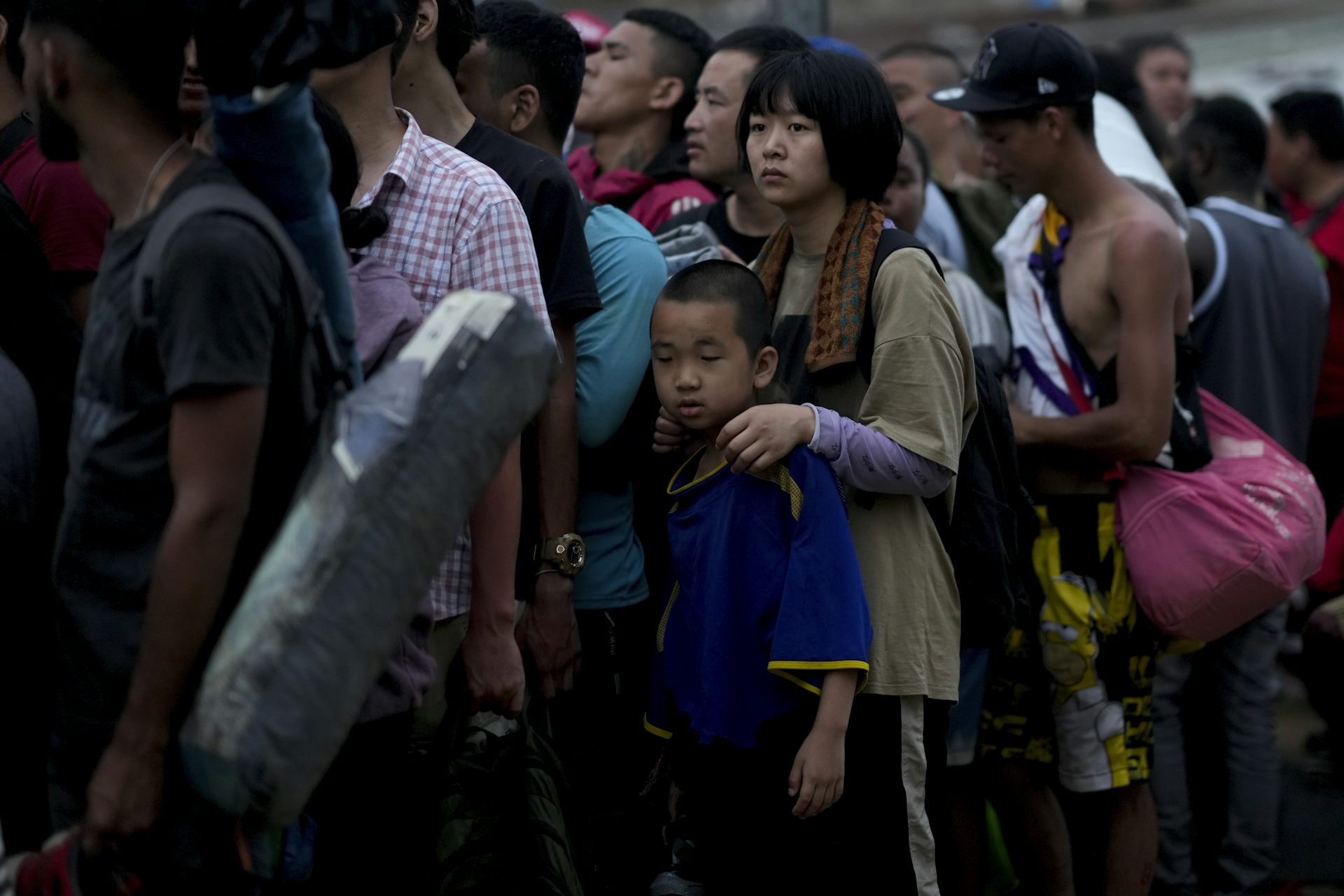
On the flip side, as Kevin R. Johnson describes, there was very much a “forced” aspect to this policy. Perhaps the most glaring indicator of this is that as many as 60% of the people “repatriated”—that is, at least ostensibly returned to their home country—were in fact U.S. citizens. And to the extent that this can be called voluntary, in that U.S. citizens could by that point not be deported against their will, this did not apply to noncitizen parents of American children. So if the government removed all the adults in a Mexican-descended family, but their children were U.S. citizens, then the adults were placed in the terrible position of either leaving their children behind in a country to which they had a legal as well as a moral claim but without anyone to care for them, or taking the children with them and thereby legitimating their effective expulsion. With respect to adults, citizen and noncitizen alike, Francisco E. Balderrama and Raymond Rodríguez describe how local governments, with support from the Hoover administration, conducted mass raids of Mexicans and Mexican-Americans and either removed them by force or offered them free train tickets to the other side of the border.
After World War II, the project of redefining American demographics through mass deportations resumed with full force. The early-to-mid-1950s, under the Eisenhower administration, saw a wave of mass deportations, this time organized by the federal government, given the name Operation Wetback—a racial slur referring to Hispanic immigrants. Once again, citizens as well as noncitizens were removed from the U.S., with the only criterion being Mexican ancestry. But that is only one part of the story. To be sure, deportation alone is significant, especially given the sheer number of people affected. However, not all of those caught up in this operation were, in fact, permanently removed from the U.S., and that is equally important.
The background for this was the Bracero program, established in 1942 by mutual agreement of the governments of the U.S. and Mexico. After the U.S. entered World War II, it quickly found itself with a severe need for agricultural labor, given the number of young men who were going off to war. So it turned south and negotiated with its neighbor (Mexico was also on the side of the Allies, but had far less of a military presence abroad than the U.S.). The two countries agreed to create, more or less on a permanent basis, a scheme by which Mexicans known as braceros would work on U.S. farms for pay that was low by U.S. standards but favorable compared to the cost of living in Mexico. These laborers did not enjoy strong legal protections at all, and were never intended to hold permanent status in the country in which they worked—indeed, bracero refers to their arms, brazos, indicating that their role in the U.S. was purely as a source of muscle. What did Mexico gain by allowing this export of its manual labor? For one, it benefited from sustaining the U.S. economy during wartime, as the U.S. was by that point a strong trading partner. Mexico also benefited from the money that the braceros spent locally or sent back to their families back home, and, more ambitiously, hoped that returning participants would bring home skills that would be useful for Mexico’s own push towards industrialization.
While Operation Wetback is most commonly described as a deportation push, it was more than just that, as Eladio Bobadilla describes for the Gilder Lehrman Institute. For one, not all those swept up were actually deported; many were taken into custody and then “paroled” back to their communities, this time with the requirement that they effectively be supervised by a U.S. farmer. For others who were in fact deported, this was not the end of their story in the U.S.: large numbers were either readmitted as braceros or simply returned without authorization. In both cases, they were once again in the U.S., but with a lower degree of security and far less of an ability to assert their rights in the area of labor and elsewhere. Operation Wetback was an intentional beating-down of the social and economic standing of Mexicans and Mexican-Americans. And it could not have happened, from start to finish to aftereffects, without the active endorsement of the Mexican government and the cooperation between Washington and the Distrito Federal.
As we have seen, the fact that migrants are essential to large swaths of the economy has never protected them from organized anti-immigration sentiment. However, this is complicated by the fact that employers dependent on migrant labor often share political affiliation with nativist voters, something that frequently leads to clashes. Consider the modern history of North Carolina’s poultry industry, a case Steve Striffler discusses in his book Chicken. Beginning in the 1990s, North Carolina became a destination for Central American migrants, often fleeing civil war or persecution, who found work in the area’s chicken processing plants. This influx was in effect a godsend for the region, which, like so much of the country, was undergoing contractions from deindustrialization and population loss. Indeed, at least at the beginning, migrants generally described getting along well with the locals, even more so than they had expected. But changing demographics often lead to discord, and chicken country soon attracted a wave of resentment of Hispanic residents, stirred up in large part by Klan leader David Duke.
Duke tapped into two sources of discontentment, one local and one national. In this part of North Carolina specifically, the proportion of students in the local schools who spoke English as a second language was increasing, which alarmed many English-speaking residents. And all of this took place in the context of the broader immigration debate, as successive presidents had sought to toughen up the border. To someone like Duke, given these conditions, it was easy to turn this part of the country into the staging ground for anti-immigrant demonstrations, which, perhaps, would have the effect of making racial purity politics acceptable once again after the success of the civil rights movement a generation prior. One must not read too much into cases like these and reach the conclusion that all opinions on one side of the immigration debate are racist, let alone tools of the Klan. But the story of North Carolina in the ‘90s, in the context of globalization woes, illustrates how even communities which depend on migrants for their labor and which see themselves transformed by their presence can come to adopt or accept strong anti-migrant hostility. That is not a new phenomenon.
One factor that complicates the involvement of migration policy in U.S. electoral politics is that voters are, by definition, citizens, while those coming to the U.S. are not. Thus, anyone running for office has an interest in appealing to as broad a base of citizens as they can, but has less of an interest in advocating for noncitizens. Of course, citizens often support policies that are friendlier to migrants, not to mention the many U.S. citizens who have loved ones on the other side of this legal binary. And, through the Fourteenth Amendment, while a person can go their whole life living in the U.S. without legal status or citizenship, their child, by virtue of being born in America, will be a citizen from the moment of birth. The effect of all these combined factors is that, especially in areas near the border or with particularly large immigrant populations, political candidates must navigate very uncertain waters.
However, it is overly simplistic to say that only noncitizens are directly harmed by measures related to migration. As the recent attempt to dramatically narrow birthright citizenship shows, taking away citizenship from future generations born to parents here unlawfully or temporarily would necessarily have called it into question for the generations of Americans (and their descendants) who had already been born and may have lived here their whole lives. While the Supreme Court thoroughly rejected that effort on the part of the government, it did allow, at least temporarily, the government to search and detain people in Southern California based in part on their race and language. There are countless examples of U.S. citizens and legal residents who have been swept up in raids ostensibly aimed only at those without legal status. The kind of rhetoric that treats all of America as a border brings the policies of the border closer to home and leaves all Americans less secure in their rights and citizenship, but especially those of us who are or appear only one generation removed from recent immigrants. So, how do candidates and policymakers thread this highly delicate and complicated needle? Unfortunately, often with promises that they have little intention of keeping, rhetoric that demonizes, and policies that preserve a status quo with which very few people are truly satisfied. That is not an accident.
Going into the 2024 election, border crossings, including unauthorized ones, were high, something that disproportionately impacted border communities and other communities with large populations of recent immigrants. Those populations, consisting of U.S. citizens, moved towards Trump. At the same time, the nativist movement opposed to migration (or nonwhite migration) generally also became more prominent within the Republican Party, as evidenced by the increasing influence wielded by Stephen Miller and Laura Loomer and the criticism directed at JD Vance for his marriage to a woman of Indian descent. For the 2024 election, these two factions, one anti-illegal-immigration and one anti-immigration period, coalesced and helped clinch the vote for Trump. But once Trump took office, he quickly realized that he could not satisfy them both at the same time.
Removing noncitizens unlawfully present in the country, especially ones who lacked strong community ties or had criminal records, would have appeased the immigrant citizen voting base, but it would not have been enough for people like Loomer, who voiced support for detaining 65 million people (which is approximately the number of Hispanics in the U.S.) in concentration camps as well as “feeding illegals to the gators.” So Trump chose to side with the nativists, initiating campaigns that went far beyond targeted searches for noncitizens known to have skipped court appearances and entailed mass arrests of people deemed not American enough. These determinations were based not on any objective criteria, but on where someone lived, what language they spoke, the color of their skin, and the type of job they worked—factors that also apply to U.S. citizens. Unsurprisingly, Trump’s popularity among Hispanic voters has plummeted, according to numerous polls months apart.
It is good, of course, to discuss the factors in Latin America that push people to leave, and the factors in the U.S. that incentivize them to come to this country in particular. But understanding Latin American migration to the U.S. requires seeing it less through the lens of pure cause and effect and more as a long-running history, one which has taken different forms at different times, but which has always had profound effects on the political arenas both local and national. The current president—not to mention the country—has experienced a dizzying roller coaster effect in the last two years. But looking further back, the overall effect of these changes in migration policy has been to strongly increase the power of the presidency relative to the other branches of government.
Aside from the fact that the increasing severity of legislative restrictions on migration has created (and funded) a massive enforcement apparatus within the executive branch, the experiences of successive waves of foreign immigration, and the nativist responses to them, have vested more and more discretion in the hands of the president. A president who exercises this discretion in furtherance of his publicly announced policy objectives, such as sharply reducing Muslim presence in America or expelling Haitians, can do so using effectively unreviewable immigration control powers. And as we have seen from court cases both recent and historic, when these actions violate the law as set by Congress or even the Constitution itself, the courts often provide little redress. An area of law in which the executive’s interpretation and decision-making are rarely second-guessed, even in egregious cases, is in effect a law-free zone.
One of the elements of migration control—both in the U.S. and in other wealthy, developed countries—that are often invisible to lifelong citizens but evident to new arrivals is just how much of the work is done either out of the country, by people other than domestic immigration officials, or both. David Scott FitzGerald describes this strategy of “remote control of migration” as consisting of several components, ranging from security cooperation with migrant-originating countries aimed at preventing people from leaving to requiring airlines to verify that their passengers are eligible to travel to their country of destination. This is not a new phenomenon. However, it is one that the U.S. has increasingly embraced in the past decades, at the same time as it has increasingly militarized its international borders.
The Chinese exclusion frenzy produced caselaw that strengthened the hand of the executive branch, at the expense of both U.S. relations with foreign countries and the most basic rights of U.S. citizens. In Chae Chan Ping v. United States (1889), the Supreme Court affirmed the power of Congress to enact restrictive immigration laws that violated existing treaty obligations, treating border control as a fundamental attribute of sovereignty that could not be contracted away in any case. And in United States v. Ju Toy (1905), the Supreme Court reached the conclusion that even a U.S.-born citizen could not challenge his exclusion at a port once he returned from an international trip, as the relevant statutes required courts to defer completely to immigration commissioners’ determinations of who was and was not a citizen. (This second ruling was unanimously cabined in Ng Fung Ho v. White (1922), which held that a person whom the government sought to deport under the Chinese Exclusion Act but who claimed to be a U.S. citizen was entitled to a judicial determination of his status, and, if a citizen, to remain in the country.) Much like the French in John Adams’ day were perceived to import radical democracy and moral libertinism, the Chinese in the late nineteenth century were associated with despotism. In both cases, a people across the sea were judged by the U.S. as incompatible with the republican form of government envisioned by the framers.
It can be said that the first major instances of Latin Americans becoming part of the U.S. took place in the early 19th century, when the border quite literally came to them. The Louisiana Purchase in 1803 and the Treaty of Guadalupe Hidalgo at the close of the Mexican-American War in 1848 brought large numbers of Spanish-speaking people into U.S. control. There was a reprise five decades later, in 1898, when the U.S. annexed Puerto Rico following the Spanish-American War, but since then, the two major ways in which the Hispanic population in the U.S. has grown have been through migration and birth in the U.S. Both of those, as we will see, have become major flashpoints, often with deeply racist implications.
The history of the southern border, and of the U.S.’ role as a migrant destination, is shaped in large part by labor. One early example exists as part of the larger story of the California gold rush. In January 1848, prospectors discovered gold, triggering a frenzy that brought people from every corner of the world to the seemingly bountiful lands of California, swelling the population and transforming the character of what would become the new state. One constituency that played an outsized role was the population of Mexicans and Central and South Americans, numbering in the tens of thousands, who came to California post-annexation. In one sense, they had an advantage over other arrivals, in that they spoke Spanish, not to mention that many of them were experienced in mining elsewhere. Even so, they ran into the fact that, despite assurances in laws and treaties that existing land rights would be respected, English-speaking settlers were encroaching on lands held by Spanish and Mexican owners who had chosen to stay, with the acquiescence of the government.
Although the early state of California did not adopt explicitly anti-migrant laws, it did enact heavily discriminatory measures against nonwhite populations writ large, including barring them from testifying in court in many cases. (Predictably, one effect of this, which was certainly not seen as unfortunate to the legislature, was that Hispanic landowners had a harder time defending their legal claims to their land against Anglo challengers. Thus, a domestic court rule both privileged white migrants over nonwhite locals and privileged white locals over nonwhite migrants.)
Despite this fraught beginning, Hispanic immigration to the U.S. only grew in the years after the beginning of the gold rush. Sometimes this took the form of Spanish-speakers from all over the Western Hemisphere moving to the U.S. West and Southwest; other times, particular parts of the U.S. received disproportionate migration from specific countries, such as the large number of Cubans who made their way to Florida. And as the years went on, land routes and geographic proximity gave way to other pathways, such that New York City, Chicago, and other cities became home to large Hispanic populations.
From as early as the gold rush, entire sectors of the U.S. economy came to depend on labor performed by Hispanics, both citizens and noncitizens. And as this happened, the Hispanic population shouldered the burden of being needed but not always wanted, especially in periods of general uncertainty or economic downturn. One striking example is the two periods of “Mexican repatriation,” one of which took place in the decade before the start of World War II (as the Great Depression raged), and the second of which occurred in the years after the end of the war.
In the first two decades of the twentieth century, Mexican immigration to the U.S. was frequent and largely unregulated. A 1921 law imposed more controls, but even those were comparatively ineffectual, especially given the difficulty of policing a large, arid land border at the time, compared to stopping ships at ports in the case of European and Asian migration. This was a trend which was very much appreciated by U.S. business interests, which had a high demand for labor and in fact sought to negotiate directly with the Mexican government to encourage even more migration. And once Mexicans were in the U.S., they settled all over the country, contributing to industrial economies in cities and to agricultural ones in rural areas.
Once the Depression hit, the existing anti-migrant sentiment only picked up force, as large numbers of American workers found themselves unemployed and government agencies sought to minimize the number of beneficiaries receiving public assistance. To that end, the federal government, especially under the Hoover administration (1929–33), worked with state and local governments to coordinate the widespread deportation of Mexican migrants and their families, a process euphemistically termed “repatriation,” as though these were refugees finally able to return home. In many cases, those repatriated did voluntarily make the move, in the hopes of having better luck avoiding the economic impacts of the Depression in Mexico. But the government also used a carrot-and-stick approach to effectuate its goal. The Mexican government, which wished to both grow its own labor force and remain on good terms with the U.S., incentivized people to return to Mexico by offering land for them to farm, an appealing prospect at a time when economic prospects in the U.S. were dire.
On the flip side, as Kevin R. Johnson describes, there was very much a “forced” aspect to this policy. Perhaps the most glaring indicator of this is that as many as 60% of the people “repatriated”—that is, at least ostensibly returned to their home country—were in fact U.S. citizens. And to the extent that this can be called voluntary, in that
U.S. citizens could by that point not be deported against their will, this did not apply to noncitizen parents of American children. So if the government removed all the adults in a Mexican-descended family, but their children were U.S. citizens, then the adults were placed in the terrible position of either leaving their children behind in a country to which they had a legal as well as a moral claim but without anyone to care for them, or taking the children with them and thereby legitimating their effective expulsion. With respect to adults, citizen and noncitizen alike, Francisco E. Balderrama and Raymond Rodríguez describe how local governments, with support from the Hoover administration, conducted mass raids of Mexicans and Mexican-Americans and either removed them by force or offered them free train tickets to the other side of the border.
After World War II, the project of redefining American demographics through mass deportations resumed with full force. The early-to-mid-1950s, under the Eisenhower administration, saw a wave of mass deportations, this time organized by the federal government, given the name Operation Wetback—a racial slur referring to Hispanic immigrants. Once again, citizens as well as noncitizens were removed from the U.S., with the only criterion being Mexican ancestry. But that is only one part of the story. To be sure, deportation alone is significant, especially given the sheer number of people affected. However, not all of those caught up in this operation were, in fact, permanently removed from the U.S., and that is equally important.
The background for this was the Bracero program, established in 1942 by mutual agreement of the governments of the U.S. and Mexico. After the U.S. entered World War II, it quickly found itself with a severe need for agricultural labor, given the number of young men who were going off to war. So it turned south and negotiated with its neighbor (Mexico was also on the side of the Allies, but had far less of a military presence abroad than the U.S.). The two countries agreed to create, more or less on a permanent basis, a scheme by which Mexicans known as braceros would work on U.S. farms for pay that was low by U.S. standards but favorable compared to the cost of living in Mexico. These laborers did not enjoy strong legal protections at all, and were never intended to hold permanent status in the country in which they worked—indeed, bracero refers to their arms, brazos, indicating that their role in the U.S. was purely as a source of muscle. What did Mexico gain by allowing this export of its manual labor? For one, it benefited from sustaining the U.S. economy during wartime, as the U.S. was by that point a strong trading partner. Mexico also benefited from the money that the braceros spent locally or sent back to their families back home, and, more ambitiously, hoped that returning participants would bring home skills that would be useful for Mexico’s own push towards industrialization.
While Operation Wetback is most commonly described as a deportation push, it was more than just that, as Eladio Bobadilla describes for the Gilder Lehrman Institute. For one, not all those swept up were actually deported; many were taken into custody and then “paroled” back to their communities, this time with the requirement that they effectively be supervised by a U.S. farmer. For others who were in fact deported, this was not the end of their story in the U.S.: large numbers were either readmitted as braceros or simply returned without authorization. In both cases, they were once again in the U.S., but with a lower degree of security and far less of an ability to assert their rights in the area of labor and elsewhere. Operation Wetback was an intentional beating-down of the social and economic standing of Mexicans and Mexican-Americans. And it could not have happened, from start to finish to aftereffects, without the active endorsement of the Mexican government and the cooperation between Washington and the Distrito Federal.
As we have seen, the fact that migrants are essential to large swaths of the economy has never protected them from organized anti-immigration sentiment. However, this is complicated by the fact that employers dependent on migrant labor often share political affiliation with nativist voters, something that frequently leads to clashes. Consider the modern history of North Carolina’s poultry industry, a case Steve Striffler discusses in his book Chicken. Beginning in the 1990s, North Carolina became a destination for Central American migrants, often fleeing civil war or persecution, who found work in the area’s chicken processing plants. This influx was in effect a godsend for the region, which, like so much of the country, was undergoing contractions from deindustrialization and population loss. Indeed, at least at the beginning, migrants generally described getting along well with the locals, even more so than they had expected. But changing demographics often lead to discord, and chicken country soon attracted a wave of resentment of Hispanic residents, stirred up in large part by Klan leader David Duke.
Duke tapped into two sources of discontentment, one local and one national. In this part of North Carolina specifically, the proportion of students in the local schools who spoke English as a second language was increasing, which alarmed many English-speaking residents. And all of this took place in the context of the broader immigration debate, as successive presidents had sought to toughen up the border. To someone like Duke, given these conditions, it was easy to turn this part of the country into the staging ground for anti-immigrant demonstrations, which, perhaps, would have the effect of making racial purity politics acceptable once again after the success of the civil rights movement a generation prior. One must not read too much into cases like these and reach the conclusion that all opinions on one side of the immigration debate are racist, let alone tools of the Klan. But the story of North Carolina in the ‘90s, in the context of globalization woes, illustrates how even communities which depend on migrants for their labor and which see themselves transformed by their presence can come to adopt or accept strong anti-migrant hostility. That is not a new phenomenon.
One factor that complicates the involvement of migration policy in U.S. electoral politics is that voters are, by definition, citizens, while those coming to the U.S. are not. Thus, anyone running for office has an interest in appealing to as broad a base of citizens as they can, but has less of an interest in advocating for noncitizens. Of course, citizens often support policies that are friendlier to migrants, not to mention the many U.S. citizens who have loved ones on the other side of this legal binary. And, through the Fourteenth Amendment, while a person can go their whole life living in the U.S. without legal status or citizenship, their child, by virtue of being born in America, will be a citizen from the moment of birth. The effect of all these combined factors is that, especially in areas near the border or with particularly large immigrant populations, political candidates must navigate very uncertain waters.
However, it is overly simplistic to say that only noncitizens are directly harmed by measures related to migration. As the recent attempt to dramatically narrow birthright citizenship shows, taking away citizenship from future generations born to parents here unlawfully or temporarily would necessarily have called it into question for the generations of Americans (and their descendants) who had already been born and may have lived here their whole lives. While the Supreme Court thoroughly rejected that effort on the part of the government, it did allow, at least temporarily, the government to search and detain people in Southern California based in part on their race and language. There are countless examples of U.S. citizens and legal residents who have been swept up in raids ostensibly aimed only at those without legal status. The kind of rhetoric that treats all of America as a border brings the policies of the border closer to home and leaves all Americans less secure in their rights and citizenship, but especially those of us who are or appear only one generation removed from recent immigrants. So, how do candidates and policymakers thread this highly delicate and complicated needle? Unfortunately, often with promises that they have little intention of keeping, rhetoric that demonizes, and policies that preserve a status quo with which very few people are truly satisfied. That is not an accident.
Going into the 2024 election, border crossings, including unauthorized ones, were high, something that disproportionately impacted border communities and other communities with large populations of recent immigrants. Those populations, consisting of U.S. citizens, moved towards Trump. At the same time, the nativist movement opposed to migration (or nonwhite migration) generally also became more prominent within the Republican Party, as evidenced by the increasing influence wielded by Stephen Miller and Laura Loomer and the criticism directed at JD Vance for his marriage to a woman of Indian descent. For the 2024 election, these two factions, one anti-illegal-immigration and one anti-immigration period, coalesced and helped clinch the vote for Trump. But once Trump took office, he quickly realized that he could not satisfy them both at the same time.
Removing noncitizens unlawfully present in the country, especially ones who lacked strong community ties or had criminal records, would have appeased the immigrant citizen voting base, but it would not have been enough for people like Loomer, who voiced support for detaining 65 million people (which is approximately the number of Hispanics in the U.S.) in concentration camps as well as “feeding illegals to the gators.” So Trump chose to side with the nativists, initiating campaigns that went far beyond targeted searches for noncitizens known to have skipped court appearances and entailed mass arrests of people deemed not American enough. These determinations were based not on any objective criteria, but on where someone lived, what language they spoke, the color of their skin, and the type of job they worked—factors that also apply to U.S. citizens. Unsurprisingly, Trump’s popularity among Hispanic voters has plummeted, according to numerous polls months apart.
It is good, of course, to discuss the factors in Latin America that push people to leave, and the factors in the U.S. that incentivize them to come to this country in particular. But understanding Latin American migration to the U.S. requires seeing it less through the lens of pure cause and effect and more as a long-running history, one which has taken different forms at different times, but which has always had profound effects on the political arenas both local and national. The current president—not to mention the country—has experienced a dizzying roller coaster effect in the last two years. But looking further back, the overall effect of these changes in migration policy has been to strongly increase the power of the presidency relative to the other branches of government.
Aside from the fact that the increasing severity of legislative restrictions on migration has created (and funded) a massive enforcement apparatus within the executive branch, the experiences of successive waves of foreign immigration, and the nativist responses to them, have vested more and more discretion in the hands of the president. A president who exercises this discretion in furtherance of his publicly announced policy objectives, such as sharply reducing Muslim presence in America or expelling Haitians, can do so using effectively unreviewable immigration control powers. And as we have seen from court cases both recent and historic, when these actions violate the law as set by Congress or even the Constitution itself, the courts often provide little redress. An area of law in which the executive’s interpretation and decision-making are rarely second-guessed, even in egregious cases, is in effect a law-free zone.
One of the elements of migration control—both in the U.S. and in other wealthy, developed countries—that are often invisible to lifelong citizens but evident to new arrivals is just how much of the work is done either out of the country, by people other than domestic immigration officials, or both. David Scott FitzGerald describes this strategy of “remote control of migration” as consisting of several components, ranging from security cooperation with migrant-originating countries aimed at preventing people from leaving to requiring airlines to verify that their passengers are eligible to travel to their country of destination. This is not a new phenomenon. However, it is one that the U.S. has increasingly embraced in the past decades, at the same time as it has increasingly militarized its international borders.
In the U.S. in recent years, two related policies, both of which have complicated pathways through the court system, have brought this to light: Remain in Mexico, and asylum metering. The first of these policies is formally called the
Migrant Protection Protocols, but almost universally referred to as Remain in Mexico. It was adopted in early 2019, as part of the first Trump administration’s comprehensive anti-immigration push. Under this policy, when a person filed a claim for asylum in the U.S. at one of several designated ports of entry and was not immediately seen as having a strong likelihood of having it approved, they would be removed to Mexico to await a determination. (The same day the policy was announced, the Mexican government signaled its intention to cooperate in implementing it.) In effect, the government was pre-screening asylum-seekers and allowing only a select few into the U.S. while their cases played out.
Although the name of the policy spoke of protecting migrants, the effect, as observed very shortly after implementation, was the opposite: according to Human Rights Watch, not even a year into the program, hundreds of people removed under its terms had become victims of violent crime in Mexico. With respect to legal status, the migrants who were subject to Remain in Mexico were significantly less likely to have their asylum claims approved compared to migrants outside the program: 0.1% versus 20% in September 2019. Remain in Mexico had a tortured procedural history in court. During the administration that implemented it, it was challenged by immigrant rights organizations on statutory grounds. Then, when the Biden administration took office, it rescinded the policy. This in turn prompted a lawsuit from several states, led by Texas, seeking to force the federal government to reinstate the policy; ultimately, the Supreme Court held in June 2022 that the rescission was lawful. Any effort to force the Biden administration to resume Remain in Mexico came to an end in 2023, when the Mexican government made clear that it would no longer accept migrants returned under the policy.
Asylum metering has its origins in 2016, at the end of the Obama administration. It arises from the way U.S. immigration law permits anyone who arrives or is present in the country to claim asylum, regardless of the legality of their entry, provided they meet strict criteria and can demonstrate a well-founded fear of persecution. But while an asylum case plays out, the claimant is generally able to live in the U.S., with the prospect of a permanent future here should their application be ultimately granted. Unsurprisingly, this means that large numbers of people come to the U.S. with the intention of claiming asylum. Many of them have strong or at least colorable claims, while others are unlikely to be approved in the end. But the prospect of entering the system enticed large numbers of migrants to come to the border, leading to a temporary and localized situation at the San Ysidro port of entry, connecting San Diego and Tijuana, in which the border authorities could not process everyone who arrived at one time.
To manage this emergency, the government began turning away many of the arrivals, telling them that they had to wait in a line and would be processed once capacity was restored. Eventually, this mechanism turned into a generalized policy under the first Trump administration. As implemented, asylum-seekers were physically prevented from entering the U.S. side of the border with Mexico, and instead of being admitted immediately, had their information entered in a book, effectively placing them on a list, to be processed when convenient for the U.S. Exactly who kept these lists varied from location to location, but it was a responsibility delegated to Mexican actors, be they public authorities or private shelters.
Asylum metering was challenged in court, on the grounds that it violated federal immigration law. But despite lower-court rulings in favor of immigrant organizations, the Supreme Court upheld the policy in June 2026, on the grounds that a noncitizen stopped at the border is neither in nor has arrived in the U.S., and is therefore not legally entitled to claim asylum at all. By adopting these strategies, the U.S. was able to reduce the number of people already in the country with active asylum claims, meaning that it could choose to only admit those whose claims it deemed likely to succeed, thereby minimizing the number of people with a high likelihood of remaining illegally once their claims were denied. It also depended on the acquiescence of Mexican authorities the whole way, from allowing the U.S. to keep migrants on the Mexican side of the border (and thereby force Mexico to remain responsible for housing them) to delegating responsibility for keeping lists of eligible migrants. With respect to Remain in Mexico, the Mexican government’s refusal to play its prescribed role in the program effectively led to its collapse. These two recent experiences illustrate how effectively the U.S. can make use of other countries and their governmental infrastructures to aid U.S. immigration policy, whatever it may be—and how, without this cooperation, these strategies cannot succeed.
The U.S. has also repeatedly imposed country-wide restrictions on entry of foreign nationals as a means of inducing the countries covered to implement security measures that meet U.S. standards. The litigation during the first Trump administration on a series of entry restrictions, popularly referred to as the “Muslim ban,” sheds light on this particular aspect of border securitization. In the first month of that administration, President Trump issued an executive order which completely suspended citizens of Iran, Iraq, Libya, Somalia, Syria, and Yemen from entering the U.S. for 90 days, temporarily suspended the U.S. Refugee Admissions Program for 120 days, and indefinitely suspended the admission of refugees from Syria, a country then gripped by a violent civil war.
The U.S. was able to reduce the number of people already in the country with active asylum claims.
In the U.S. in recent years, two related policies, both of which have complicated pathways through the court system, have brought this to light: Remain in Mexico, and asylum metering. The first of these policies is formally called the Migrant Protection Protocols, but almost universally referred to as Remain in Mexico. It was adopted in early 2019, as part of the first Trump administration’s comprehensive anti-immigration push. Under this policy, when a person filed a claim for asylum in the U.S. at one of several designated ports of entry and was not immediately seen as having a strong likelihood of having it approved, they would be removed to Mexico to await a determination. (The same day the policy was announced, the Mexican government signaled its intention to cooperate in implementing it.) In effect, the government was pre-screening asylum-seekers and allowing only a select few into the U.S. while their cases played out.
Although the name of the policy spoke of protecting migrants, the effect, as observed very shortly after implementation, was the opposite: according to Human Rights Watch, not even a year into the program, hundreds of people removed under its terms had become victims of violent crime in Mexico. With respect to legal status, the migrants who were subject to Remain in Mexico were significantly less likely to have their asylum claims approved compared to migrants outside the program: 0.1% versus 20% in September 2019. Remain in Mexico had a tortured procedural history in court. During the administration that implemented it, it was challenged by immigrant rights organizations on statutory grounds. Then, when the Biden administration took office, it rescinded the policy. This in turn prompted a lawsuit from several states, led by Texas, seeking to force the federal government to reinstate the policy; ultimately, the Supreme Court held in June 2022 that the rescission was lawful. Any effort to force the Biden administration to resume Remain in Mexico came to an end in 2023, when the Mexican government made clear that it would no longer accept migrants returned under the policy.
Asylum metering has its origins in 2016, at the end of the Obama administration. It arises from the way U.S. immigration law permits anyone who arrives or is present in the country to claim asylum, regardless of the legality of their entry, provided they meet strict criteria and can demonstrate a well-founded fear of persecution. But while an asylum case plays out, the claimant is generally able to live in the U.S., with the prospect of a permanent future here should their application be ultimately granted. Unsurprisingly, this means that large numbers of people come to the U.S. with the intention of claiming asylum. Many of them have strong or at least colorable claims, while others are unlikely to be approved in the end. But the prospect of entering the system enticed large numbers of migrants to come to the border, leading to a temporary and localized situation at the San Ysidro port of entry, connecting San Diego and Tijuana, in which the border authorities could not process everyone who arrived at one time.
To manage this emergency, the government began turning away many of the arrivals, telling them that they had to wait in a line and would be processed once capacity was restored. Eventually, this mechanism turned into a generalized policy under the first Trump administration. As implemented, asylum-seekers were physically prevented from entering the U.S. side of the border with Mexico, and instead of being admitted immediately, had their information entered in a book, effectively placing them on a list, to be processed when convenient for the U.S. Exactly who kept these lists varied from location to location, but it was a responsibility delegated to Mexican actors, be they public authorities or private shelters.
Asylum metering was challenged in court, on the grounds that it violated federal immigration law. But despite lower-court rulings in favor of immigrant organizations, the Supreme Court upheld the policy in June 2026, on the grounds that a noncitizen stopped at the border is neither in nor has arrived in the U.S., and is therefore not legally entitled to claim asylum at all. By adopting these strategies, the U.S. was able to reduce the number of people already in the country with active asylum claims, meaning that it could choose to only admit those whose claims it deemed likely to succeed, thereby minimizing the number of people with a high likelihood of remaining illegally once their claims were denied. It also depended on the acquiescence of Mexican authorities the whole way, from allowing the U.S. to keep migrants on the Mexican side of the border (and thereby force Mexico to remain responsible for housing them) to delegating responsibility for keeping lists of eligible migrants. With respect to Remain in Mexico, the Mexican government’s refusal to play its prescribed role in the program effectively led to its collapse. These two recent experiences illustrate how effectively the U.S. can make use of other countries and their governmental infrastructures to aid U.S. immigration policy, whatever it may be—and how, without this cooperation, these strategies cannot succeed.
The U.S. has also repeatedly imposed country-wide restrictions on entry of foreign nationals as a means of inducing the countries covered to implement security measures that meet U.S. standards. The litigation during the first Trump administration on a series of entry restrictions, popularly referred to as the “Muslim ban,” sheds light on this particular aspect of border securitization. In the first month of that administration, President Trump issued an executive order which completely suspended citizens of Iran, Iraq, Libya, Somalia, Syria, and Yemen from entering the U.S. for 90 days, temporarily suspended the U.S. Refugee Admissions Program for 120 days, and indefinitely suspended the admission of refugees from Syria, a country then gripped by a violent civil war.
Migration policy has served as both a domestic instrument of presidential power and a broader tool of U.S. strategy abroad.
Recommended

Between Global Overreach and Strategic Retreat

How Semiconductors Shape the New World Order
Why Putin and Xi Need Each Other And How the U.S. Should Respond

A Hamiltonian Approach to Power and Foreign Policy

China’s Post-Ideological Strategy of Power