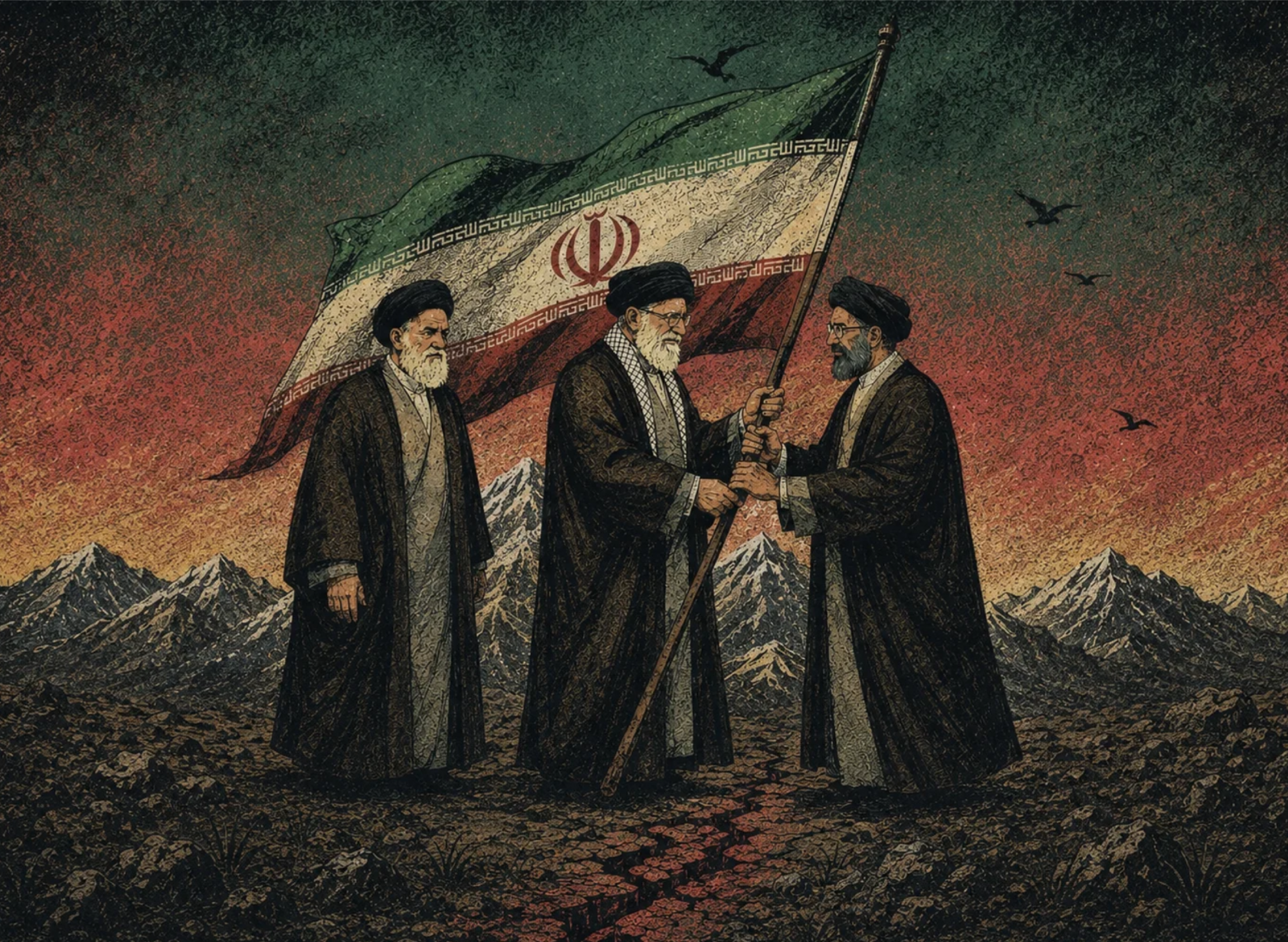
This illustration has been created by AI to use only in this article.
In international politics, overreach is associated with decline rather than ascent, which drives instability. This instability depletes the number of decisions a state can make, which rivals interpret as an opportunity. As their dominance erodes, states cling to expansive commitments, widening the gap between perceived strength and actual capacity. Rising powers are similarly susceptible to this gap, as short-term gains are often misperceived as durable advantages. Economic growth, military modernization, and diplomatic influence generate momentum, but their conversion to durable strategic power is not linear. Misjudging relative gains as absolute power shapes state behavior and fosters strategic overstretch, as states’ commitments, ambitions, and confrontations exceed capacity. Despite conventional scholarship, the overstretch trap is not an indicator of decline but a structural risk embedded in the dynamics of growth. From prewar Germany and interwar Japan to the Soviet Union and modern-day China, Russia, Iran, and India, a state’s most precarious moments occur when ambition outpaces capability.
The Logic of Overstretch
In the overstretch trap, states misread their own strength, treating relative gains as absolute power rather than isolated successes. Relative gains signal that a state is potentially growing faster than its competitors, but absolute power is the ability to shape outcomes. While small victories create the perception of power, they do not eliminate underlying limitations. Economic expansion is a common source of this illusion. While growth strengthens states, the conversion of wealth to power is not immediate. Wealth becomes power when states can mobilize resources toward strategic ends, whereas power relies on institutional competence and the ability to absorb shocks. Cognitive bias compounds this problem, as early successes become reference points for strategy. Consequently, leaders overestimate their ability to shape outcomes and misread economic expansion as strategic capability.
Leadership narratives reinforce this illusion in times of growth. Leaders herald ascent as inevitable and rooted in historical destiny, reducing sensitivity to risk and recasting restraint as weakness. This momentum amplifies historical tales of expansion and exaggerates threat perception, skewing policy toward unmanageable offensive strategies and compressing timelines. In Maoist China, leaders interpreted relative gains as evidence of restored historical status, dismissed resistance as temporary, and justified simultaneous confrontations with the U.S. and the Soviet Union as necessary engagements, thereby overstretching China’s capacity through multi-front competition.
Growth cultivates confidence and encourages leaders to take on additional commitments. For rising powers, this manifests in transitioning from securing the immediate periphery to regional dominance. Overstretch becomes visible when ambitions outpace bureaucratic depth, alliance management, and domestic economic resilience. Rising powers underestimate the friction between ambitions and capacity by assuming that development keeps pace with objectives. In reality, the absence of means accelerates vulnerability, not dominance. With newfound confidence, strategy is driven by opportunity and reaction. Escalating objectives and insufficient infrastructure embolden the pursuit of multiple goals and expanded commitments simultaneously. Along with confidence, early successes reinforce this pattern, prompting leaders to undertake unsustainable ventures. As commitments grow, leaders underestimate the costs of competition and resort to reactive crisis management. The result is a widening gap between expanding ends and insufficient means, a core mechanism of the overstretch trap.
Growth as Vulnerability
While rising powers use nationalism to legitimize foreign policy, nationalist narratives equate expansion with strength and restraint with weakness, feeding overstretch. As leaders invoke historical myths of guaranteed growth to justify risk-taking and silence dissent, they reframe expansion as necessary and opposition as disloyal. Furthermore, leaders use nationalist narratives to reduce domestic resistance to policies and, when initiatives falter, double down to reaffirm legitimacy. In the 1930s, Japan sought to redefine the East Asian security order by cultivating domestic support for expansion and American retrenchment. These actions underpinned the nationalist belief that assertiveness validates great-power status.
holds a master’s degree in U.S. Foreign Policy and National Security from American University School of Internationa Service. Her work focuses on threat assessment, structural drivers of state behavior, and the risks of strategic overreach in emerging power rivalries.
In international politics, overreach is associated with decline rather than ascent, which drives instability. This instability depletes the number of decisions a state can make, which rivals interpret as an opportunity. As their dominance erodes, states cling to expansive commitments, widening the gap between perceived strength and actual capacity. Rising powers are similarly susceptible to this gap, as short-term gains are often misperceived as durable advantages. Economic growth, military modernization, and diplomatic influence generate momentum, but their conversion to durable strategic power is not linear. Misjudging relative gains as absolute power shapes state behavior and fosters strategic overstretch, as states’ commitments, ambitions, and confrontations exceed capacity. Despite conventional scholarship, the overstretch trap is not an indicator of decline but a structural risk embedded in the dynamics of growth. From prewar Germany and interwar Japan to the Soviet Union and modern-day China, Russia, Iran, and India, a state’s most precarious moments occur when ambition outpaces capability.
The Logic of Overstretch
In the overstretch trap, states misread their own strength, treating relative gains as absolute power rather than isolated successes. Relative gains signal that a state is potentially growing faster than its competitors, but absolute power is the ability to shape outcomes. While small victories create the perception of power, they do not eliminate underlying limitations. Economic expansion is a common source of this illusion. While growth strengthens states, the conversion of wealth to power is not immediate. Wealth becomes power when states can mobilize resources toward strategic ends, whereas power relies on institutional competence and the ability to absorb shocks. Cognitive bias compounds this problem, as early successes become reference points for strategy. Consequently, leaders overestimate their ability to shape outcomes and misread economic expansion as strategic capability.
Leadership narratives reinforce this illusion in times of growth. Leaders herald ascent as inevitable and rooted in historical destiny, reducing sensitivity to risk and recasting restraint as weakness. This momentum amplifies historical tales of expansion and exaggerates threat perception, skewing policy toward unmanageable offensive strategies and compressing timelines. In Maoist China, leaders interpreted relative gains as evidence of restored historical status, dismissed resistance as temporary, and justified simultaneous confrontations with the U.S. and the Soviet Union as necessary engagements, thereby overstretching China’s capacity through multi-front competition.
Growth cultivates confidence and encourages leaders to take on additional commitments. For rising powers, this manifests in transitioning from securing the immediate periphery to regional dominance. Overstretch becomes visible when ambitions outpace bureaucratic depth, alliance management, and domestic economic resilience. Rising powers underestimate the friction between ambitions and capacity by assuming that development keeps pace with objectives. In reality, the absence of means accelerates vulnerability, not dominance. With newfound confidence, strategy is driven by opportunity and reaction. Escalating objectives and insufficient infrastructure embolden the pursuit of multiple goals and expanded commitments simultaneously. Along with confidence, early successes reinforce this pattern, prompting leaders to undertake unsustainable ventures. As commitments grow, leaders underestimate the costs of competition and resort to reactive crisis management. The result is a widening gap between expanding ends and insufficient means, a core mechanism of the overstretch trap.
Growth as Vulnerability
While rising powers use nationalism to legitimize foreign policy, nationalist narratives equate expansion with strength and restraint with weakness, feeding overstretch. As leaders invoke historical myths of guaranteed growth to justify risk-taking and silence dissent, they reframe expansion as necessary and opposition as disloyal. Furthermore, leaders use nationalist narratives to reduce domestic resistance to policies and, when initiatives falter, double down to reaffirm legitimacy. In the 1930s, Japan sought to redefine the East Asian security order by cultivating domestic support for expansion and American retrenchment. These actions underpinned the nationalist belief that assertiveness validates great-power status.
holds a master’s degree in U.S. Foreign Policy and National Security from American University School of Internationa Service. Her work focuses on threat assessment, structural drivers of state behavior, and the risks of strategic overreach in emerging power rivalries.


Growth arrives in cycles: when it surges, domestic populations rejoice, and when it slows, dissatisfaction runs rampant. To combat frustration and renew legitimacy, leaders seek to expand. Furthermore, slowed ascent also increases the likelihood of conflict. With domestic support, leaders pursue expansion without the necessary capacity to sustain it, accelerating foreign commitments. This dynamic feeds strategic overreach and contributes to rising powers falling prey to the overstretch trap. Centralized decision-making and weakened institutional constraints intensify domestic support for expansion. As authority consolidates, dissenting voices are silenced, and leaders rely on loyalists to reinforce assumptions and suppress dissent regarding long-term costs. With fewer institutional checks, decision-making accelerates as scrutiny declines. This emboldens leaders to act on perceived momentum without restriction. Under these conditions, foreign policy becomes easier to initiate and harder to restrain, increasing the likelihood that states overextend beyond their capacity.
Misperception of rival actions also encourages strategic overreach. Rising powers often misperceive the actions of rivals; what rival states see as precautionary balancing, rising powers often see as threats. The misperception of actions creates a security dilemma in which efforts by one state to enhance security provoke countermeasures and escalation from another. In the face of perceived threats, rising powers escalate by pursuing foreign policy to dominate their rivals. For example, the Soviet Union interpreted Western defensive initiatives as direct threats, prompting aggressive responses that exceeded their capacity and deepened confrontation.
Overconfidence in deterrence and escalation feeds misperception. Strong deterrence measures rely on capacity, yet in periods of growth, leaders misperceive limited successes as mastery. Small victories encourage leaders to overestimate their ability to manage rivals and serve as proof of competence. The perception of control creates a feedback loop: apparent mastery encourages further escalation, commitments multiply, and the costs of misperception rise. As behavior becomes more assertive, underlying vulnerabilities emerge.
Historical analogies further compound the overstretch trap, as leaders map past successes onto new contexts. As Khong demonstrates, U.S. leaders generalized early successes and lessons from World War II in Europe onto the Vietnam War. Leadership mistook short-term gains for lasting strategic superiority and committed to a conflict without the structural conditions for success. Tactical victories also encourage overconfidence when misread as structural advantages. Success in specific engagements often reflects effective policy, organization, or timing rather than enduring structural superiority. By overgeneralizing limited tactical success, states assume broader strategic advantage and expand obligations, widening the gap between capacity and commitments. Finally, underestimation of long-term economic, military, and reputational costs exacerbates the overstretch trap. Instead of adapting when constraints emerge, leaders often double down, turning manageable risks into cumulative vulnerabilities. Growth generates the illusion of permanent advantage: early successes obscure structural pressures, while expanding commitments lock states into trajectories that widen the divide between ambition and ability.
Contemporary Pathways to Overreach
China’s ambitions have expanded faster than its strategic maturity. Its cumulative pressures and domestic constraints have narrowed its ability to maneuver, while assertiveness has masked escalation risks. China’s ambitions have centered on reshaping the regional order in Southeast Asia, reintegrating Taiwan, securing economic infrastructure through the Belt and Road Initiative (BRI), reducing American primacy, and shaping norms in international institutions. These ambitions reveal a growing tension between China’s global reach and strategic maturity.
Growth arrives in cycles: when it surges, domestic populations rejoice, and when it slows, dissatisfaction runs rampant. To combat frustration and renew legitimacy, leaders seek to expand. Furthermore, slowed ascent also increases the likelihood of conflict. With domestic support, leaders pursue expansion without the necessary capacity to sustain it, accelerating foreign commitments. This dynamic feeds strategic overreach and contributes to rising powers falling prey to the overstretch trap. Centralized decision-making and weakened institutional constraints intensify domestic support for expansion. As authority consolidates, dissenting voices are silenced, and leaders rely on loyalists to reinforce assumptions and suppress dissent regarding long-term costs. With fewer institutional checks, decision-making accelerates as scrutiny declines. This emboldens leaders to act on perceived momentum without restriction. Under these conditions, foreign policy becomes easier to initiate and harder to restrain, increasing the likelihood that states overextend beyond their capacity.
Misperception of rival actions also encourages strategic overreach. Rising powers often misperceive the actions of rivals; what rival states see as precautionary balancing, rising powers often see as threats. The misperception of actions creates a security dilemma in which efforts by one state to enhance security provoke countermeasures and escalation from another. In the face of perceived threats, rising powers escalate by pursuing foreign policy to dominate their rivals. For example, the Soviet Union interpreted Western defensive initiatives as direct threats, prompting aggressive responses that exceeded their capacity and deepened confrontation.
Overconfidence in deterrence and escalation feeds misperception. Strong deterrence measures rely on capacity, yet in periods of growth, leaders misperceive limited successes as mastery. Small victories encourage leaders to overestimate their ability to manage rivals and serve as proof of competence. The perception of control creates a feedback loop: apparent mastery encourages further escalation, commitments multiply, and the costs of misperception rise. As behavior becomes more assertive, underlying vulnerabilities emerge.
Historical analogies further compound the overstretch trap, as leaders map past successes onto new contexts. As Khong demonstrates, U.S. leaders generalized early successes and lessons from World War II in Europe onto the Vietnam War. Leadership mistook short-term gains for lasting strategic superiority and committed to a conflict without the structural conditions for success. Tactical victories also encourage overconfidence when misread as structural advantages. Success in specific engagements often reflects effective policy, organization, or timing rather than enduring structural superiority. By overgeneralizing limited tactical success, states assume broader strategic advantage and expand obligations, widening the gap between capacity and commitments. Finally, underestimation of long-term economic, military, and reputational costs exacerbates the overstretch trap. Instead of adapting when constraints emerge, leaders often double down, turning manageable risks into cumulative vulnerabilities. Growth generates the illusion of permanent advantage: early successes obscure structural pressures, while expanding commitments lock states into trajectories that widen the divide between ambition and ability.
Contemporary Pathways to Overreach
China’s ambitions have expanded faster than its strategic maturity. Its cumulative pressures and domestic constraints have narrowed its ability to maneuver, while assertiveness has masked escalation risks. China’s ambitions have centered on reshaping the regional order in Southeast Asia, reintegrating Taiwan, securing economic infrastructure through the Belt and Road Initiative (BRI), reducing American primacy, and shaping norms in international institutions. These ambitions reveal a growing tension between China’s global reach and strategic maturity.
By misreading short-term gains as enduring advantages, a rising Russia stumbled before its peak.
The BRI exemplifies this imbalance. Intended to convert economic strength into strategic leverage, the BRI has generated debt disputes, elite resistance, and reputational costs, reflecting ambition without sufficient institutional and financial maturity. China’s growing exposure across multiple pressure points further encourages overstretch. Simultaneous engagement in the South China Sea, coercion against Taiwan, and competition with the U.S. require military readiness and extensive crisis management capacity. While China has modernized select military capabilities, its ability to project power and manage escalation across multiple theaters simultaneously remains imbalanced. These external ambitions are colliding with mounting structural constraints. Slowing economic growth, demographic decline, and environmental stress hinder China’s ability to sustain competition. Rising labor costs erode comparative advantage, an aging workforce constrains future growth, and resource pressures narrow policy flexibility. These constraints reduce China’s ability to sustain commitments and heighten vulnerability to overstretch.
The risk for China is not imminent collapse, but gradual overstretch, as expanding commitments outpace the institutional, economic, and strategic foundations required to manage them. China’s trajectory demonstrates that growth creates opportunity, but it also compresses timelines, expands obligations, and magnifies the consequences of miscalculation. The central question is whether China’s ambitions have advanced faster than its capacity to sustain them.
Russia’s recent economic stabilization encouraged a significant rise in status. In misreading relative recovery as absolute power, confidence in coercion and escalation control proved misguided, producing long-term isolation and attrition. Russia’s actions in Georgia, Crimea, and Syria reinforced perceptions of effectiveness, demonstrating that limited force posturing could achieve political outcomes. However, these successes masked structural constraints. The economy remained dependent on energy exports, lacking the logistical depth to sustain conflict. This overconfidence was applied to the 2022 invasion of Ukraine and reflected this overconfidence. A cost-benefit analysis assumed rapid military success, collapse in Kyiv, limited Western retaliation, and effective nuclear signaling to deter intervention. These assumptions failed; rather than consolidation, Russian actions generated prolonged attrition and economic and reputational costs.
Russia’s reputation as a modern power created a halo effect in which isolated successes were read as structural transformations. Limited victories in Georgia, Crimea, and Syria reinforced the perception that post-Soviet deficiencies had been overcome but did not translate into sustainable readiness. As losses continue to mount, sunk-cost dynamics and concerns about regime legitimacy discourage de-escalation and have incentivized energy coercion and nuclear rhetoric, deepening international isolation. Without the logistical depth and integration required for sustained conflict, Russia’s war in Ukraine forced its military reputation to collide with its structural limitations, mirroring the overconfidence trap. Russia also underestimated the cumulative costs of conflict. Rather than fracturing Western solidarity, the invasion hardened alliances and imposed constraints on Russia’s economic base. What began as an effort to restore influence resulted in accelerated strategic marginalization, binding Russia to a narrow set of partners and competition with the West.
On the eve of the war in Ukraine, Russia was not a weak power, but its commitments expanded faster than its structural capacity could sustain. By misreading short-term gains as enduring advantages, a rising Russia stumbled before its peak. Russia’s future is likely to be shaped by narrowing options as declining capacity collides with sustained commitments. While China and Russia manifest overstretch at the Great Power level, Iran and India demonstrate how regional ambition collides with structural constraints. Revolutionary ideology and geopolitical opportunity have encouraged Iran to expand via proxy networks to counterbalance rivals and promote its preferred regional order. While delivering tactical victories, proxies have imposed burdens that have outpaced capacity. Reliance on proxy networks like the Qods Force and Hezbollah has bred perpetual confrontation and economic strain. Structural limitations, including economic fragility and diplomatic isolation, have constrained Iran’s ability to convert influence into durable regional leadership.
India’s overstretch risk stems from multifront deterrence and evolving institutional capacity. Rivalry with Pakistan and border skirmishes with China have stretched India’s military planning and bureaucratic capacity. Unlike traditional rising powers driven by expansion, India faces cumulative strain from managing multiple deterrence relationships simultaneously without fully developed institutional mechanisms to sustain them. Iran and India demonstrate the costs of regional leadership without consolidation. In both cases, ambition risks outpacing capacity. Iran’s proxy strategy masks economic fragility and diplomatic isolation, while India’s projection as a stabilizing regional leader is fraught with competing priorities. Over time, these structural constraints have exposed both states to costs that erode the leverage their ambitions seek to secure.
Overstretch as a Systemic Pattern, not a Policy Failure
Rising powers overestimate their ability to convert growth into dominance. As ascent accelerates, expansionary impulses that deliver immediate gains are rewarded, and long-term costs are concealed. Relative gains are misread as absolute power, and confidence in deterrence hides the costs of expansion. While China, Russia, Iran, and India exemplify these dynamics, historical precedent illustrates that the combination of confidence and constrained capacity produces vulnerability. Overstretch historically emerges from structural incentives that prioritize action over restraint.
Prewar Germany faced industrialization and modernization that incentivized aggressive strategy. Leaders believed early victories would secure great-power status, ignoring overextension in a two-front war against France and Russia. Imperial Japan similarly assumed that territorial gains would cement security and economic advantages, but growing cumulative commitments ultimately led to the empire’s fall. Finally, the Soviet Union’s institutional rigidity and ideological confidence magnified overreach; its intervention in Afghanistan reflected global ambition and overestimation of capacity. Soviet leaders misread relative parity with the U.S. and NATO as sufficient to sustain commitments. These historical cases illustrate that ambition has repeatedly outpaced ability, even in the absence of immediate existential threats.
Human nature also encourages overstretch, as leaders interpret contradictory assessments as threats to a state’s trajectory, and dissenting voices face resistance. Structural incentives within the international system compound this dynamic. In competitive environments, defensive actions convince leaders that failing to consolidate gains risks vulnerability. Restraint appears dangerous rather than prudent. Across different regions, eras, and resource endowments, periods of ascent produce vulnerability as confidence accelerates faster than capacity. Overstretch is not a series of policy failures; it is a structural risk embedded in the trajectory of rising powers, a consequence of growth, ambition, and misperception.
The international system amplifies overstretch dynamics. As restraint appears weak, rising powers interpret uncertainty as a window to consolidate influence. While appealing, these conditions increase the risk of strategic error as states face multiple competitors and overlapping commitments. In this current moment of multipolarity, these opportunities and miscalculations have intensified. Power vacuums exacerbate these dynamics. When dominant powers disengage from regions, rising powers perceive opportunity, flooding the vacuum with competing states, proxy conflicts, and balancing responses. These environments are read as strategically enticing until existing powers mobilize to counterbalance actions once their interests are threatened. Power vacuums also compress decision-making timelines by rewarding early movers. In these environments, hesitation is punished, while expansion appears decisive, pushing rising powers toward overextension.
The BRI exemplifies this imbalance. Intended to convert economic strength into strategic leverage, the BRI has generated debt disputes, elite resistance, and reputational costs, reflecting ambition without sufficient institutional and financial maturity. China’s growing exposure
across multiple pressure points further encourages overstretch. Simultaneous engagement in the South China Sea, coercion against Taiwan, and competition with the U.S. require military readiness and extensive crisis management capacity. While China has modernized select military capabilities, its ability to project power and manage escalation across multiple theaters simultaneously remains imbalanced. These external ambitions are colliding with mounting structural constraints. Slowing economic growth, demographic decline, and environmental stress hinder China’s ability to sustain competition. Rising labor costs erode comparative advantage, an aging workforce constrains future growth, and resource pressures narrow policy flexibility. These constraints reduce China’s ability to sustain commitments and heighten vulnerability to overstretch.
The risk for China is not imminent collapse, but gradual overstretch, as expanding commitments outpace the institutional, economic, and strategic foundations required to manage them. China’s trajectory demonstrates that growth creates opportunity, but it also compresses timelines, expands obligations, and magnifies the consequences of miscalculation. The central question is whether China’s ambitions have advanced faster than its capacity to sustain them.
Russia’s recent economic stabilization encouraged a significant rise in status. In misreading relative recovery as absolute power, confidence in coercion and escalation control proved misguided, producing long-term isolation and attrition. Russia’s actions in Georgia, Crimea, and Syria reinforced perceptions of effectiveness, demonstrating that limited force posturing could achieve political outcomes. However, these successes masked structural constraints. The economy remained dependent on energy exports, lacking the logistical depth to sustain conflict. This overconfidence was applied to the 2022 invasion of Ukraine and reflected this overconfidence. A cost-benefit analysis assumed rapid military success, collapse in Kyiv, limited Western retaliation, and effective nuclear signaling to deter intervention. These assumptions failed; rather than consolidation, Russian actions generated prolonged attrition and economic and reputational costs.
Russia’s reputation as a modern power created a halo effect in which isolated successes were read as structural transformations. Limited victories in Georgia, Crimea, and Syria reinforced the perception that post-Soviet deficiencies had been overcome but did not translate into sustainable readiness. As losses continue to mount, sunk-cost dynamics and concerns about regime legitimacy discourage de-escalation and have incentivized energy coercion and nuclear rhetoric, deepening international isolation. Without the logistical depth and integration required for sustained conflict, Russia’s war in Ukraine forced its military reputation to collide with its structural limitations, mirroring the overconfidence trap. Russia also underestimated the cumulative costs of conflict. Rather than fracturing Western solidarity, the invasion hardened alliances and imposed constraints on Russia’s economic base. What began as an effort to restore influence resulted in accelerated strategic marginalization, binding Russia to a narrow set of partners and competition with the West.
On the eve of the war in Ukraine, Russia was not a weak power, but its commitments expanded faster than its structural capacity could sustain. By misreading short-term gains as enduring advantages, a rising Russia stumbled before its peak. Russia’s future is likely to be shaped by narrowing options as declining capacity collides with sustained commitments. While China and Russia manifest overstretch at the Great Power level, Iran and India demonstrate how regional ambition collides with structural constraints. Revolutionary ideology and geopolitical opportunity have encouraged Iran to expand via proxy networks to counterbalance rivals and promote its preferred regional order. While delivering tactical victories, proxies have imposed burdens that have outpaced capacity. Reliance on proxy networks like the Qods Force and Hezbollah has bred perpetual confrontation and economic strain. Structural limitations, including economic fragility and diplomatic isolation, have constrained Iran’s ability to convert influence into durable regional leadership.
India’s overstretch risk stems from multifront deterrence and evolving institutional capacity. Rivalry with Pakistan and border skirmishes with China have stretched India’s military planning and bureaucratic capacity. Unlike traditional rising powers driven by expansion, India faces cumulative strain from managing multiple deterrence relationships simultaneously without fully developed institutional mechanisms to sustain them. Iran and India demonstrate the costs of regional leadership without consolidation. In both cases, ambition risks outpacing capacity. Iran’s proxy strategy masks economic fragility and diplomatic isolation, while India’s projection as a stabilizing regional leader is fraught with competing priorities. Over time, these structural constraints have exposed both states to costs that erode the leverage their ambitions seek to secure.
Overstretch as a Systemic Pattern, not a Policy Failure
Rising powers overestimate their ability to convert growth into dominance. As ascent accelerates, expansionary impulses that deliver immediate gains are rewarded, and long-term costs are concealed. Relative gains are misread as absolute power, and confidence in deterrence hides the costs of expansion. While China, Russia, Iran, and India exemplify these dynamics, historical precedent illustrates that the combination of confidence and constrained capacity produces vulnerability. Overstretch historically emerges from structural incentives that prioritize action over restraint.
Prewar Germany faced industrialization and modernization that incentivized aggressive strategy. Leaders believed early victories would secure great-power status, ignoring overextension in a two-front war against France and Russia. Imperial Japan similarly assumed that territorial gains would cement security and economic advantages, but growing cumulative commitments ultimately led to the empire’s fall. Finally, the Soviet Union’s institutional rigidity and ideological confidence magnified overreach; its intervention in Afghanistan reflected global ambition and overestimation of capacity. Soviet leaders misread relative parity with the U.S. and NATO as sufficient to sustain commitments. These historical cases illustrate that ambition has repeatedly outpaced ability, even in the absence of immediate existential threats.
Human nature also encourages overstretch, as leaders interpret contradictory assessments as threats to a state’s trajectory, and dissenting voices face resistance. Structural incentives within the international system compound this dynamic. In competitive environments, defensive actions convince leaders that failing to consolidate gains risks vulnerability. Restraint appears dangerous rather than prudent. Across different regions, eras, and resource endowments, periods of ascent produce vulnerability as confidence accelerates faster than capacity. Overstretch is not a series of policy failures; it is a structural risk embedded in the trajectory of rising powers, a consequence of growth, ambition, and misperception.
The international system amplifies overstretch dynamics. As restraint appears weak, rising powers interpret uncertainty as a window to consolidate influence. While appealing, these conditions increase the risk of strategic error as states face multiple competitors and overlapping commitments. In this current moment of multipolarity, these opportunities and miscalculations have intensified. Power vacuums exacerbate these dynamics. When dominant powers disengage from regions, rising powers perceive opportunity, flooding the vacuum with competing states, proxy conflicts, and balancing responses. These environments are read as strategically enticing until existing powers mobilize to counterbalance actions once their interests are threatened. Power vacuums also compress decision-making timelines by rewarding early movers. In these environments, hesitation is punished, while expansion appears decisive, pushing rising powers toward overextension.
The international system also distorts threat perception and containment narratives. States rarely interpret rival actions as intended. Once hostility is perceived, ambiguous signals confirm prior suspicions, reinforcing cycles of escalation. As security dilemmas emerge, states adopt defensive postures to prevent encirclement,
intensifying rival threat perceptions. Rising powers perceive restraint as an invitation to future constraint, allowing containment narratives to gain traction without overt aggression. Furthermore, the international system rewards short-term gains and penalizes long-term stability. For rising powers, this asymmetry reinforces illusions of control during ascent and encourages commitments before capacity matures or limitations materialize. The international system magnifies these risks; China, Russia, Iran, and India are each facing dimensions of the overstretch trap that, in tandem with the international system, prioritize action over endurance.
Why States Fail Before They Peak
The assumption that states are most unstable in decline obscures a consequential reality: strategic errors occur just before a state reaches its apex, when ambition outpaces the structural foundations required to sustain it. Furthermore, growth does not insulate states from risk; it amplifies vulnerability by distorting perceptions and accelerating commitments. As periods of ascent widen the gap between ambition and capacity, economic expansion and military modernization generate expectations of dominance that exceed structural depth. Coupled with early successes that encourage escalation and hidden long-term costs, strategic overreach is a predictable outcome of misjudged strength during ascent.
Historical parallels echo this sentiment. Prewar Germany, interwar Japan, and the Soviet Union all expanded their commitments, believing that relative gains signaled durable advantages. In each case, optimism silenced dissent, compressed timelines, and privileged expansion over consolidation, with overreach emerging when leaders took advantage of a strategic window. The international system magnifies these tendencies. Multipolarity, power vacuums, and containment dynamics reward short-term advances while obscuring long-term constraints, so restraint appears perilous and ambition rational.
Power accumulation is not linear. Growth phases are often the most fragile points in a state’s trajectory because the miscalculation of hidden costs makes course correction difficult. Understanding overreach as a structural risk rather than a series of isolated policy failures shifts the analytical lens from decline to the limitations of ascent. In an era of intensified competition, restraint may be the most undervalued form of power for rising states.
Strategic errors occur just before a state reaches its apex, when ambition outpaces the structural foundations required to sustain it.
The international system also distorts threat perception and containment narratives. States rarely interpret rival actions as intended. Once hostility is perceived, ambiguous signals confirm prior suspicions, reinforcing cycles of escalation. As security dilemmas emerge, states adopt defensive postures to prevent encirclement, intensifying rival threat perceptions. Rising powers perceive restraint as an invitation to future constraint, allowing containment narratives to gain traction without overt aggression. Furthermore, the international system rewards short-term gains and penalizes long-term stability. For rising powers, this asymmetry reinforces illusions of control during ascent and encourages commitments before capacity matures or limitations materialize. The international system magnifies these risks; China, Russia, Iran, and India are each facing dimensions of the overstretch trap that, in tandem with the international system, prioritize action over endurance.
Why States Fail Before They Peak
The assumption that states are most unstable in decline obscures a consequential reality: strategic errors occur just before a state reaches its apex, when ambition outpaces the structural foundations required to sustain it. Furthermore, growth does not insulate states from risk; it amplifies vulnerability by distorting perceptions and accelerating commitments. As periods of ascent widen the gap between ambition and capacity, economic expansion and military modernization generate expectations of dominance that exceed structural depth. Coupled with early successes that encourage escalation and hidden long-term costs, strategic overreach is a predictable outcome of misjudged strength during ascent.
Historical parallels echo this sentiment. Prewar Germany, interwar Japan, and the Soviet Union all expanded their commitments, believing that relative gains signaled durable advantages. In each case, optimism silenced dissent, compressed timelines, and privileged expansion over consolidation, with overreach emerging when leaders took advantage of a strategic window. The international system magnifies these tendencies. Multipolarity, power vacuums, and containment dynamics reward short-term advances while obscuring long-term constraints, so restraint appears perilous and ambition rational.
Power accumulation is not linear. Growth phases are often the most fragile points in a state’s trajectory because the miscalculation of hidden costs makes course correction difficult. Understanding overreach as a structural risk rather than a series of isolated policy failures shifts the analytical lens from decline to the limitations of ascent. In an era of intensified competition, restraint may be the most undervalued form of power for rising states.
Recommended

The Empire That Fights to Exist

How Semiconductors Shape the New World Order
The Decline of External Powers and Rise of Regional Powers

A Hamiltonian Approach to Power and Foreign Policy
How the Chinese Military Could Shape China’s Next Chapter