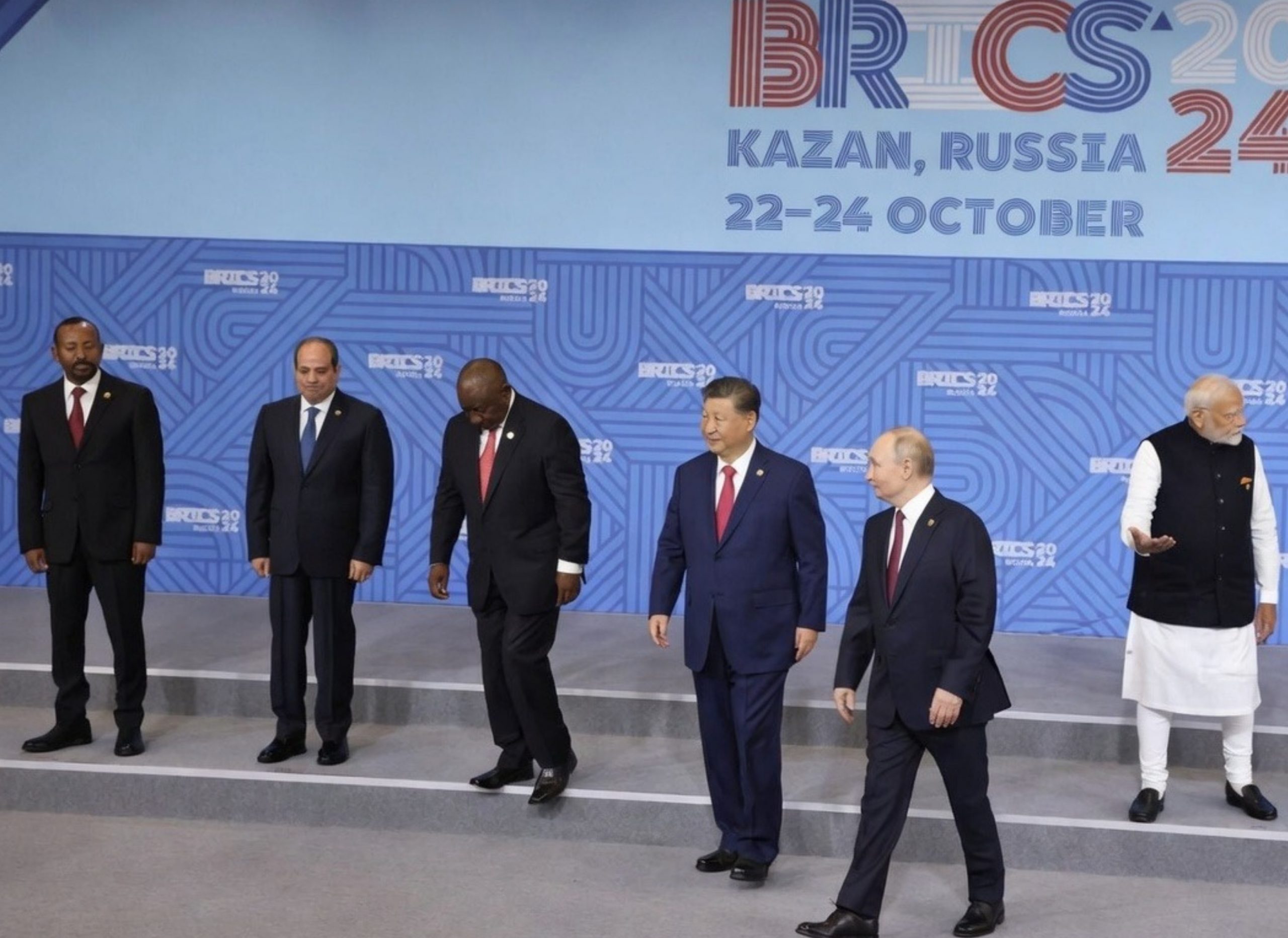



This illustration has been created by AI to use only in this article.
In the aftermath of the Great Wars, and particularly from the post-World War II period, the United States, amidst the weight of global destruction and the power vacuum occasioned by a weakened Europe, was viewed by both domestic and foreign audiences as the indispensable guarantor of the stability of the international system. In its role in championing the post-war liberal international architecture through international institutions such as the United Nations, the Bretton Woods institutions, and the North Atlantic Treaty Organization (NATO), the United States fused its domestic power with global responsibility. This assessment was reinforced even further in the immediate post-Cold War decade, when the American position as a unilateral superpower—victorious in its ideological struggle against the Soviet Union, confident in the universality of its capitalist model, and convinced of its important leadership in shaping the international system—wholesomely embraced its “burden” of global leadership. For many observers, the 20th century could rightfully be claimed as the “American century.”
Yet the same cannot be said of the present. Indeed, two and a half decades into the 21st century, much of the previous century’s assessment has changed, and conflicting assessments revolve around whether the United States remains an indispensable stabilizer or an unreliable global actor that is in an inevitable and perhaps even irreversible decline. In large part, America’s global posture in the last two and a half decades has been rooted in an exceptional ambition that the international order could be policed by a single actor that can suppress threats across the globe, deter great power competition, and promote democratic rule. Indeed, from Africa to Asia, to Europe, to the Middle East, and now South America, much of the security logic underpinning American foreign policy is that it requires perpetual vigilance and active engagement. Yet, as will be aptly demonstrated in this analysis, this strategic overstretch has, over time, revealed serious contradictions and growing perceptions of an unsustainable burden of American foreign policy, resulting in an American global leadership that is highly fragmented and marked by diminished global credibility.
Cognizant of these developments, there is an imperative to rethink American global leadership for both present and future ends. Specifically, how can the United States reclaim and maintain its global leadership without overreaching as the world’s enforcer or isolating itself from the community of nations? There are many traditions that shape a country’s foreign policy, and a “Hamiltonian” tradition offers one such framework. Although much of the reference to Alexander Hamilton, a military officer, founding father, and the first United States Secretary of the Treasury (1789–1795), is often confined to his contribution to domestic policy, there has been limited attention to the implications of his political thought on American foreign policy. It is, however, important to recognize that this passive attention to Hamiltonian thinking in foreign policy is not without rationale. Indeed, unlike the contemporary era, where America has evolved into a global power, the international system of the Hamiltonian era lacked the complexities of today’s world. As such, Hamilton was largely writing for a young, vulnerable republic whose fundamental strategic concern was survival and autonomy, and whose greatest challenges were internal.
But Hamilton’s sparse intellectual visibility in foreign policy is not tantamount to weak influence. This is because core tenets of Hamiltonian thought have selectively been part and parcel of a range of intellectual traditions that emerged to suit the needs of distinct historical periods and challenges. From the 19th-century advocates of an American System to the 20th-century liberal economic order, to the 21st-century proponents of geostrategic statecraft, the relevance of Hamiltonian foundations of economic strength, national cohesion, and institutions as the premise of national power and global leadership continues to endure.
Intellectual Roots of Hamiltonian Tradition
When debate over how to best organize the emerging post-revolutionary domestic political systems took hold in the late 18th century in the transatlantic hemisphere through the intellectual contributions of Enlightenment thinkers and revolutionary movements, the implications were not merely attuned to domestic ends but also extended into foreign policy domains. For instance, proponents of limited or enlightened monarchical orders at the time—from Burke, to Hume, to Montesquieu, to Voltaire—all alluded to its comparative advantages of stability, continuity, efficiency, and long-term strategic vision insulated from the threat of factional ideologies. However, this position found its strongest critique in the scholarship of pro-republican or radical democratic constitutional thinkers such as Jean-Jacques Rousseau, Thomas Paine, and the Radical Jacobins in France.
In the United States, a similar critique was found among the American Federalist anti-monarchists, a group often linked with Thomas Jefferson, who advocated for a decentralized republican system on the premise that consent-based governance could produce a more rational, restrained, and peaceful political order. Specifically, these voices, shaped by the anxieties of past experiences in the hands of a widely perceived corrupt, tyrannical, expansionist, and inefficient English monarchy, coalesced around the idea of “democratic republicanism,” a system that was more egalitarian, closely linked to grassroots political mobilization, suspicious of hierarchical authority, and practiced through popular participation and majority rule.
is a PhD Presidential Scholar at Carter School, George Mason University, and a co-author of the book “The Somalia Conflict Revisited: Trends and Complexities of Spatial Governance on National and Regional Security.”
In the aftermath of the Great Wars, and particularly from the post-World War II period, the United States, amidst the weight of global destruction and the power vacuum occasioned by a weakened Europe, was viewed by both domestic and foreign audiences as the indispensable guarantor of the stability of the international system. In its role in championing the post-war liberal international architecture through international institutions such as the United Nations, the Bretton Woods institutions, and the North Atlantic Treaty Organization (NATO), the United States fused its domestic power with global responsibility. This assessment was reinforced even further in the immediate post-Cold War decade, when the American position as a unilateral superpower—victorious in its ideological struggle against the Soviet Union, confident in the universality of its capitalist model, and convinced of its important leadership in shaping the international system—wholesomely embraced its “burden” of global leadership. For many observers, the 20th century could rightfully be claimed as the “American century.”
Yet the same cannot be said of the present. Indeed, two and a half decades into the 21st century, much of the previous century’s assessment has changed, and conflicting assessments revolve around whether the United States remains an indispensable stabilizer or an unreliable global actor that is in an inevitable and perhaps even irreversible decline. In large part, America’s global posture in the last two and a half decades has been rooted in an exceptional ambition that the international order could be policed by a single actor that can suppress threats across the globe, deter great power competition, and promote democratic rule. Indeed, from Africa to Asia, to Europe, to the Middle East, and now South America, much of the security logic underpinning American foreign policy is that it requires perpetual vigilance and active engagement. Yet, as will be aptly demonstrated in this analysis, this strategic overstretch has, over time, revealed serious contradictions and growing perceptions of an unsustainable burden of American foreign policy, resulting in an American global leadership that is highly fragmented and marked by diminished global credibility.
Cognizant of these developments, there is an imperative to rethink American global leadership for both present and future ends. Specifically, how can the United States reclaim and maintain its global leadership without overreaching as the world’s enforcer or isolating itself from the community of nations? There are many traditions that shape a country’s foreign policy, and a “Hamiltonian” tradition offers one such framework. Although much of the reference to Alexander Hamilton, a military officer, founding father, and the first United States Secretary of the Treasury (1789–1795), is often confined to his contribution to domestic policy, there has been limited attention to the implications of his political thought on American foreign policy. It is, however, important to recognize that this passive attention to Hamiltonian thinking in foreign policy is not without rationale. Indeed, unlike the contemporary era, where America has evolved into a global power, the international system of the Hamiltonian era lacked the complexities of today’s world. As such, Hamilton was largely writing for a young, vulnerable republic whose fundamental strategic concern was survival and autonomy, and whose greatest challenges were internal.
But Hamilton’s sparse intellectual visibility in foreign policy is not tantamount to weak influence. This is because core tenets of Hamiltonian thought have selectively been part and parcel of a range of intellectual traditions that emerged to suit the needs of distinct historical periods and challenges. From the 19th-century advocates of an American System to the 20th-century liberal economic order, to the 21st-century proponents of geostrategic statecraft, the relevance of Hamiltonian foundations of economic strength, national cohesion, and institutions as the premise of national power and global leadership continues to endure.
Intellectual Roots of Hamiltonian Tradition
When debate over how to best organize the emerging post-revolutionary domestic political systems took hold in the late 18th century in the transatlantic hemisphere through the intellectual contributions of Enlightenment thinkers and revolutionary movements, the implications were not merely attuned to domestic ends but also extended into foreign policy domains. For instance, proponents of limited or enlightened monarchical orders at the time—from Burke, to Hume, to Montesquieu, to Voltaire—all alluded to its comparative advantages of stability, continuity, efficiency, and long-term strategic vision insulated from the threat of factional ideologies. However, this position found its strongest critique in the scholarship of pro-republican or radical democratic constitutional thinkers such as Jean-Jacques Rousseau, Thomas Paine, and the Radical Jacobins in France.
In the United States, a similar critique was found among the American Federalist anti-monarchists, a group often linked with Thomas Jefferson, who advocated for a decentralized republican system on the premise that consent-based governance could produce a more rational, restrained, and peaceful political order. Specifically, these voices, shaped by the anxieties of past experiences in the hands of a widely perceived corrupt, tyrannical, expansionist, and inefficient English monarchy, coalesced around the idea of “democratic republicanism,” a system that was more egalitarian, closely linked to grassroots political mobilization, suspicious of hierarchical authority, and practiced through popular participation and majority rule.
is a PhD Presidential Scholar at Carter School, George Mason University, and a co-author of the book “The Somalia Conflict Revisited: Trends and Complexities of Spatial Governance on National and Regional Security.”

Yet, for the flaws and risks associated with monarchical systems, and the limitations of excessive decentralization and agrarian idealism inherent in democratic republicanism, Hamilton occupied a third, more complex position in the debate. This position, often described as that of an “energetic” or “commercial republican,” was tweaked to emulate selective virtues of a monarchical system’s executive decisiveness, vigor, and unity, combined with republican political legitimacy and commerce, that collectively could preserve liberty at home and safeguard American interests abroad. In The Federalist Papers, Hamilton argued that: “There is an idea, which is not without its advocates, that a vigorous Executive is inconsistent with the genius of republican government. The enlightened well-wishers to this species of government must at least hope that the supposition is destitute of foundation; since they can never admit its truth, without at the same time admitting the condemnation of their own principles. Energy in the Executive is a leading character in the definition of good government. It is essential to the protection of the community against foreign attacks; it is not less essential to the steady administration of the laws; to the protection of property against those irregular and high-handed combinations which sometimes interrupt the ordinary course of justice; to the security of liberty against the enterprises and assaults of ambition, of faction, and of anarchy…”
This Hamiltonian conviction of an “energetic” executive in a post-revolutionary, anti-centralist political environment placed him as one of the most contested and polarizing figures in early American political thought, mainly because his political vision, even if politically necessary for the republic, was culturally counterrevolutionary, while his economic vision was far ahead of American public opinion. Indeed, on the one hand, his political propositions threatened popular ideas of agrarian independence and small government, thus pitting his idea of centralization as dangerously close to monarchism. On the other hand, Hamilton’s economic program, which advocated for a national economic architecture anchored in manufacturing, finance, commerce, and public debt—vital architectural components for national strength—was interpreted by democratic republicans as aristocratic, corrupt, anti-republican, elitist, and British-leaning.
However, it is this opposition to Hamilton that deeply shaped his vision of the commercial republic. Indeed, unlike the dominant intellectual currents that gravitated towards agrarianism, Hamilton believed that commerce as a principle of political order is the foundation of national security and the bond of the republican union. In other words, internal economic unity and stability are the first condition of America’s security. In The Federalist Papers Nos. 11 and 12, Hamilton put forth two important arguments.
First, Hamilton warned of the danger that loomed should America fail to build a powerful national economy, observing that: “There are appearances to authorize a supposition, that the adventurous spirit, which distinguishes the commercial character of America, has already excited uneasy sensations in several of the maritime powers of Europe. They seem to be apprehensive of our too great interference in that carrying trade, which is the support of their navigation and the foundation of their naval strength. Those of them which have colonies in America look forward to what this country is capable of becoming with painful solicitude.”
In this warning, Hamilton recognized the “uneasy sensations” in Europe, revealing that, more than a mere economic activity, commerce was inherently a security question with implications for the international system. Indeed, while he recognized that America would not be a powerful and sovereign republic through an agrarian and decentralized political system, he was also aware of the reality that its commercial expansion through global trade would directly threaten European security and provoke efforts to either contain or undermine American power. Thus, Hamilton considered that a commercial republic could provide the necessary economic leverage to protect America from powerful external actors, writing that, “If we continue united, we may counteract a policy so unfriendly to our prosperity in a variety of ways. By prohibitory regulations, extending at the same time throughout the States, we may oblige foreign countries to bid against each other, for the privileges of our markets.”
Second, he argued that a commercial republic would foster internal unity by resolving a longstanding tension and misunderstanding between proponents of agrarian agriculture and commerce, writing that, “The often-agitated question between agriculture and commerce has, from indubitable experience, received a decision which has silenced the rivalship that once subsisted between them, and has proved, to the satisfaction of their friends, that their interests are intimately blended and interwoven.”
Yet, for the flaws and risks associated with monarchical systems, and the limitations of excessive decentralization and agrarian idealism inherent in democratic republicanism, Hamilton occupied a third, more complex position in the debate. This position, often described as that of an “energetic” or “commercial republican,” was tweaked to emulate selective virtues of a monarchical system’s executive decisiveness, vigor, and unity, combined with republican political legitimacy and commerce, that collectively could preserve liberty at home and safeguard American interests abroad. In The Federalist Papers, Hamilton argued that: “There is an idea, which is not without its advocates, that a vigorous Executive is inconsistent with the genius of republican government. The enlightened well-wishers to this species of government must at least hope that the supposition is destitute of foundation; since they can never admit its truth, without at the same time admitting the condemnation of their own principles. Energy in the Executive is a leading character in the definition of good government. It is essential to the protection of the community against foreign attacks; it is not less essential to the steady administration of the laws; to the protection of property against those irregular and high-handed combinations which sometimes interrupt the ordinary course of justice; to the security of liberty against the enterprises and assaults of ambition, of faction, and of anarchy…”
This Hamiltonian conviction of an “energetic” executive in a post-revolutionary, anti-centralist political environment placed him as one of the most contested and polarizing figures in early American political thought, mainly because his political vision, even if politically necessary for the republic, was culturally counterrevolutionary, while his economic vision was far ahead of American public opinion. Indeed, on the one hand, his political propositions threatened popular ideas of agrarian independence and small government, thus pitting his idea of centralization as dangerously close to monarchism. On the other hand, Hamilton’s economic program, which advocated for a national economic architecture anchored in manufacturing, finance, commerce, and public debt—vital architectural components for national strength—was interpreted by democratic republicans as aristocratic, corrupt, anti-republican, elitist, and British-leaning.
However, it is this opposition to Hamilton that deeply shaped his vision of the commercial republic. Indeed, unlike the dominant intellectual currents that gravitated towards agrarianism, Hamilton believed that commerce as a principle of political order is the foundation of national security and the bond of the republican union. In other words, internal economic unity and stability are the first condition of America’s security. In The Federalist Papers Nos. 11 and 12, Hamilton put forth two important arguments.
First, Hamilton warned of the danger that loomed should America fail to build a powerful national economy, observing that: “There are appearances to authorize a supposition, that the adventurous spirit, which distinguishes the commercial character of America, has already excited uneasy sensations in several of the maritime powers of Europe. They seem to be apprehensive of our too great interference in that carrying trade, which is the support of their navigation and the foundation of their naval strength. Those of them which have colonies in America look forward to what this country is capable of becoming with painful solicitude.”
In this warning, Hamilton recognized the “uneasy sensations” in Europe, revealing that, more than a mere economic activity, commerce was inherently a security question with implications for the international system. Indeed, while he recognized that America would not be a powerful and sovereign republic through an agrarian and decentralized political system, he was also aware of the reality that its commercial expansion through global trade would directly threaten European security and provoke efforts to either contain or undermine American power. Thus, Hamilton considered that a commercial republic could provide the necessary economic leverage to protect America from powerful external actors, writing that, “If we continue united, we may counteract a policy so unfriendly to our prosperity in a variety of ways. By prohibitory regulations, extending at the same time throughout the States, we may oblige foreign countries to bid against each other, for the privileges of our markets.”
Second, he argued that a commercial republic would foster internal unity by resolving a longstanding tension and misunderstanding between proponents of agrarian agriculture and commerce, writing that, “The often-agitated question between agriculture and commerce has, from indubitable experience, received a decision which has silenced the rivalship that once subsisted between them, and has proved, to the satisfaction of their friends, that their interests are intimately blended and interwoven.”
This financial triangle proved unstable, as the entire reparations system was dependent on American credit, which dried up, leading to the Great Depression.
For Hamilton, this was a dangerous conflict, and it was only by entrenching the identity of the new republic in commerce that national unity could be achieved. This is because, as he argued, there is a symbiotic relationship between the two sectors, in the sense that agriculture (agrarian farmers) depended on commerce to expand markets, while commerce (merchants) depended on agriculture for raw materials. Overcoming this rivalry and misunderstanding therefore meant that national prosperity required the input of all social and economic classes in the republic. Moreover, and perhaps most importantly, Hamilton understood that a purely agrarian republic was incapacitated to generate the revenue, industrial capacity, and institutional sophistication that are needed to protect the autonomy of a modern state that could survive in an international system dominated by powerful empires.
As such, Hamilton considered that it was vital to have a predictable and uniform political and economic system, which culminated in his revolutionary reforms at the Treasury. These were reflected in the establishment of the first national bank, the development of a financial system created through the consolidation of federal and state debts incurred during the Revolutionary War, the construction of a federal revenue infrastructure through tariffs and excise taxes, and the enactment of uniform laws to support domestic manufacturing and economic diversification.
Much of Hamilton’s vision of a commercial republic took hold in the 19th century, when American Anglophobia—that is, a nationalistic disdain for Britain—continued to shape economic policies, especially towards external actors. Protectionist policies, which had roots in Hamilton’s political thought aptly captured in his Report on Manufactures, published in 1791, later found support amongst proponents of protectionism such as Henry Carey and members of the Republican Party, who argued—especially after the Panic of 1819—that Britain had waged an economic war of extermination against America. As such, protectionism was presented as a “really American policy” capable of mitigating class divisions and promoting mutual interests between capitalists and workers. This push resulted in decades of trade restrictions in the United States, as was reflected in the enactment of the Morrill Tariff (1861), the McKinley Tariff (1890), and the Dingley Tariff (1897), the latter increasing tariffs to 50 percent on more than one thousand goods. It was not until the Underwood Tariff of 1913 that the United States briefly departed towards a freer trade regime by lowering taxes from an average of 41 percent to 27 percent—the lowest in over five decades—before it was disrupted during World War I, reverting the United States back to protectionist tendencies.
Observers agree that the interwar years saw the collapse of the global trade and financial system, beginning with the unstable reparations of war debts in the 1920s that culminated in the Great Depression, which was characterized by defaults, banking crises, and protectionist responses. After World War I, Germany was committed to paying massive reparations to the Allied powers for its responsibility in the war, while the Allied powers were also indebted to the United States from their borrowing during the war. This financial triangle proved unstable, as the entire reparations system was dependent on American credit, which dried up, leading to the Great Depression.
As such, in the post–World War II period, the United States recognized the need for an alternative global economic, financial, and political framework to lead the postwar recovery. Much like the Hamiltonian vision, albeit scaled from the domestic into the international sphere, the United States understood that a stable international order could only be established through predictable and robust multilateral lending institutions. Thus, the emergence of the dollar as an international reserve currency, the establishment of the Bretton Woods institutions, and the General Agreement on Tariffs and Trade (GATT), coupled with the belief that economic interdependence rather than coercion and imperial control could diminish geopolitical rivalry, paralleled the Hamiltonian tradition that centers economic and financial institutionalization as the foundation for stability. The Marshall Plan, for instance, which availed American credit and market access to Europe, did not only communicate benign intentions but also reassured European allies that American power was safe for the international system.
This post-war posture by the United States marked an important transition from the classical frontier-managing that was common, for example, with the British and French empires that both governed expansive colonies and enforced exclusive economic zones, to a framework-building, rules-based global leadership that incentivized cooperation. Even with its unparalleled military power in the post-war period, rather than engaging in territorial annexation or occupation, the United States prioritized alliance-building with other sovereigns such as Germany, Korea, and Japan, a phenomenon described by some observers as “empire-building by invitation.”
For Hamilton, this was a dangerous conflict, and it was only by entrenching the identity of the new republic in commerce that national unity could be achieved. This is because, as he argued, there is a symbiotic relationship between the two sectors, in the sense that agriculture (agrarian farmers) depended on commerce to expand markets, while commerce
(merchants) depended on agriculture for raw materials. Overcoming this rivalry and misunderstanding therefore meant that national prosperity required the input of all social and economic classes in the republic. Moreover, and perhaps most importantly, Hamilton understood that a purely agrarian republic was incapacitated to generate the revenue, industrial capacity, and institutional sophistication that are needed to protect the autonomy of a modern state that could survive in an international system dominated by powerful empires.
As such, Hamilton considered that it was vital to have a predictable and uniform political and economic system, which culminated in his revolutionary reforms at the Treasury. These were reflected in the establishment of the first national bank, the development of a financial system created through the consolidation of federal and state debts incurred during the Revolutionary War, the construction of a federal revenue infrastructure through tariffs and excise taxes, and the enactment of uniform laws to support domestic manufacturing and economic diversification.
Much of Hamilton’s vision of a commercial republic took hold in the 19th century, when American Anglophobia—that is, a nationalistic disdain for Britain—continued to shape economic policies, especially towards external actors. Protectionist policies, which had roots in Hamilton’s political thought aptly captured in his Report on Manufactures, published in 1791, later found support amongst proponents of protectionism such as Henry Carey and members of the Republican Party, who argued—especially after the Panic of 1819—that Britain had waged an economic war of extermination against America. As such, protectionism was presented as a “really American policy” capable of mitigating class divisions and promoting mutual interests between capitalists and workers. This push resulted in decades of trade restrictions in the United States, as was reflected in the enactment of the Morrill Tariff (1861), the McKinley Tariff (1890), and the Dingley Tariff (1897), the latter increasing tariffs to 50 percent on more than one thousand goods. It was not until the Underwood Tariff of 1913 that the United States briefly departed towards a freer trade regime by lowering taxes from an average of 41 percent to 27 percent—the lowest in over five decades—before it was disrupted during World War I, reverting the United States back to protectionist tendencies.
Observers agree that the interwar years saw the collapse of the global trade and financial system, beginning with the unstable reparations of war debts in the 1920s that culminated in the Great Depression, which was characterized by defaults, banking crises, and protectionist responses. After World War I, Germany was committed to paying massive reparations to the Allied powers for its responsibility in the war, while the Allied powers were also indebted to the United States from their borrowing during the war. This financial triangle proved unstable, as the entire reparations system was dependent on American credit, which dried up, leading to the Great Depression.
As such, in the post–World War II period, the United States recognized the need for an alternative global economic, financial, and political framework to lead the postwar recovery. Much like the Hamiltonian vision, albeit scaled from the domestic into the international sphere, the United States understood that a stable international order could only be established through predictable and robust multilateral lending institutions. Thus, the emergence of the dollar as an international reserve currency, the establishment of the Bretton Woods institutions, and the General Agreement on Tariffs and Trade (GATT), coupled with the belief that economic interdependence rather than coercion and imperial control could diminish geopolitical rivalry, paralleled the Hamiltonian tradition that centers economic and financial institutionalization as the foundation for stability. The Marshall Plan, for instance, which availed American credit and market access to Europe, did not only communicate benign intentions but also reassured European allies that American power was safe for the international system.
This post-war posture by the United States marked an important transition from the classical frontier-managing that was common, for example, with the British and French empires that both governed expansive colonies and enforced exclusive economic zones, to a framework-building, rules-based global leadership that incentivized cooperation. Even with its unparalleled military power in the post-war period, rather than engaging in territorial annexation or occupation, the United States prioritized alliance-building with other sovereigns such as Germany, Korea, and Japan, a phenomenon described by some observers as “empire-building by invitation.”
However, it is important to recognize that although the post-war system functioned as an international liberal order, this does not contradict the view that it also carried a Hamiltonian tradition. Indeed, when speaking about the
liberal international order, reference is made to its normative character, comprised of values and goals such as open markets, multilateralism, free trade, and democracy. The Hamiltonian tradition, on the other hand, is fundamentally concerned with institutional design logic and statecraft logic, meaning the means through which the United States built its power and influence by structuring international economic life in ways that enabled it to embed its own advantages. In other words, the United States promoted liberal aims through Hamiltonian instruments.
Resisting the Temptation to Police
In the post-9/11 era, the character of the United States’ foreign policy has revealed a profound departure from the foundational principles that once guided the rise of America to the status of a global power and systemic leader. In many arenas, the allure of framework-building as a core principle of American post-war global statecraft appears to have been abandoned in favor of a model of hyper-engagement characterized by a militarized interventionist posture focused on managing local conflicts and social engineering of distant civilizations. This departure from post-war statecraft has been consequential for both American domestic and foreign policy, where its material and institutional power has eroded, and the legitimacy, credibility, and strategic coherence of its leadership role within the international liberal order have declined.
However, after 9/11, there was an accelerated shift in favor of global policing and frontier management, whereby the underpinning assumption of American security was that it depended on its ability to manage and determine security outcomes in far-flung regions spanning the Middle East, Central Asia, and Africa. The “never-ending wars” that primarily involved counterterrorism and counterinsurgency campaigns, as well as nation-building efforts aimed at redesigning entire political orders—especially in Afghanistan and Iraq—came at significant strategic costs.
First, the fiscal implications were substantial. Indeed, estimates show that the United States spent at least eight trillion dollars on military deployments and reconstruction efforts, much of it funded through debt. A Hamiltonian lens would have viewed the costs of this form of hyper-engagement as extremely dangerous, as it not only negated the imperatives of prudent public debt but also departed from past practices of funding debts through a mixture of higher taxes, budget cuts, and regular defense budgets. For example, one observer argues that: “Using an unprecedented combination of borrowing, accounting tricks, and outsourcing, presidential administrations, Congress, and the Pentagon were able to circumvent traditional military budget processes in a way that kept war costs out of the public debate and resulted in trillions being spent with minimal oversight. The result: corporations and wealthy investors raking in huge profits; massive waste and fraud; and—combined with the Bush and Trump tax cuts—a shifting of the burden of the costs of war away from the wealthy and onto middle- and lower-income people and future generations.”
Yet, even beyond the financial costs, the opportunity costs have equally been severe, given that resources that could have revamped the engines of national power—such as investments in advanced technology, modern infrastructure, and capacity building of the American workforce—were consumed by protracted conflicts with minimal returns. Indeed, few would deny that the emergence of China as a strong competitor to American global influence and leadership in manufacturing, emerging technology, global supply chains, and modern infrastructure is partly due to the financial and opportunity costs of America’s hyper-engagement.
Second, the military activism of the post-9/11 era substantially eroded the moral and political legitimacy of America’s global leadership. On the one hand, American interventions contributed to the total breakdown of governance, radicalization, and violent extremism, and on the other hand, the United States evolved into a militarily powerful actor capable of intervening anywhere but too unfocused to consolidate any meaningful gains. Moreover, while the war on terror was packaged as an international coalition, it merely reflected a symbolic rather than a substantive coalition. Much of the intervention reflected a willingness on the part of the United States to bypass international institutions and law, and to act unilaterally rather than through consensus-building. As such, a large part of the post-9/11 period has seen the implementation of a foreign policy that has elevated tactical activism rather than strategic clarity that foregrounds realistic assessments of national interests and capabilities. Had that been the case, the post-9/11 conflicts would have been embedded in clear, credible, and feasible political and economic objectives, instead of the sweeping goals of spreading liberal democracy by attempting to reengineer whole societies and civilizations.
America First or America Alone?
Today, the United States finds itself in an international environment that is bedeviled by crisis. Unlike the post-war period, where much of the dynamics shaping the international system revolved around cooperative liberalism, the contemporary order is embedded in conflict and strategic competition. The rise of China and the gradual fragmentation of American hegemony have produced an international order in which tariffs, sanctions, and control of critical global supply chains are increasingly wielded as geoeconomic instruments of rivalry, while emerging technologies in artificial intelligence and cybersecurity function as strategic battlegrounds.
Yet, the rules-based liberal international order, which once anchored the emergence and subsequent spread of American hegemony, has been weakened not only by the assertiveness of other great power actors such as China and Russia, but also by the strategic choices of American foreign policy, which has often been structured around partial contests such as realists versus liberalists, and interventionists versus non-interventionists. However, Trump has not neatly fit into these debates. For instance, his stance is often contrary to the tenets of the liberalist tradition because of his rejection of altruistic foreign policy and the promotion of liberal democracy as a principle. Neither is Trump a realist, given his disregard for prudence, the logic of balance of power, and the management of alliances. As one observer argues: “Although U.S. military preparedness matters, the cornerstone of a wise response to the China challenge would be close political partnerships and committed alliances with key players in the region.” Indeed, on multiple instances, Trump’s skepticism of foundational multilateral alliances such as NATO embodies his preference to treat alliances as merely transactional arrangements rather than strategic assets.
Moreover, even those who are persuaded to regard him as non-interventionist because of his rhetoric opposing “endless wars” would be tasked to explain his lack of restraint and willingness to intervene in domestic political affairs in countries with far-right opposition groups. In many regards, the Trump administration appears to have embraced the notion that refusing to cooperate presents the best strategy to win. Some observers caution that this position largely communicates that America is both an opportunistic and unstable actor whose commitments may not have lasting value in international relations.
It should not be lost that at face value, Trump’s rhetoric on “America First” appears to be laced with Hamiltonian traditions, particularly through his emphasis that trade, manufacturing, technology, control of critical global supply chains, and finance are the core foundations of national and global power. However, the parallels largely end at this level of diagnosis. This is because in the Hamiltonian tradition, statecraft in foreign policy is not merely about using economic tools to coerce; rather, it is about leveraging economic power to build domestic and international systems and institutions that create predictability and confidence. For the current administration, embedding a Hamiltonian approach in foreign policy would significantly strengthen American national interests and global leadership in at least three important ways.
First, it would shift the current transactional nationalist approach into strategic economic statecraft that neither ignores Trump’s core intuition that economics is the primacy of global power, nor requires a return to liberal internationalism that is critiqued for much of the costly, open-ended American interventions of the last two decades. Instead, unlike Trump’s policy, which weaponizes the American economic base as an instrument for unpredictable and episodic bargaining rather than as an instrument of a coherent system, a Hamiltonian statecraft would induce greater predictability and coordination in ways that produce long-term productive power. Multiple reports highlight that the use of tariffs has not had much of an impact on American “adversaries” such as China or “competitors,” but instead has isolated America within the international system, as allies have increasingly looked elsewhere for trade. A Hamiltonian economic system seeks to make participation in the American economic system advantageous and difficult to exit and, in the process, embed American leadership in market institutions rather than short-term threats.
Second, although Trump’s trade war with China reflects an appropriate strategic calculation that economic rather than military confrontation presents, perhaps, the axis of great power competition today, extending that confrontation to allies and neutral actors ultimately harms American power. Indeed, it is widely recognized that the international, dollar-centered economic and financial system provides the United States with the most decisive leverage over China. Recent research, for instance, notes that the unilateral imposition of global tariffs by the Trump administration triggered unprecedented feedback, in which, rather than flocking to American Treasuries as a safe haven, foreign investors dumped dollar-denominated assets. From a Hamiltonian tradition, Trump’s trade wars are self-defeating, as they not only escalate de-dollarization, but also free China from an international currency system that it has long struggled to replicate.
As such, securing American national interests in the form of deterring China would require a decisive shift from how the current administration weaponizes trade through tariffs toward a policy that is centered on attraction, inducement, and systemic leadership to signal that America is committed to continuing to use economic instruments to generate mutual gains for allies and bind
strategic competitors more deeply into a U.S.-led economic and financial order. Otherwise, a confrontational posture toward China, whose defensive economic and financial buffers are formidable because of its domestic market, diversity of economy, financial insulation, and control of key global supply-chain chokepoints, would fail to produce the desired outcomes for American foreign policy goals. A winning strategy against China is not to block it but to outorganize it within a competitive but rule-based international system that invites participation based on incentives in critical areas such as digital trade, climate finance, artificial intelligence, data governance, and development lending, in which China is increasingly playing the dominant leadership role.
Lastly, and perhaps the most profound Hamiltonian revision to Trumpism, is the recognition that a nation’s foreign policy is only as coherent and influential as its internal cohesion, institutional capacity, and public confidence in government. America finds itself in a position where these foundations have come under much pressure, and perhaps even eroded, and this is reflected not just in material indicators, but equally in public perceptions of what direction the country should take when engaging with international society. For example, a recent survey found that six out of ten Americans expressed concern that the country is headed in the wrong direction on measures such as the economy, the functioning of the federal government, the management of immigration, and foreign relations. Specifically, a majority of respondents opposed sharp cuts to health care, universities, and research institutions, new tariffs, and the aggressive enforcement of immigration policies. A Hamiltonian perspective would treat this survey with much concern, given that such fragmentation is not merely a social issue, but also a strategic vulnerability.
While there is a strong case to make that domestic renewal, be it in the form of additional investments in education, workforce development, manufacturing, and infrastructure development, is imperative to restore national greatness, it also has much utility for foreign policy goals. Indeed, domestic renewal is equally an issue of legitimacy. The Hamiltonian tradition recognizes the challenge of making a claim to global leadership if other governments perceive failure on the domestic front. Contemporary domestic challenges have raised many concerns about American democracy, which has been downgraded from a “full” to a “flawed democracy” by some observers. This is of great relevance, especially when it comes to competition with China, whose challenge is not only material but also narrative; that is, China’s order has proven to be orderly, effective, and capable of delivering development. Consequently, if the United States cannot demonstrate that its pluralistic and open political system can equally guarantee broad-based prosperity, institutional reliability, and order, then the attractiveness of its model diminishes regardless of how economically or militarily powerful it becomes.
Power Is Built at Home
Revisiting the utility of a Hamiltonian tradition is timely because it offers a compelling framework to rethink American foreign policy beyond the mainstream choices oscillating between overreach and isolation. As argued in this analysis, a Hamiltonian statecraft appreciates that power and global leadership are built, sustained, and legitimized through credible, predictable, and productive institutions that generate confidence in the systems through which nations pursue their national interests. This begins at the domestic level, where the role of leadership is to provide stability, order, and opportunity that other countries would consider rational to accept and costly to avoid or replace.
This means that, as an alternative to the mainstream belief that a powerful nation must either engage in exercises of overreach or abdication to maintain its influence, a Hamiltonian tradition underscores the imperative for caution and strategic engagement. Evidence from the post-9/11 era clearly shows the costs of American strategic overreach in the form of fiscal exhaustion, eroded legitimacy, and strategic distraction. Yet, to retreat would also mean abandoning the system that shaped the emergence of the United States as a global power and surrendering the strategic arenas of competition—such as institutions, rules, and norms—where long-term global leadership is decided.
The promise of a Hamiltonian tradition is clear, especially in the face of a strong strategic competitor like China, which is resilient and harbors systemic ambitions. Using episodic trade wars is shortsighted, as it not only erodes American credibility but also alienates key partners and accelerates the fragmentation of the international order. A Hamiltonian response offers an alternative counterstrategy that could push American leadership to prevail by shifting American foreign policy toward widening institutional trust, productive capacity, and innovation in ways that position American leadership as principled without being reckless, and powerful without dominating. In other words, rather than a call for restraint, “to lead the world, not to police it” is a call for strategic maturity that builds power from the domestic arena through strong and credible institutions that allow the United States to remain engaged, influential, and appear legitimate in its role in shaping international institutions through which other actors pursue their interests.
Today, the United States finds itself in an international environment that is bedeviled by crisis.
However, it is important to recognize that although the post-war system functioned as an international liberal order, this does not contradict the view that it also carried a Hamiltonian tradition. Indeed, when speaking about the liberal international order, reference is made to its normative character, comprised of values and goals such as open markets, multilateralism, free trade, and democracy. The Hamiltonian tradition, on the other hand, is fundamentally concerned with institutional design logic and statecraft logic, meaning the means through which the United States built its power and influence by structuring international economic life in ways that enabled it to embed its own advantages. In other words, the United States promoted liberal aims through Hamiltonian instruments.
Resisting the Temptation to Police
In the post-9/11 era, the character of the United States’ foreign policy has revealed a profound departure from the foundational principles that once guided the rise of America to the status of a global power and systemic leader. In many arenas, the allure of framework-building as a core principle of American post-war global statecraft appears to have been abandoned in favor of a model of hyper-engagement characterized by a militarized interventionist posture focused on managing local conflicts and social engineering of distant civilizations. This departure from post-war statecraft has been consequential for both American domestic and foreign policy, where its material and institutional power has eroded, and the legitimacy, credibility, and strategic coherence of its leadership role within the international liberal order have declined.
However, after 9/11, there was an accelerated shift in favor of global policing and frontier management, whereby the underpinning assumption of American security was that it depended on its ability to manage and determine security outcomes in far-flung regions spanning the Middle East, Central Asia, and Africa. The “never-ending wars” that primarily involved counterterrorism and counterinsurgency campaigns, as well as nation-building efforts aimed at redesigning entire political orders—especially in Afghanistan and Iraq—came at significant strategic costs.
First, the fiscal implications were substantial. Indeed, estimates show that the United States spent at least eight trillion dollars on military deployments and reconstruction efforts, much of it funded through debt. A Hamiltonian lens would have viewed the costs of this form of hyper-engagement as extremely dangerous, as it not only negated the imperatives of prudent public debt but also departed from past practices of funding debts through a mixture of higher taxes, budget cuts, and regular defense budgets. For example, one observer argues that: “Using an unprecedented combination of borrowing, accounting tricks, and outsourcing, presidential administrations, Congress, and the Pentagon were able to circumvent traditional military budget processes in a way that kept war costs out of the public debate and resulted in trillions being spent with minimal oversight. The result: corporations and wealthy investors raking in huge profits; massive waste and fraud; and—combined with the Bush and Trump tax cuts—a shifting of the burden of the costs of war away from the wealthy and onto middle- and lower-income people and future generations.”
Yet, even beyond the financial costs, the opportunity costs have equally been severe, given that resources that could have revamped the engines of national power—such as investments in advanced technology, modern infrastructure, and capacity building of the American workforce—were consumed by protracted conflicts with minimal returns. Indeed, few would deny that the emergence of China as a strong competitor to American global influence and leadership in manufacturing, emerging technology, global supply chains, and modern infrastructure is partly due to the financial and opportunity costs of America’s hyper-engagement.
Second, the military activism of the post-9/11 era substantially eroded the moral and political legitimacy of America’s global leadership. On the one hand, American interventions contributed to the total breakdown of governance, radicalization, and violent extremism, and on the other hand, the United States evolved into a militarily powerful actor capable of intervening anywhere but too unfocused to consolidate any meaningful gains. Moreover, while the war on terror was packaged as an international coalition, it merely reflected a symbolic rather than a substantive coalition. Much of the intervention reflected a willingness on the part of the United States to bypass international institutions and law, and to act unilaterally rather than through consensus-building. As such, a large part of the post-9/11 period has seen the implementation of a foreign policy that has elevated tactical activism rather than strategic clarity that foregrounds realistic assessments of national interests and capabilities. Had that been the case, the post-9/11 conflicts would have been embedded in clear, credible, and feasible political and economic objectives, instead of the sweeping goals of spreading liberal democracy by attempting to reengineer whole societies and civilizations.
America First or America Alone?
Today, the United States finds itself in an international environment that is bedeviled by crisis. Unlike the post-war period, where much of the dynamics shaping the international system revolved around cooperative liberalism, the contemporary order is embedded in conflict and strategic competition. The rise of China and the gradual fragmentation of American hegemony have produced an international order in which tariffs, sanctions, and control of critical global supply chains are increasingly wielded as geoeconomic instruments of rivalry, while emerging technologies in artificial intelligence and cybersecurity function as strategic battlegrounds.
Yet, the rules-based liberal international order, which once anchored the emergence and subsequent spread of American hegemony, has been weakened not only by the assertiveness of other great power actors such as China and Russia, but also by the strategic choices of American foreign policy, which has often been structured around partial contests such as realists versus liberalists, and interventionists versus non-interventionists. However, Trump has not neatly fit into these debates. For instance, his stance is often contrary to the tenets of the liberalist tradition because of his rejection of altruistic foreign policy and the promotion of liberal democracy as a principle. Neither is Trump a realist, given his disregard for prudence, the logic of balance of power, and the management of alliances. As one observer argues: “Although U.S. military preparedness matters, the cornerstone of a wise response to the China challenge would be close political partnerships and committed alliances with key players in the region.” Indeed, on multiple instances, Trump’s skepticism of foundational multilateral alliances such as NATO embodies his preference to treat alliances as merely transactional arrangements rather than strategic assets.
Moreover, even those who are persuaded to regard him as non-interventionist because of his rhetoric opposing “endless wars” would be tasked to explain his lack of restraint and willingness to intervene in domestic political affairs in countries with far-right opposition groups. In many regards, the Trump administration appears to have embraced the notion that refusing to cooperate presents the best strategy to win. Some observers caution that this position largely communicates that America is both an opportunistic and unstable actor whose commitments may not have lasting value in international relations.
It should not be lost that at face value, Trump’s rhetoric on “America First” appears to be laced with Hamiltonian traditions, particularly through his emphasis that trade, manufacturing, technology, control of critical global supply chains, and finance are the core foundations of national and global power. However, the parallels largely end at this level of diagnosis. This is because in the Hamiltonian tradition, statecraft in foreign policy is not merely about using economic tools to coerce; rather, it is about leveraging economic power to build domestic and international systems and institutions that create predictability and confidence. For the current administration, embedding a Hamiltonian approach in foreign policy would significantly strengthen American national interests and global leadership in at least three important ways.
First, it would shift the current transactional nationalist approach into strategic economic statecraft that neither ignores Trump’s core intuition that economics is the primacy of global power, nor requires a return to liberal internationalism that is critiqued for much of the costly, open-ended American interventions of the last two decades. Instead, unlike Trump’s policy, which weaponizes the American economic base as an instrument for unpredictable and episodic bargaining rather than as an instrument of a coherent system, a Hamiltonian statecraft would induce greater predictability and coordination in ways that produce long-term productive power. Multiple reports highlight that the use of tariffs has not had much of an impact on American “adversaries” such as China or “competitors,” but instead has isolated America within the international system, as allies have increasingly looked elsewhere for trade. A Hamiltonian economic system seeks to make participation in the American economic system advantageous and difficult to exit and, in the process, embed American leadership in market institutions rather than short-term threats.
Second, although Trump’s trade war with China reflects an appropriate strategic calculation that economic rather than military confrontation presents, perhaps, the axis of great power competition today, extending that confrontation to allies and neutral actors ultimately harms American power. Indeed, it is widely recognized that the international, dollar-centered economic and financial system provides the United States with the most decisive leverage over China. Recent research, for instance, notes that the unilateral imposition of global tariffs by the Trump administration triggered unprecedented feedback, in which, rather than flocking to American Treasuries as a safe haven, foreign investors dumped dollar-denominated assets. From a Hamiltonian tradition, Trump’s trade wars are self-defeating, as they not only escalate de-dollarization, but also free China from an international currency system that it has long struggled to replicate.
Using episodic trade wars is shortsighted, as it not only erodes American credibility but also alienates key partners and accelerates the fragmentation of the international order.
As such, securing American national interests in the form of deterring China would require a decisive shift from how the current administration weaponizes trade through tariffs toward a policy that is centered on attraction, inducement, and systemic leadership to signal that America is committed to continuing to use economic instruments to generate mutual gains for allies and bind strategic competitors more deeply into a U.S.-led economic and financial order. Otherwise, a confrontational posture toward China, whose defensive economic and financial buffers are formidable because of its domestic market, diversity of economy, financial insulation, and control of key global supply-chain chokepoints, would fail to produce the desired outcomes for American foreign policy goals. A winning strategy against China is not to block it but to outorganize it within a competitive but rule-based international system that invites participation based on incentives in critical areas such as digital trade, climate finance, artificial intelligence, data governance, and development lending, in which China is increasingly playing the dominant leadership role.
Lastly, and perhaps the most profound Hamiltonian revision to Trumpism, is the recognition that a nation’s foreign policy is only as coherent and influential as its internal cohesion, institutional capacity, and public confidence in government. America finds itself in a position where these foundations have come under much pressure, and perhaps even eroded, and this is reflected not just in material indicators, but equally in public perceptions of what direction the country should take when engaging with international society. For example, a recent survey found that six out of ten Americans expressed concern that the country is headed in the wrong direction on measures such as the economy, the functioning of the federal government, the management of immigration, and foreign relations. Specifically, a majority of respondents opposed sharp cuts to health care, universities, and research institutions, new tariffs, and the aggressive enforcement of immigration policies. A Hamiltonian perspective would treat this survey with much concern, given that such fragmentation is not merely a social issue, but also a strategic vulnerability.
While there is a strong case to make that domestic renewal, be it in the form of additional investments in education, workforce development, manufacturing, and infrastructure development, is imperative to restore national greatness, it also has much utility for foreign policy goals. Indeed, domestic renewal is equally an issue of legitimacy. The Hamiltonian tradition recognizes the challenge of making a claim to global leadership if other governments perceive failure on the domestic front. Contemporary domestic challenges have raised many concerns about American democracy, which has been downgraded from a “full” to a “flawed democracy” by some observers. This is of great relevance, especially when it comes to competition with China, whose challenge is not only material but also narrative; that is, China’s order has proven to be orderly, effective, and capable of delivering development. Consequently, if the United States cannot demonstrate that its pluralistic and open political system can equally guarantee broad-based prosperity, institutional reliability, and order, then the attractiveness of its model diminishes regardless of how economically or militarily powerful it becomes.
Power Is Built at Home
Revisiting the utility of a Hamiltonian tradition is timely because it offers a compelling framework to rethink American foreign policy beyond the mainstream choices oscillating between overreach and isolation. As argued in this analysis, a Hamiltonian statecraft appreciates that power and global leadership are built, sustained, and legitimized through credible, predictable, and productive institutions that generate confidence in the systems through which nations pursue their national interests. This begins at the domestic level, where the role of leadership is to provide stability, order, and opportunity that other countries would consider rational to accept and costly to avoid or replace.
This means that, as an alternative to the mainstream belief that a powerful nation must either engage in exercises of overreach or abdication to maintain its influence, a Hamiltonian tradition underscores the imperative for caution and strategic engagement. Evidence from the post-9/11 era clearly shows the costs of American strategic overreach in the form of fiscal exhaustion, eroded legitimacy, and strategic distraction. Yet, to retreat would also mean abandoning the system that shaped the emergence of the United States as a global power and surrendering the strategic arenas of competition—such as institutions, rules, and norms—where long-term global leadership is decided.
The promise of a Hamiltonian tradition is clear, especially in the face of a strong strategic competitor like China, which is resilient and harbors systemic ambitions. Using episodic trade wars is shortsighted, as it not only erodes American credibility but also alienates key partners and accelerates the fragmentation of the international order. A Hamiltonian response offers an alternative counterstrategy that could push American leadership to prevail by shifting American foreign policy toward widening institutional trust, productive capacity, and innovation in ways that position American leadership as principled without being reckless, and powerful without dominating. In other words, rather than a call for restraint, “to lead the world, not to police it” is a call for strategic maturity that builds power from the domestic arena through strong and credible institutions that allow the United States to remain engaged, influential, and appear legitimate in its role in shaping international institutions through which other actors pursue their interests.
Recommended

How Semiconductors Shape the New World Order
How Europe Balances Russia, China, and Itself
How Iran and Gaza Operations Undermine the NSS of the U.S.
How the Chinese Military Could Shape China’s Next Chapter
The Wilsonian Mission Never Ends