

HENRY H. MARLOWE
On its outer edge, apartment blocks stretch toward a horizon of construction cranes, shrouded by a perpetual industrial haze. The wind moves dust from the Gobi in the north. The neighborhoods are ordinary, functional, and dense, animated by the routines of residents of a capital that governs more than a billion people. Move inward, and the scene changes. Universities grow more elite. Compounds grow more guarded. History compresses. Closer still, the rings tighten around symbols that define the Chinese state: Tiananmen Square, the Great Hall of the People, the vermilion walls of the Forbidden City. Tourists pass through these spaces daily, photographing what remains of imperial grandeur. Yet adjacent to this former seat of dynastic authority lies something less visible and far more consequential.
Within the guarded walls of Zhongnanhai, once an imperial garden, now the inner sanctum of the Chinese Communist Party, another set of concentric circles takes shape. Beyond the gates monitored by the Central Guard Bureau, an institutional geometry unfolds. First, the sprawling Party apparatus: the Organization Department that manages careers, the Central Propaganda Department that forms narratives, the Central Commission for Discipline Inspection that enforces loyalty. Inside those circles sits the Politburo, then the Politburo Standing Committee, the narrow chamber where national direction is set. And at the very center is a still figure.
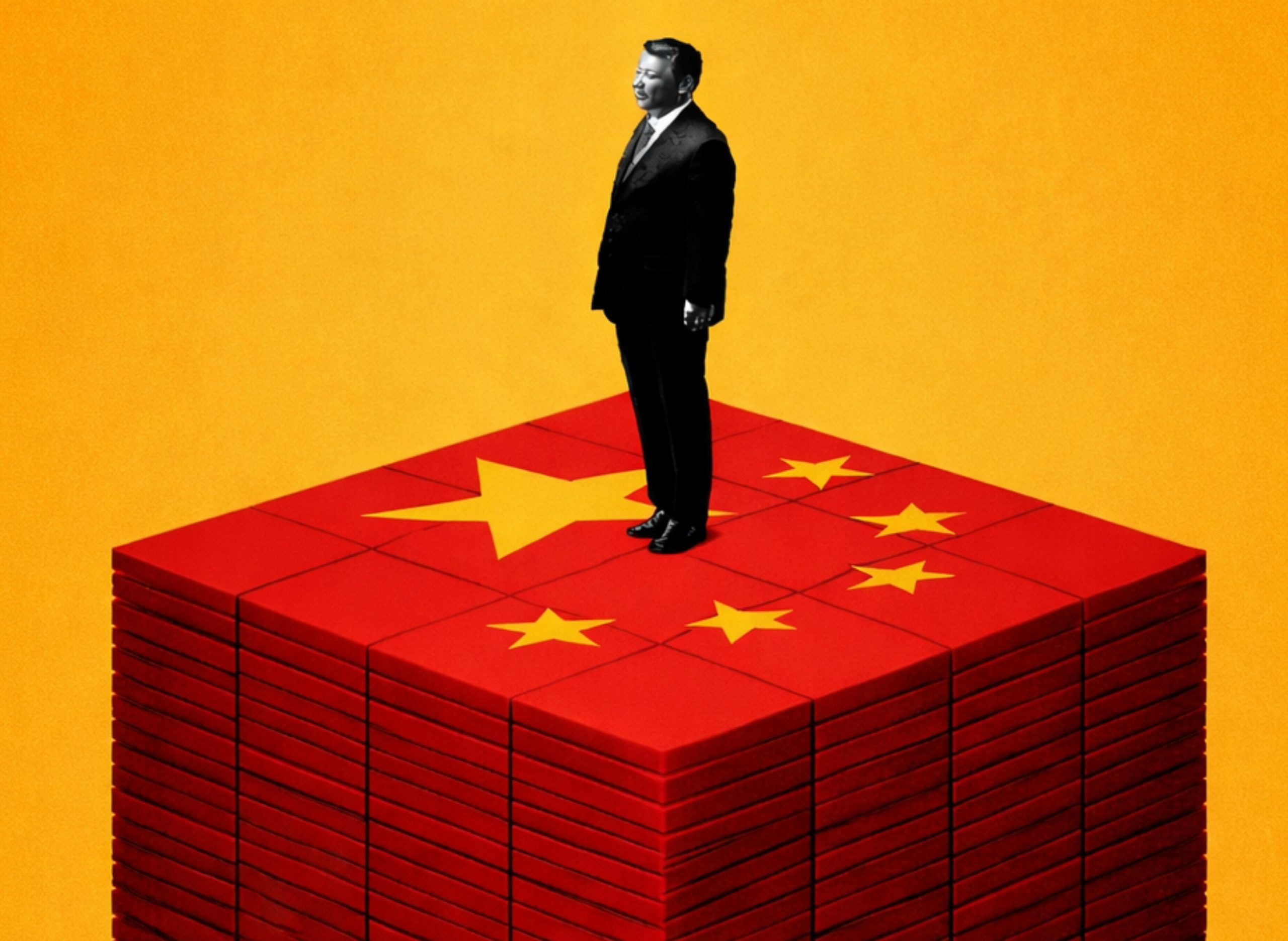
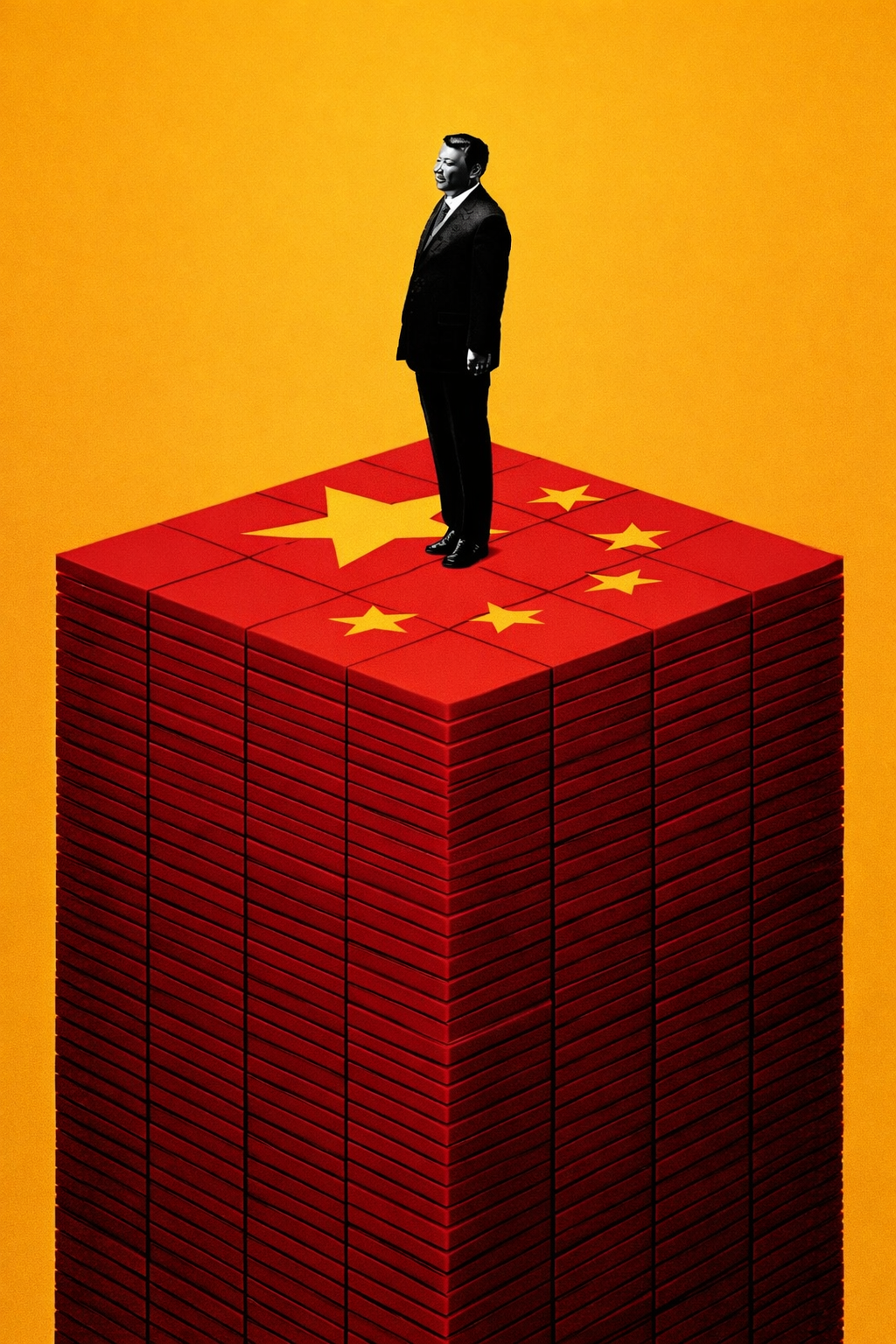
Xi Jinping holds the titles of General Secretary of the Chinese Communist Party and Chairman of the Central Military Commission. In practice, he functions as something more: the living core of the Party’s authority. His reach extends across Party, state, and military domains, joining them into a disciplined whole. Under his tenure, the People’s Republic of China appears more centralized, more consolidated, and more capable than at any point since Mao. The PLA continues its historic trajectory upward and outward, pursuing hawkish yet often ambiguous claims that inspire nationalistic fervor while worrying the international community. And the Party speaks with a collective voice, parroting the whims of Xi himself.
Yet within this tightening geometry lies a peculiarity. The system has changed. The Party, too. His style of authority stands apart from his predecessors. Authority has been drawn inward and upward through the Party apparatus, concentrated to a space within his own reach. What once operated through collective leadership and managed succession now orbits around embodiment at the middle. The circles remain, but their center has grown heavier, more consequential, more personalized. The growing density of Party centralization leaves little room for error in the geopolitical realm. In Washington, China is cast as the “near-peer” pacing challenge. In Brussels, interdependence has changed into vulnerability. In Tehran, partnership carries an asymmetric advantage. In Taipei, the stakes are existential. The gravitational pull of Beijing’s innermost circle extends outward, drawing other capitals into its orbit.
Xi Jinping has bound China’s stability to the durability of his own authority. He presides over a civilizational project framed as national rejuvenation and historical restoration. The Party he leads appears disciplined and unified. But the closer one moves to the center, the more the question shifts from how power is exercised to how it will be sustained. This is a system designed to function with extraordinary efficiency so long as its core stays intact. Whether it can reproduce that core once it is gone is the question that now defines China’s future.
Personalist rule is not novel in China’s history. “Cults of personality” have repeatedly served as instruments of control in authoritarian communist systems, just as imperial restorations have periodically rerouted China’s historical path. Ideology has stood as a necessary substitute for institutional governance during periods of systemic strain. But what is striking about Xi Jinping’s twenty-first-century China is not a return to personalism, but the intentional fusion of personalism with a civilizational mandate within a modern party-state explicitly designed to prevent such an accumulation of power.
holds his master degree from Georgetown University’s Edmund A. Walsh’s School of Foreign Service.
How the Chinese Military Could Shape China’s Next Chapter

Xi Jinping inherited a China facing a convergence of pressures that endangered the Party’s claim to legitimacy: an economy defined by decelerating growth and diminishing returns; elite networks fragmenting into rival cliques capable of dissent; and a society moving away from the communist ideology that once underwrote political consent. Deng Xiaoping had presided over an era of extraordinary growth. Deng left a system that rested on informal norms, managed succession, and collective, procedure-bound leadership. As institutional dynamism waned and these arrangements lost credibility, personal authority emerged as the remaining logical integrative force capable of binding the Party—and the country—together.
Under Xi’s personalization of authority, the Party’s power structure was not merely consolidated; the terms on which Chinese public stability rested were also changed. As power was directed upward, the institutions that once served as mediators for interest groups and as arenas where risks could be taken increasingly functioned as instruments for transmitting Xi’s own authority. Governance in China became less a matter of rules and procedures and more about signaling adherence to Xi’s vision and loyalty to the top. In this configuration, stability was no longer determined by institutional frameworks designed to outlast leadership turnover, but by the uninterrupted rule of Xi Jinping himself. The result: a system that appeared unified and disciplined yet contained an equilibrium of power that grew more contingent, more individualized, and ultimately more fragile.
Despite appearances, China, without an appointed successor, will face tremendous challenges in regenerating itself. Xi’s concentration of authority has produced a single, interdependent system with risks that cannot be understood in isolation. Politically, his personalization of power has reduced the potency of elite signaling while obliterating even the discussion of succession, binding regime continuity and legitimacy to himself. Militarily, his centralized control has consolidated his command while concentrating strategic miscalculation, generating an atmosphere in which voicing opposition directly leads to public purges.
Economically, the erosion of the once-trademark high-growth, perpetual-prosperity model that had underscored Party legitimacy for decades has forced Xi to labor intensively to control and curate the narrative China tells about its future, to enforce discipline within the Party bureaucracy, and to use administrative power to manage discontent. Geopolitically, outside pressures and nationalist mobilization increasingly serve as mechanisms of domestic unity, binding domestic stability amid a volatile international environment. Taken together, these domains reveal a China that is powerful and assertive today, yet more exposed than it appears once the question of succession moves to the foreground.
Xiism Without a Future?
Deng Xiaoping did not democratize China, but he did something almost as consequential: he began to regularize elite politics. Following the social and economic turmoil of Mao’s final years, stability grew inseparable from predictability. Deng stepped back from formal positions (he was never the Party’s General Secretary) while retaining ultimate influence, signaling that a leadership transition could occur without collapse at a time the Party needed it most. Age norms, staged promotions, and visible grooming of future leaders gradually formed what amounted to informal rules of single-party-state succession. This process did not become transparent, but it became legible. Elites could read the signals.
Jiang Zemin inherited a Party shaken by Tiananmen, increasing international isolation, and the shocking collapse of the Soviet Union. These factors shaped his agenda: consolidation was essential to the Party’s functioning, but personalization was not. His outsized personality and charisma were instead used to balance factions and preserve term limits, while permitting collective leadership to serve as a procedural shell within the Party. Importantly, he signaled succession early in his tenure to reassure elites that the eventual turnover would not lead to chaos within the Party. Hu Jintao’s rise followed the same logic. Elevated to the Politburo Standing Committee at a relatively young age, Hu’s trajectory was visible years in advance. The Jiang–Hu era normalized Party leadership transition after the Mao-Deng era. Elites could plan careers. Factions could bargain within guardrails. Retirement came with dignity. Authority was institutional, procedural, and, importantly, predictable.
Xi Jinping inherited a China facing a convergence of pressures that endangered the Party’s claim to legitimacy: an economy defined by decelerating growth and diminishing returns; elite networks fragmenting into rival cliques capable of dissent; and a society moving away from the communist ideology that once underwrote political consent. Deng Xiaoping had presided over an era of extraordinary growth. Deng left a system that rested on informal norms, managed succession, and collective, procedure-bound leadership. As institutional dynamism waned and these arrangements lost credibility, personal authority emerged as the remaining logical integrative force capable of binding the Party—and the country—together.
Under Xi’s personalization of authority, the Party’s power structure was not merely consolidated; the terms on which Chinese public stability rested were also changed. As power was directed upward, the institutions that once served as mediators for interest groups and as arenas where risks could be taken increasingly functioned as instruments for transmitting Xi’s own authority. Governance in China became less a matter of rules and procedures and more about signaling adherence to Xi’s vision and loyalty to the top. In this configuration, stability was no longer determined by institutional frameworks designed to outlast leadership turnover, but by the uninterrupted rule of Xi Jinping himself. The result: a system that appeared unified and disciplined yet contained an equilibrium of power that grew more contingent, more individualized, and ultimately more fragile.
Despite appearances, China, without an appointed successor, will face tremendous challenges in regenerating itself. Xi’s concentration of authority has produced a single, interdependent system with risks that cannot be understood in isolation. Politically, his personalization of power has reduced the potency of elite signaling while obliterating even the discussion of succession, binding regime continuity and legitimacy to himself. Militarily, his centralized control has consolidated his command while concentrating strategic miscalculation, generating an atmosphere in which voicing opposition directly leads to public purges.
Economically, the erosion of the once-trademark high-growth, perpetual-prosperity model that had underscored Party legitimacy for decades has forced Xi to labor intensively to control and curate the narrative China tells about its future, to enforce discipline within the Party bureaucracy, and to use administrative power to manage discontent. Geopolitically, outside pressures and nationalist mobilization increasingly serve as mechanisms of domestic unity, binding domestic stability amid a volatile international environment. Taken together, these domains reveal a China that is powerful and assertive today, yet more exposed than it appears once the question of succession moves to the foreground.
Xiism Without a Future?
Deng Xiaoping did not democratize China, but he did something almost as consequential: he began to regularize elite politics. Following the social and economic turmoil of Mao’s final years, stability grew inseparable from predictability. Deng stepped back from formal positions (he was never the Party’s General Secretary) while retaining ultimate influence, signaling that a leadership transition could occur without collapse at a time the Party needed it most. Age norms, staged promotions, and visible grooming of future leaders gradually formed what amounted to informal rules of single-party-state succession. This process did not become transparent, but it became legible. Elites could read the signals.
Jiang Zemin inherited a Party shaken by Tiananmen, increasing international isolation, and the shocking collapse of the Soviet Union. These factors shaped his agenda: consolidation was essential to the Party’s functioning, but personalization was not. His outsized personality and charisma were instead used to balance factions and preserve term limits, while permitting collective leadership to serve as a procedural shell within the Party. Importantly, he signaled succession early in his tenure to reassure elites that the eventual turnover would not lead to chaos within the Party. Hu Jintao’s rise followed the same logic. Elevated to the Politburo Standing Committee at a relatively young age, Hu’s trajectory was visible years in advance. The Jiang–Hu era normalized Party leadership transition after the Mao-Deng era. Elites could plan careers. Factions could bargain within guardrails. Retirement came with dignity. Authority was institutional, procedural, and, importantly, predictable.
Hu’s leadership was often described as technocratic to a fault, being steady, procedural, and rarely charismatic. Compared to Jiang, he seemed lacking, subdued. But that quality was not accidental. It reflected a system that had come to value process over personality. The state of the Party enabled Hu’s rise to the top. Decisions moved through layers of committee review, and responsibility was shared, sometimes to the point of policy or decision dilution. The goal was not boldness but stability. The Party under Hu could be opaque, even frustratingly so, but it was also predictable. Several potential successors were visible well before any formal transition. Leadership turnover was treated as something to be managed collectively, not fought over personally.
When Xi Jinping emerged in 2012, his rise did not immediately appear disruptive. He fit the mold that had been reinforced for years: the son of a revolutionary veteran, seasoned through provincial administration, acceptable to multiple factions. His public messaging stressed continuity rather than upheaval. There was little reason, at the time, to assume that the informal guardrails constructed since Deng would be dismantled. Xi did not arrive as an outsider forcing change upon the system. He came up through it. Xi’s anti-corruption campaign began as a popular and necessary correction. Corruption was pervasive across local governments, state-owned enterprises, security organs, and the military. Framing corruption as an existential threat to the Party’s survival allowed Xi to move quickly and broadly. What began as discipline soon altered elite incentives more fundamentally. Punishments were retroactive and far-reaching. Informal protective networks lost their credibility. Advancement became increasingly tied to demonstrated political loyalty rather than factional shelter or bureaucratic performance.
The change surpassed discipline. Collective leadership was preserved in form but hollowed in function. Decision-making gravitated toward small, centralized leading groups under Xi’s direction. Norms that once constrained overreach—rotation, deference, consensus—remained nominally intact but lost practical force. Authority accumulated not through institutional mandate, but through proximity to the center. What remained was coordination without constraint. Succession planning became incompatible with this architecture. In earlier eras, unusually young promotions to the Politburo Standing Committee signaled generational transition. Under Xi, no comparable grooming occurred. Political time ceased to revolve around turnover. The decisive break came in 2018, when the removal of presidential term limits severed leadership from a predictable endpoint. Even if the General Secretary position had never been formally term-limited, the symbolic signal was unmistakable: the horizon had disappeared. A visible successor would constitute an alternative center of gravity. Under this logic, succession became a risk to defer rather than a process to manage.
Xi’s authority extended outward across Party, state, and military structures. Party commissions increasingly overshadowed the State Council. Political loyalty outweighed specialization in determining trust. Ideological discipline intensified, elevating “Xi Jinping Thought” from doctrine to governing framework. Cadres learned to anticipate preferences rather than debate policy. Authority became vertically integrated. The system projected discipline and unity with impressive efficiency. What changed was not simply who held power, but how power was organized. The post-Deng model treated succession as a stabilizing mechanism embedded within collective leadership. Xi’s model treated stability as something to be secured through concentration. The Party was no longer structured primarily to manage elites; it was structured to command them.
Xiism has accumulated power, but it has not yet demonstrated how that power survives its architect.
By the end of Xi’s first decade, governance no longer revolved primarily around bureaucratic competence or negotiated consensus, but around demonstrated political reliability. Advancement flowed through networks of trust tied to Xi himself rather than through institutional reputation or factional balance. Cadres learned to anticipate preferences rather than debate policy. That shift produced discipline and speed, but it also narrowed the system’s adaptive capacity. When authority is embodied so completely in one figure, initiative becomes cautious, and correction becomes risky. Institutions still function, but only conditionally, as long as the center remains present and decisive. This is not a dynasty in the traditional sense. There is no formalized inheritance, no structured reproduction of authority, no institutional mechanism that guarantees continuity beyond the individual. What has emerged instead is something more precarious: a political order whose coherence depends on personal centrality but lacks a durable method for transferring it. Xiism has accumulated power, but it has not yet demonstrated how that power survives its architect.
The Problem of No End
The Party’s most consequential weakness today is not ideological drift or factional rivalry, but the absence of a predictable future. That absence is not abstract or deferred—it actively reshapes how Chinese elites behave in the present. The system no longer produces a recognizable set of potential successors, nor does it offer a common understanding of how authority is eventually transferred. Unlike earlier periods, this is not a temporary gap to be filled later. It is a structural condition. Succession has ceased to function as a planning horizon altogether. Political time, once organized around institutional rhythms and generational turnover, has instead collapsed into the expected longevity of a single leader. The result is not uncertainty at the edges of the Party, but at its center: governance continues, but without a common sense of how power is meant to end, renew, or move on.
In the post-Deng era, elite bargaining was stabilized by the expectation of turnover. Officials could afford to align, compete, and compromise because the future remained legible. Under Xi’s system, that logic no longer holds. Without succession norms, there are no neutral forums for arbitration and no safe timelines for coalitions to form. Being aligned with a future alternative is no longer prudent because no future alternative can be named without risk. What once functioned as a balancing mechanism has become a liability. Elite politics do not disappear, but they lose their horizontal dimension. Instead of negotiation across institutions or factions, political behavior narrows upward, oriented toward survival rather than positioning. The system becomes quieter, but also more brittle.
This leadership vacuum alters behavior long before any formal transition is in sight. Officials hedge not by preparing for succession but by avoiding initiative altogether. Risk aversion supplants competition as the dominant survival strategy, slowing policy innovation precisely when the system confronts growing internal and external strain. Evading blame becomes more important than pursuing outcomes. Political contestation does not vanish—it is driven underground. The system seems stable because overt movement is suppressed, not because tension has been resolved. That tension accumulates instead, compressed beneath a surface of cohesion, until it reemerges in sudden, disruptive interventions. In closed authoritarian systems where elite politics cannot be expressed openly, stability is maintained less through negotiation than through periodic shocks designed to reassert control.
Despite the erosion of succession norms and institutional safeguards, the Party continues to function with remarkable discipline. But that discipline no longer stems from shared rules or distributed authority. It runs in one direction. Elite incentives now point almost exclusively toward Xi Jinping. Advancement depends less on administrative competence than on political fidelity. Policy is not developed through institutional bargaining; it is validated by agreement with the center. The question in elite politics is no longer “What is institutionally sound?” but “What is consistent with Xi?” This configuration produces a tremendous yet fragile coherence. Decisions move quickly because authority is unambiguous. But that clarity comes at a cost. Coherence has become inseparable from embodiment. The same concentration that eliminates ambiguity also eliminates redundancy. No parallel center exists. No institutional substitute has been cultivated. Authority has been drawn so tightly around one figure that its transfer would not be merely procedural—it would be structural. Remove the focal point, and the lines of incentive that currently run upward have nowhere obvious to reconnect. The Party’s order, therefore, is not self-sustaining. It is sustained.
The system stays together because its center holds and continues to work, but it remains highly susceptible to damage. Once that center is absent, coherence does not gradually revert to the stability of institutional control, but rather confronts the problem of never having been embedded there in the first place. The most damaging consequence of personalist rule is not what it does, but its potential to create crises through blind spots. Systems organized around affirming and projecting unity are poorly suited to absorb unfavorable information. In such an environment, warnings travel upward cautiously, passed through layers of self-preservation. Professional disagreement risks being read as political unreliability. When authority is tightly bound to a single figure, dissent is not procedural; it is existential. Under these conditions, risk is assessed through loyalty rather than independent evaluation. The system becomes quick to respond to visible threats yet increasingly inattentive toward slower, foundational flaws.
The recent purges within the People’s Liberation Army offer a clear illustration. Senior figures tied to modernization, procurement, and joint command reform, including current and former members of the Central Military Commission, were removed through Party disciplinary mechanisms rather than transparent institutional review. Many were not peripheral actors but central participants in Xi’s military reform agenda. The message was unmistakable: proximity and prior trust do not guarantee security. The purge swiftly restored discipline. It also reinforced a lesson familiar to personalist systems: survival depends on alignment, not candor. There is precedent for this pattern. Mao’s political campaigns and Stalin’s Red Army purges both relied on “shock discipline” to reassert control when confidence faltered. In each case, obedience increased in the short term while horizontal trust and professional openness declined. Militaries, like bureaucracies, adapt to these settings by managing exposure rather than confronting risk. Problems are concealed, softened, or reframed upward. Correction becomes episodic and punitive instead of continuous and procedural.
The danger in this design is not constant instability. It is an accumulation of misjudgments. Centralized authority accelerates decisions but narrows the informational bandwidth that feeds them. As China’s military reach, economic scale, and international ambitions expand, the consequences of misperception grow. A system optimized for projecting unity may struggle to process complexity. Small distortions compound when internal correction is weak and external signals are misread. What emerges is not a fragile state in the conventional sense, but a powerful one increasingly constrained by the limits of its own architecture.
Post-Xi Scenarios
When succession is unresolved, competition does not disappear. It mutates. Under predictable transitions, rivalry is legible: elites can see who is rising, who is declining, and which behavior is rewarded. Under Xi’s system, that clarity has narrowed to a single focal point. Any visible alignment outside the center risks being read as disloyalty. Signals become indirect. Intentions are inferred rather than declared. Bargaining continues, but without rules or a shared horizon. What once functioned as managed competition becomes muted positioning under the surface. In such an environment, the first actors to matter are not insurgents but custodians. Senior Party officials embedded in discipline and organizational control, figures such as Li Xi or Cai Qi, represent continuity of enforcement rather than renewal of authority. They could stabilize procedures in a moment of uncertainty. But procedure is not the same as legitimacy. A system that has trained elites to command compliance does not easily transition to one that negotiates consent. What they could preserve is order; what they may struggle to provide is direction.
The military and security apparatus form a second gravitational center. The PLA does not need to seize capacity to direct outcomes; its position alone amplifies uncertainty. Recent purges have hollowed out identifiable leadership figures without reducing the institution’s structural weight. In ambiguous moments, militaries translate political uncertainty into posture. They do so not necessarily through aggression but through demonstration. A hyper-modernized force operating in a system without clearly stabilized stewardship is politically consequential. It acts both as a signal and an instrument. The technocratic and economic stabilizers form a third layer. Officials responsible for monetary policy, debt management, and administrative continuity, officials such as Pan Gongsheng or He Lifeng, would be tasked not with asserting authority but with preventing unraveling. Their power lies in competence and credibility. Yet economic governance depends on timely correction and trusted communication. When political time is undefined and initiative is risky, correction becomes cautious. Stabilization turns reactive. Deep foundational weaknesses are managed, not resolved.
Hu’s leadership was often described as technocratic to a fault, being steady, procedural, and rarely charismatic. Compared to Jiang, he seemed lacking, subdued. But that quality was not accidental. It reflected a system that had come to value process over personality. The state of the Party enabled Hu’s rise to the top. Decisions moved through layers of committee review, and responsibility was shared, sometimes to the point of policy or decision dilution. The goal was not boldness but stability. The Party under Hu could be opaque, even frustratingly so, but it was also predictable. Several potential successors were visible well before any formal transition. Leadership turnover was treated as something to be managed collectively, not fought over personally.
When Xi Jinping emerged in 2012, his rise did not immediately appear disruptive. He fit the mold that had been reinforced for years: the son of a revolutionary veteran, seasoned through provincial administration, acceptable to multiple factions. His public messaging stressed continuity rather than upheaval. There was little reason, at the time, to assume that the informal guardrails constructed since Deng would be dismantled. Xi did not arrive as an outsider forcing change upon the system. He came up through it. Xi’s anti-corruption campaign began as a popular and necessary correction. Corruption was pervasive across local governments, state-owned enterprises, security organs, and the military. Framing corruption as an existential threat to the Party’s survival allowed Xi to move quickly and broadly. What began as discipline soon altered elite incentives more fundamentally. Punishments were retroactive and far-reaching. Informal protective networks lost their credibility. Advancement became increasingly tied to demonstrated political loyalty rather than factional shelter or bureaucratic performance.
The change surpassed discipline. Collective leadership was preserved in form but hollowed in function. Decision-making gravitated toward small, centralized leading groups under Xi’s direction. Norms that once constrained overreach—rotation, deference, consensus—remained nominally intact but lost practical force. Authority accumulated not through institutional mandate, but through proximity to the center. What remained was coordination without constraint. Succession planning became incompatible with this architecture. In earlier eras, unusually young promotions to the Politburo Standing Committee signaled generational transition. Under Xi, no comparable grooming occurred. Political time ceased to revolve around turnover. The decisive break came in 2018, when the removal of presidential term limits severed leadership from a predictable endpoint. Even if the General Secretary position had never been formally term-limited, the symbolic signal was unmistakable: the horizon had disappeared. A visible successor would constitute an alternative center of gravity. Under this logic, succession became a risk to defer rather than a process to manage.
Xi’s authority extended outward across Party, state, and military structures. Party commissions increasingly overshadowed the State Council. Political loyalty outweighed specialization in determining trust. Ideological discipline intensified, elevating “Xi Jinping Thought” from doctrine to governing framework. Cadres learned to anticipate preferences rather than debate policy. Authority became vertically integrated. The system projected discipline and unity with impressive efficiency. What changed was not simply who held power, but how power was organized. The post-Deng model treated succession as a stabilizing mechanism embedded within collective leadership. Xi’s model treated stability as something to be secured through concentration. The Party was no longer structured primarily to manage elites; it was structured to command them.
The system becomes adept at avoiding immediate breakdown while postponing deeper reform.
At this point, imperial logic becomes relevant. When legitimacy cannot be settled internally, it seeks external affirmation. Under Xi, the language of national rejuvenation has already reframed political authority in civilizational terms. Frontiers are not simply strategic; they are symbolic. Maritime space, in particular, carries ideological weight. Naval deployments, island fortifications, gray-zone pressure, and persistent signaling in the Taiwan Strait and the South China Sea do more than deter adversaries. They affirm presence and project permanence. In an imperial posture, authority is manifested through spatial means.
This does not mean that succession uncertainty automatically produces aggression. It does mean that external assertion becomes politically useful. If elite bargaining lacks a shared endpoint, visible demonstrations of resolve can temporarily substitute for it. In this configuration, Taiwan is not simply a territorial dispute. It is the most concentrated site where questions of sovereignty, legitimacy, and historical destiny intersect. Miscalculation becomes more likely not because leaders seek confrontation but because external signaling carries domestic political weight. In a system where coherence has been embodied and legitimacy increasingly narrated through national destiny, the line between strategic signaling and structural escalation grows thinner.
Empire does not require expansion to be dangerous. It requires projection. And projection, when tied to still-unresolved internal authority, introduces risks that are difficult to calibrate. The risk is not inevitability, but exposure to miscalculation in a system with thinner guardrails. Centralization clarifies who decides. It does not always clarify how decisions should be implemented. In a system where authority has narrowed and succession remains undefined, institutions begin to hedge. Officials are no longer simply executing policy; they are interpreting signals. Some move aggressively to demonstrate alignment. Others slow down, waiting for unmistakable direction. The result is not open conflict between institutions, but divergence in tempo and emphasis.
In the military sphere, modernization continues apace. Procurement advances, joint command reforms deepen, and naval deployments expand in range and persistence. But without durable stewardship at the top, posture can harden faster than strategy matures. Operational assertiveness may indicate genuine strategic calculation, or it may reflect an effort to demonstrate resolve in a politically charged environment. When signaling carries domestic political weight, the boundary between deterrence and demonstration grows less distinct. In the economic realm, stabilization remains the overriding priority. Debt risks are managed, liquidity is adjusted, and local crises are contained. Yet economic governance depends on credibility and early correction. In an environment where political time is ambiguous and initiative carries risk, unwelcome data travels cautiously. Structural imbalances are addressed incrementally rather than decisively. The system becomes adept at avoiding immediate breakdown while postponing deeper reform.
At the provincial level, incentives fragment even further. Local officials must manage growth targets, social stability, regulatory compliance, and political conformity. Without a clear political horizon, experimentation becomes hazardous. Ambitious reforms risk misreading the center’s intent; inaction risks appearing ineffective. Over time, caution becomes the default. Implementation diverges quietly throughout regions, not because of open resistance but because clarity thins as it descends.
By the end of Xi’s first decade, governance no longer revolved primarily around bureaucratic competence or negotiated consensus, but around demonstrated political reliability. Advancement flowed through networks of trust tied to Xi
None of these distortions is dramatic in isolation. They do not signal imminent collapse. Instead, they produce unevenness, including policies that advance forcefully in one sector while stagnating in another, signals that escalate faster than they are calibrated, and reforms announced with confidence yet adjusted through improvisation. Drift here does not appear to be paralysis. It looks more like misalignment, with policies advancing unevenly across domains. In a powerful state expanding its military reach and international ambitions, misalignment carries a cost. When internal coordination depends heavily on a single focal point and that focal point becomes uncertain, institutions begin to operate on the basis of inference rather than integration. Over time, inference accumulates error. Within environments like the Taiwan Strait or the South China Sea, where signaling, deterrence, and national prestige intersect, even small distortions can have outsized consequences.
The most consequential effects of a personalized system rarely appear during routine governance. They surface under stress. A high-risk window does not imply inevitable conflict. It describes a period when the leeway for error narrows, and the cost of miscalculation rises. In such moments, systems optimized for projection and discipline can struggle to calibrate. Taiwan is the tightest convergence point of China’s internal political design and its external ambitions. It is embedded within the narrative of national rejuvenation and sovereignty restoration, while situated within an increasingly militarized maritime environment. PLA air incursions into Taiwan’s Air Defense Identification Zone have become routine. Large-scale exercises following political events have normalized encirclement drills. Naval deployments in the South China Sea and the Western Pacific demonstrate sustained reach. These patterns signal capability and deterrent intent. They also invite constant interpretation.
In a system where external demonstrations carry domestic political weight, signaling can harden faster than strategy develops. Actions meant to affirm resolve may be read as escalation. Moves calibrated as deterrence may be interpreted as preparation. When authority is centralized and internal correction mechanisms are constrained, there is less room to absorb ambiguity. Recent U.S.–China crisis communication failures highlight this vulnerability. Military-to-military dialogue has been suspended at politically sensitive moments, including after high-profile visits to Taiwan. Close encounters between U.S. and Chinese naval vessels and aircraft have occurred amid limited direct communication. Even established channels, such as hotlines, have proven unevenly utilized. The 2023 balloon incident demonstrated how quickly political distrust can freeze contact rather than facilitate clarification. These episodes do not prove intent to engage in conflict. They do illustrate how fragile guardrails can be when political signaling overrides institutional routine.
The public mood in Taipei today is not panic but normalization. Air-raid drills proceed with administrative calm. Reports of PLA flights are treated as background noise among the Taiwanese people. The exceptional has become procedural. That normalization shows both deterrence and accommodation, but it also reflects the constant presence of signaling. When signaling becomes a daily practice, distinguishing rehearsal from escalation becomes more difficult for all parties. The United States, Taiwan, and regional actors are active participants in this environment. They respond, adjust, and signal in turn. The danger is not in unilateral recklessness but in reciprocal misreading. In a system where coherence depends heavily on embodiment and legitimacy is reinforced through projection, the capacity to de-escalate through institutional reflex weakens. Small distortions, whether military, economic, or diplomatic, can compound, particularly when prestige and sovereignty are intertwined.
A high-risk window does not arise from volatility alone but from structure. China today is powerful and disciplined. It is not fragile in the conventional sense. Yet it operates under a system in which authority is concentrated, succession remains unsettled, and projection carries political weight. Under such conditions, the line between strategic signaling and unintended escalation grows thinner. The risk is not inevitable. It is exposure.
Built to Hold, Not to Last
Xi Jinping has built a strong structure of control. Authority moves upward with little resistance. Discipline is enforced efficiently. The Party projects unity at home and resolve abroad. By conventional authoritarian measures, this is a consolidation of the highest order. But concentration is not the same as continuity.
The paradox of Xi’s rule is that it has maximized control while narrowing the system’s capacity to renew itself. Earlier post-Mao leaders treated succession as a stabilizing feature of governance—an informal, although real, mechanism that allowed authority to circulate without threatening the Party’s survival. Xi treated succession differently. Rather than embedding it within collective leadership, he deferred it. What has emerged is neither a dynasty with institutionalized inheritance nor a collective system with distributed continuity, but a configuration of power whose coherence depends heavily on embodiment. Authority has been consolidated with remarkable effectiveness. Its transfer remains undefined.
That distinction is not confined to elite politics. It runs through every domain examined here. Military modernization proceeds under centralized command. Economic stabilization depends on calibrated top-down intervention. Maritime signaling and nationalist projection carry both strategic and domestic political weight. These are not separate vulnerabilities. They are expressions of the same structural condition: a system engineered to function smoothly so long as its center remains intact.
China today is powerful, capable, and disciplined. China’s strength is not in question. What is still unclear is whether that strength has been organized in a way that can survive the man who concentrated it.
himself rather than through institutional reputation or factional balance. Cadres learned to anticipate preferences rather than debate policy. That shift produced discipline and speed, but it also narrowed the system’s adaptive capacity. When authority is embodied so completely in one figure, initiative becomes cautious, and correction becomes risky. Institutions still function, but only conditionally, as long as the center remains present and decisive. This is not a dynasty in the traditional sense. There is no formalized inheritance, no structured reproduction of authority, no institutional mechanism that guarantees continuity beyond the individual. What has emerged instead is something more precarious: a political order whose coherence depends on personal centrality but lacks a durable method for transferring it. Xiism has accumulated power, but it has not yet demonstrated how that power survives its architect.
The Problem of No End
The Party’s most consequential weakness today is not ideological drift or factional rivalry, but the absence of a predictable future. That absence is not abstract or deferred—it actively reshapes how Chinese elites behave in the present. The system no longer produces a recognizable set of potential successors, nor does it offer a common understanding of how authority is eventually transferred. Unlike earlier periods, this is not a temporary gap to be filled later. It is a structural condition. Succession has ceased to function as a planning horizon altogether. Political time, once organized around institutional rhythms and generational turnover, has instead collapsed into the expected longevity of a single leader. The result is not uncertainty at the edges of the Party, but at its center: governance continues, but without a common sense of how power is meant to end, renew, or move on.
In the post-Deng era, elite bargaining was stabilized by the expectation of turnover. Officials could afford to align, compete, and compromise because the future remained legible. Under Xi’s system, that logic no longer holds. Without succession norms, there are no neutral forums for arbitration and no safe timelines for coalitions to form. Being aligned with a future alternative is no longer prudent because no future alternative can be named without risk. What once functioned as a balancing mechanism has become a liability. Elite politics do not disappear, but they lose their horizontal dimension. Instead of negotiation across institutions or factions, political behavior narrows upward, oriented toward survival rather than positioning. The system becomes quieter, but also more brittle.
This leadership vacuum alters behavior long before any formal transition is in sight. Officials hedge not by preparing for succession but by avoiding initiative altogether. Risk aversion supplants competition as the dominant survival strategy, slowing policy innovation precisely when the system confronts growing internal and external strain. Evading blame becomes more important than pursuing outcomes. Political contestation does not vanish—it is driven underground. The system seems stable because overt movement is suppressed, not because tension has been resolved. That tension accumulates instead, compressed beneath a surface of cohesion, until it reemerges in sudden, disruptive interventions. In closed authoritarian systems where elite politics cannot be expressed openly, stability is maintained less through negotiation than through periodic shocks designed to reassert control.
Despite the erosion of succession norms and institutional safeguards, the Party continues to function with remarkable discipline. But that discipline no longer stems from shared rules or distributed authority. It runs in one direction. Elite incentives now point almost exclusively toward Xi Jinping. Advancement depends less on administrative competence than on political fidelity. Policy is not developed through institutional bargaining; it is validated by agreement with the center. The question in elite politics is no longer “What is institutionally sound?” but “What is consistent with Xi?” This configuration produces a tremendous yet fragile coherence. Decisions move quickly because authority is unambiguous. But that clarity comes at a cost. Coherence has become inseparable from embodiment. The same concentration that eliminates ambiguity also eliminates redundancy. No parallel center exists. No institutional substitute has been cultivated. Authority has been drawn so tightly around one figure that its transfer would not be merely procedural—it would be structural. Remove the focal point, and the lines of incentive that currently run upward have nowhere obvious to reconnect. The Party’s order, therefore, is not self-sustaining. It is sustained.
The system stays together because its center holds and continues to work, but it remains highly susceptible to damage. Once that center is absent, coherence does not gradually revert to the stability of institutional control, but rather confronts the problem of never having been embedded there in the first place. The most damaging consequence of personalist rule is not what it does, but its potential to create crises through blind spots. Systems organized around affirming and projecting unity are poorly suited to absorb unfavorable information. In such an environment, warnings travel upward cautiously, passed through layers of self-preservation. Professional disagreement risks being read as political unreliability. When authority is tightly bound to a single figure, dissent is not procedural; it is existential. Under these conditions, risk is assessed through loyalty rather than independent evaluation. The system becomes quick to respond to visible threats yet increasingly inattentive toward slower, foundational flaws.
The recent purges within the People’s Liberation Army offer a clear illustration. Senior figures tied to modernization, procurement, and joint command reform, including current and former members of the Central Military Commission, were removed through Party disciplinary mechanisms rather than transparent institutional review. Many were not peripheral actors but central participants in Xi’s military reform agenda. The message was unmistakable: proximity and prior trust do not guarantee security. The purge swiftly restored discipline. It also reinforced a lesson familiar to personalist systems: survival depends on alignment, not candor. There is precedent for this pattern. Mao’s political campaigns and Stalin’s Red Army purges both relied on “shock discipline” to reassert control when confidence faltered. In each case, obedience increased in the short term while horizontal trust and professional openness declined. Militaries, like bureaucracies, adapt to these settings by managing exposure rather than confronting risk. Problems are concealed, softened, or reframed upward. Correction becomes episodic and punitive instead of continuous and procedural.
The danger in this design is not constant instability. It is an accumulation of misjudgments. Centralized authority accelerates decisions but narrows the informational bandwidth that feeds them. As China’s military reach, economic scale, and international ambitions expand, the consequences of misperception grow. A system optimized for projecting unity may struggle to process complexity. Small distortions compound when internal correction is weak and external signals are misread. What emerges is not a fragile state in the conventional sense, but a powerful one increasingly constrained by the limits of its own architecture.
Post-Xi Scenarios
When succession is unresolved, competition does not disappear. It mutates. Under predictable transitions, rivalry is legible: elites can see who is rising, who is declining, and which behavior is rewarded. Under Xi’s system, that clarity has narrowed to a single focal point. Any visible alignment outside the center risks being read as disloyalty. Signals become indirect. Intentions are inferred rather than declared. Bargaining continues, but without rules or a shared horizon. What once functioned as managed competition becomes muted positioning under the surface. In such an environment, the first actors to matter are not insurgents but custodians. Senior Party officials embedded in discipline and organizational control, figures such as Li Xi or Cai Qi, represent continuity of enforcement rather than renewal of authority. They could stabilize procedures in a moment of uncertainty. But procedure is not the same as legitimacy. A system that has trained elites to command compliance does not easily transition to one that negotiates consent. What they could preserve is order; what they may struggle to provide is direction.
The military and security apparatus form a second gravitational center. The PLA does not need to seize capacity to direct outcomes; its position alone amplifies uncertainty. Recent purges have hollowed out identifiable leadership figures without reducing the institution’s structural weight. In ambiguous moments, militaries translate political uncertainty into posture. They do so not necessarily through aggression but through demonstration. A hyper-modernized force operating in a system without clearly stabilized stewardship is politically consequential. It acts both as a signal and an instrument. The technocratic and economic stabilizers form a third layer. Officials responsible for monetary policy, debt management, and administrative continuity, officials such as Pan Gongsheng or He Lifeng, would be tasked not with asserting authority but with preventing unraveling. Their power lies in competence and credibility. Yet economic governance depends on timely correction and trusted communication. When political time is undefined and initiative is risky, correction becomes cautious. Stabilization turns reactive. Deep foundational weaknesses are managed, not resolved.
At this point, imperial logic becomes relevant. When legitimacy cannot be settled internally, it seeks external affirmation. Under Xi, the language of national rejuvenation has already reframed political authority in
civilizational terms. Frontiers are not simply strategic; they are symbolic. Maritime space, in particular, carries ideological weight. Naval deployments, island fortifications, gray-zone pressure, and persistent signaling in the Taiwan Strait and the South China Sea do more than deter adversaries. They affirm presence and project permanence. In an imperial posture, authority is manifested through spatial means.
This does not mean that succession uncertainty automatically produces aggression. It does mean that external assertion becomes politically useful. If elite bargaining lacks a shared endpoint, visible demonstrations of resolve can temporarily substitute for it. In this configuration, Taiwan is not simply a territorial dispute. It is the most concentrated site where questions of sovereignty, legitimacy, and historical destiny intersect. Miscalculation becomes more likely not because leaders seek confrontation but because external signaling carries domestic political weight. In a system where coherence has been embodied and legitimacy increasingly narrated through national destiny, the line between strategic signaling and structural escalation grows thinner.
Empire does not require expansion to be dangerous. It requires projection. And projection, when tied to still-unresolved internal authority, introduces risks that are difficult to calibrate. The risk is not inevitability, but exposure to miscalculation in a system with thinner guardrails. Centralization clarifies who decides. It does not always clarify how decisions should be implemented. In a system where authority has narrowed and succession remains undefined, institutions begin to hedge. Officials are no longer simply executing policy; they are interpreting signals. Some move aggressively to demonstrate alignment. Others slow down, waiting for unmistakable direction. The result is not open conflict between institutions, but divergence in tempo and emphasis.
In the military sphere, modernization continues apace. Procurement advances, joint command reforms deepen, and naval deployments expand in range and persistence. But without durable stewardship at the top, posture can harden faster than strategy matures. Operational assertiveness may indicate genuine strategic calculation, or it may reflect an effort to demonstrate resolve in a politically charged environment. When signaling carries domestic political weight, the boundary between deterrence and demonstration grows less distinct. In the economic realm, stabilization remains the overriding priority. Debt risks are managed, liquidity is adjusted, and local crises are contained. Yet economic governance depends on credibility and early correction. In an environment where political time is ambiguous and initiative carries risk, unwelcome data travels cautiously. Structural imbalances are addressed incrementally rather than decisively. The system becomes adept at avoiding immediate breakdown while postponing deeper reform.
At the provincial level, incentives fragment even further. Local officials must manage growth targets, social stability, regulatory compliance, and political conformity. Without a clear political horizon, experimentation becomes hazardous. Ambitious reforms risk misreading the center’s intent; inaction risks appearing ineffective. Over time, caution becomes the default. Implementation diverges quietly throughout regions, not because of open resistance but because clarity thins as it descends.
None of these distortions is dramatic in isolation. They do not signal imminent collapse. Instead, they produce unevenness, including policies that advance forcefully in one sector while stagnating in another, signals that escalate faster than they are calibrated, and reforms announced with confidence yet adjusted through improvisation. Drift here does not appear to be paralysis. It looks more like misalignment, with policies advancing unevenly across domains. In a powerful state expanding its military reach and international ambitions, misalignment carries a cost. When internal coordination depends heavily on a single focal point and that focal point becomes uncertain, institutions begin to operate on the basis of inference rather than integration. Over time, inference accumulates error. Within environments like the Taiwan Strait or the South China Sea, where signaling, deterrence, and national prestige intersect, even small distortions can have outsized consequences.
The most consequential effects of a personalized system rarely appear during routine governance. They surface under stress. A high-risk window does not imply inevitable conflict. It describes a period when the leeway for error narrows, and the cost of miscalculation rises. In such moments, systems optimized for projection and discipline can struggle to calibrate. Taiwan is the tightest convergence point of China’s internal political design and its external ambitions. It is embedded within the narrative of national rejuvenation and sovereignty restoration, while situated within an increasingly militarized maritime environment. PLA air incursions into Taiwan’s Air Defense Identification Zone have become routine. Large-scale exercises following political events have normalized encirclement drills. Naval deployments in the South China Sea and the Western Pacific demonstrate sustained reach. These patterns signal capability and deterrent intent. They also invite constant interpretation.
In a system where external demonstrations carry domestic political weight, signaling can harden faster than strategy develops. Actions meant to affirm resolve may be read as escalation. Moves calibrated as deterrence may be interpreted as preparation. When authority is centralized and internal correction mechanisms are constrained, there is less room to absorb ambiguity. Recent U.S.–China crisis communication failures highlight this vulnerability. Military-to-military dialogue has been suspended at politically sensitive moments, including after high-profile visits to Taiwan. Close encounters between U.S. and Chinese naval vessels and aircraft have occurred amid limited direct communication. Even established channels, such as hotlines, have proven unevenly utilized. The 2023 balloon incident demonstrated how quickly political distrust can freeze contact rather than facilitate clarification. These episodes do not prove intent to engage in conflict. They do illustrate how fragile guardrails can be when political signaling overrides institutional routine.
The public mood in Taipei today is not panic but normalization. Air-raid drills proceed with administrative calm. Reports of PLA flights are treated as background noise among the Taiwanese people. The exceptional has become procedural. That normalization shows both deterrence and accommodation, but it also reflects the constant presence of signaling. When signaling becomes a daily practice, distinguishing rehearsal from escalation becomes more difficult for all parties. The United States, Taiwan, and regional actors are active participants in this environment. They respond, adjust, and signal in turn. The danger is not in unilateral recklessness but in reciprocal misreading. In a system where coherence depends heavily on embodiment and legitimacy is reinforced through projection, the capacity to de-escalate through institutional reflex weakens. Small distortions, whether military, economic, or diplomatic, can compound, particularly when prestige and sovereignty are intertwined.
A high-risk window does not arise from volatility alone but from structure. China today is powerful and disciplined. It is not fragile in the conventional sense. Yet it operates under a system in which authority is concentrated, succession remains unsettled, and projection carries political weight. Under such conditions, the line between strategic signaling and unintended escalation grows thinner. The risk is not inevitable. It is exposure.
Built to Hold, Not to Last
Xi Jinping has built a strong structure of control. Authority moves upward with little resistance. Discipline is enforced efficiently. The Party projects unity at home and resolve abroad. By conventional authoritarian measures, this is a consolidation of the highest order. But concentration is not the same as continuity.
The paradox of Xi’s rule is that it has maximized control while narrowing the system’s capacity to renew itself. Earlier post-Mao leaders treated succession as a stabilizing feature of governance—an informal, although real, mechanism that allowed authority to circulate without threatening the Party’s survival. Xi treated succession differently. Rather than embedding it within collective leadership, he deferred it. What has emerged is neither a dynasty with institutionalized inheritance nor a collective system with distributed continuity, but a configuration of power whose coherence depends heavily on embodiment. Authority has been consolidated with remarkable effectiveness. Its transfer remains undefined.
That distinction is not confined to elite politics. It runs through every domain examined here. Military modernization proceeds under centralized command. Economic stabilization depends on calibrated top-down intervention. Maritime signaling and nationalist projection carry both strategic and domestic political weight. These are not separate vulnerabilities. They are expressions of the same structural condition: a system engineered to function smoothly so long as its center remains intact.
China today is powerful, capable, and disciplined. China’s strength is not in question. What is still unclear is whether that strength has been organized in a way that can survive the man who concentrated it.
Recommended
No More Free Rides in a Transactional World
Why the Return of Many Powers Does Not Mean the Birth of a New Order
The Machinery of Wealth and Obedience
No More Free Rides in a Transactional World

How Jeffersonians See Foreign Burdens?